What is Quick Commerce? Complete guide to Q-Commerce, hyperlocal delivery, AI logistics, and business benefits.
Quick Answer: Quick Commerce (Q-Commerce) is an advanced form of e-commerce that delivers products such as groceries, medicines, food, and daily essentials in as little as 10–30 minutes. Powered by hyperlocal fulfillment, AI-driven logistics, and real-time inventory management, it is redefining customer expectations and transforming the future of retail.
Introduction
Imagine realizing you’ve run out of milk just before breakfast or needing a phone charger minutes before an important meeting. A few years ago, solving these problems meant visiting a nearby store. Today, all it takes is a few taps on a smartphone, and the product arrives at your doorstep within minutes. This shift is the driving force behind Quick Commerce (Q-Commerce).
Industry research shows that changing consumer behavior is one of the primary drivers behind the rapid growth of Quick Commerce. Modern consumers increasingly prioritize convenience, speed, and instant access to everyday essentials over traditional delivery timelines. As busy lifestyles, smartphone adoption, and digital shopping continue to rise, customers expect products to be delivered within minutes rather than days. This shift in expectations has encouraged businesses worldwide to adopt Quick Commerce, enabling them to deliver faster, enhance customer satisfaction, and stay competitive in an increasingly convenience-driven market.
Across the world, Quick Commerce has evolved from a niche concept into one of the fastest-growing retail segments. From India and the United States to the United Kingdom and other emerging markets, businesses are embracing ultra-fast delivery to meet changing consumer expectations. Driven by widespread smartphone adoption, digital payments, AI-powered logistics, and hyperlocal fulfillment networks, Quick Commerce is transforming the way people shop for everyday essentials and shaping the future of retail.
In this guide, you’ll learn:
- What Quick Commerce is
- How it works behind the scenes
- Why it is growing so rapidly
- How it differs from traditional e-commerce
- The technologies powering it
- Challenges and opportunities
- Why businesses should prepare for the future of instant delivery
What Is Quick Commerce?
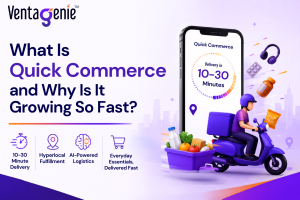
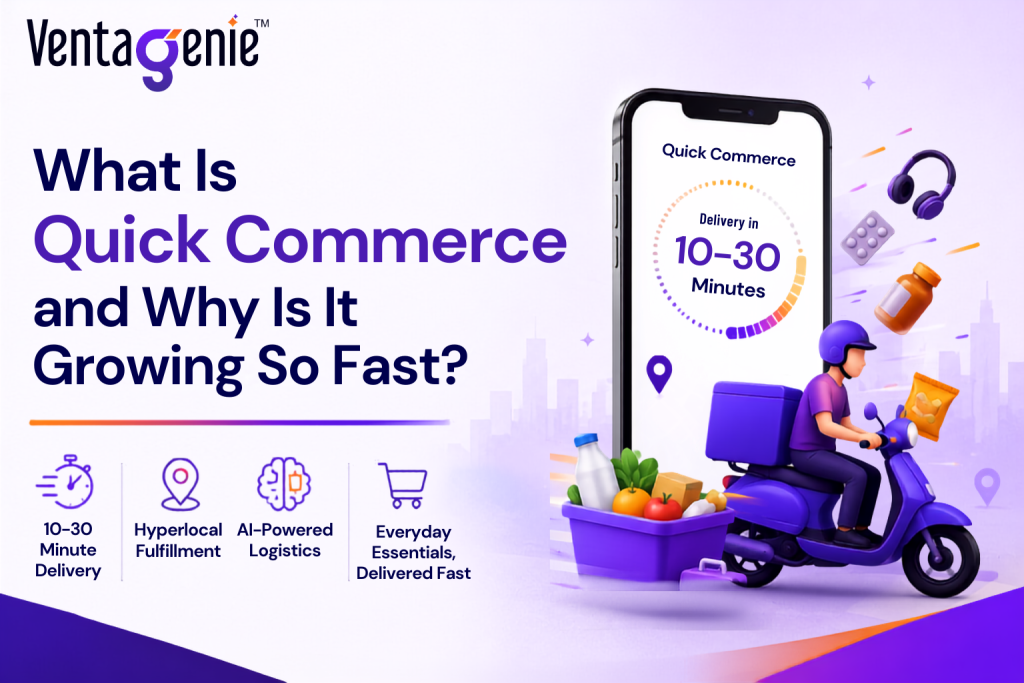
Quick Commerce, commonly known as Q-Commerce, is a retail model that focuses on delivering products within 10 to 30 minutes, compared to traditional e-commerce deliveries that may take one or more days.
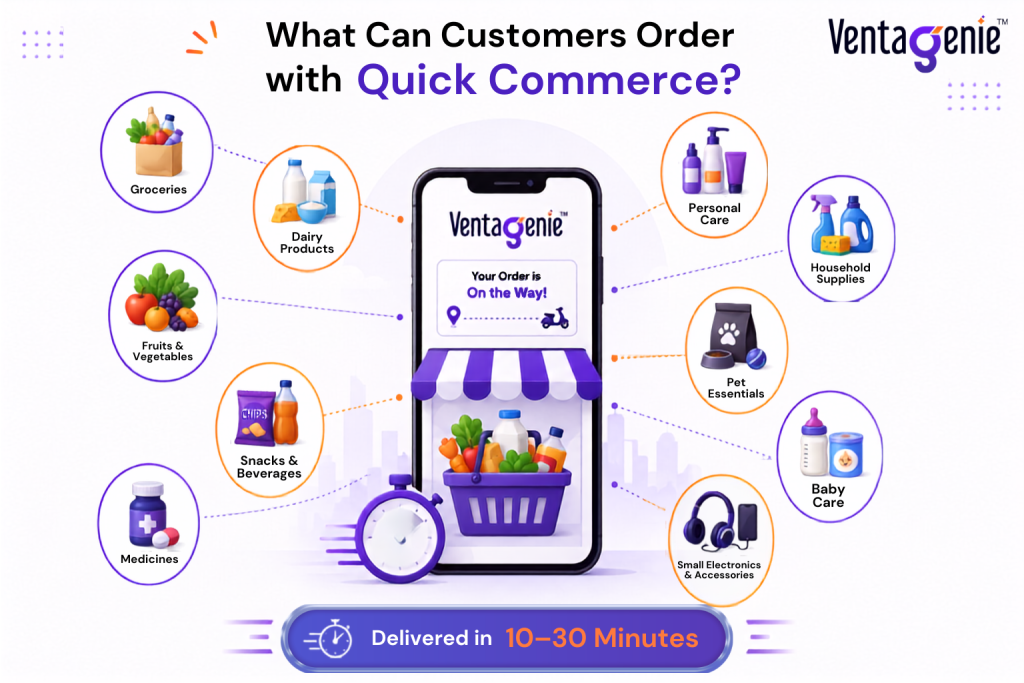
Rather than offering millions of products, Quick Commerce platforms prioritize high-demand, frequently purchased essentials, including:
The goal isn’t simply to sell products online—it’s to solve immediate customer needs.
Think of Quick Commerce as the digital version of your neighborhood convenience store—only faster and available 24/7 through your smartphone.
The Evolution of Quick Commerce
Online shopping has evolved significantly over the last decade.
Traditional Retail → E-commerce → Same-Day Delivery → Quick Commerce
Initially, online shopping focused on convenience and product variety. Customers were willing to wait several days for deliveries.
Then came same-day delivery.
Today, speed has become a key differentiator.
The COVID-19 pandemic accelerated this transformation as millions relied on online platforms for groceries and daily essentials. Even after restrictions ended, customer expectations remained permanently changed.
Today, Quick Commerce has evolved far beyond grocery delivery. While groceries and daily essentials remain its foundation, consumers can now order a wide variety of products, including medicines, electronics, beauty and personal care items, pet supplies, gifts, kitchen essentials, and office supplies—all delivered within minutes. As customer expectations continue to rise, convenience is no longer just about shopping online; it’s about getting the right product at the right time. This shift has made speed, reliability, and seamless delivery an essential part of the modern shopping experience.
Why Is Quick Commerce Growing So Fast?
Several factors are driving the rapid rise of Quick Commerce worldwide.
1. Consumers Want Instant Gratification
Modern consumers value time more than ever.
Whether it’s ordering groceries after work or replacing a forgotten household item, people increasingly prefer instant solutions over waiting several days.
Convenience has become a purchasing decision—not just a bonus.
2. Urban Lifestyles Demand Speed
Busy professionals, students, and families often have limited time for shopping.
Quick Commerce eliminates unnecessary store visits by delivering essentials within minutes, helping customers focus on work, family, and personal priorities.
3. Smartphones and Digital Payments
The widespread adoption of smartphones, mobile apps, and digital payment systems has made ordering products incredibly simple. With secure payment options and user-friendly interfaces, consumers can place orders in seconds.
4. AI and Advanced Technology
Modern Quick Commerce platforms use Artificial Intelligence to improve every stage of operations.
Technology helps businesses:
- Predict customer demand
- Optimize inventory
- Assign delivery partners
- Calculate the fastest delivery routes
- Reduce delivery delays
The result is faster service with improved operational efficiency.
5. Hyperlocal Delivery Networks
Unlike traditional e-commerce warehouses located far from customers, Quick Commerce relies on hyperlocal fulfillment centers located close to residential neighborhoods.
This significantly reduces delivery time.
6. Changing Customer Expectations
Customers who experience 15-minute deliveries often expect similar service across other industries.
As expectations evolve, businesses must innovate to remain competitive.
7. Expansion Beyond Groceries
Quick Commerce is no longer limited to grocery delivery. Today, customers order:
- Mobile accessories
- Cosmetics
- Stationery
- Healthcare products
- Fresh flowers
- Home essentials
- Festival gifts
This broader product range continues to fuel market growth.
How Does Quick Commerce Work?
Quick Commerce may seem simple from a customer’s perspective—you place an order through an app, and your products arrive within minutes. However, behind this seamless experience is a highly coordinated system powered by advanced technology, intelligent logistics, and strategically located fulfillment centers. Every stage of the process is optimized to reduce delays and ensure orders are delivered as quickly and accurately as possible.
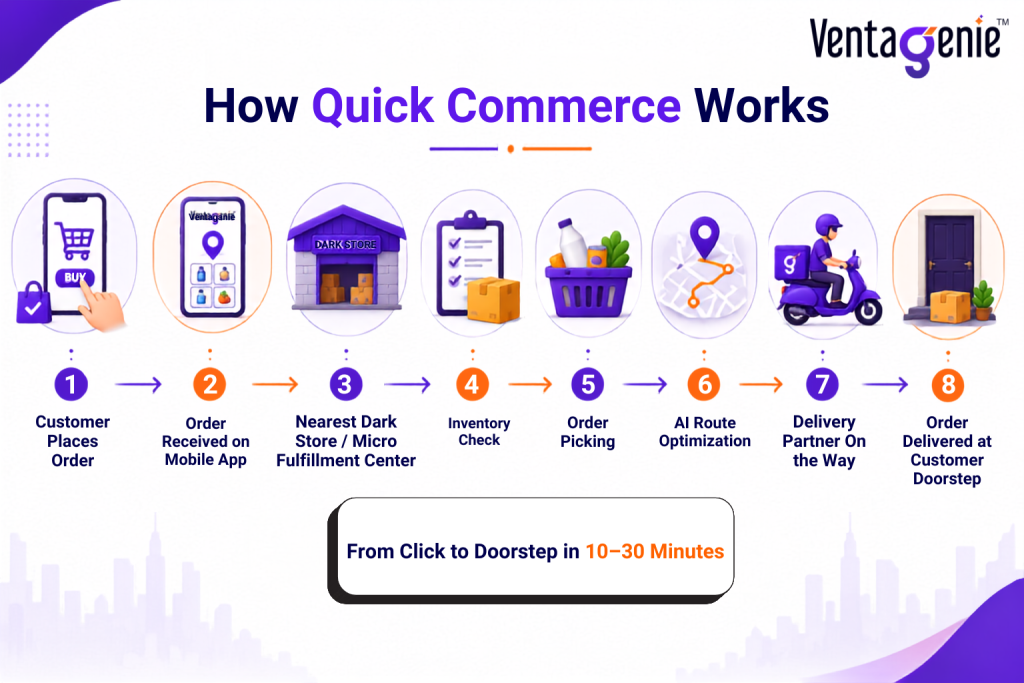
Here’s a closer look at how the Quick Commerce model works:
1. Micro-Fulfillment Centers (MFCs)
Micro-Fulfillment Centers (MFCs) are the backbone of the Quick Commerce ecosystem. These are compact warehouses strategically located within residential neighborhoods or high-demand urban areas, usually within a 2–5 km radius of customers. Unlike large distribution centers used by traditional e-commerce businesses, MFCs stock only the most frequently purchased products, such as groceries, dairy items, beverages, snacks, personal care products, and household essentials.
Because these fulfillment centers are located close to customers, delivery partners can pick up orders and reach the destination much faster. This localized inventory model significantly reduces delivery time while ensuring products remain fresh and readily available. Businesses also benefit from lower transportation costs and improved operational efficiency.
2. Dark Stores
Dark stores are specialized retail outlets that function exclusively as fulfillment centers for online orders. Although they look similar to supermarkets, they are not open to walk-in customers. Instead, they are designed to maximize speed and efficiency in order processing.
When an order is received, store associates quickly locate the required products, pack them, and prepare them for dispatch. Since there are no shoppers inside the store, employees can move freely through the aisles, making the picking and packing process much faster than in a traditional retail environment.
Dark stores also maintain carefully planned inventory based on local purchasing patterns, ensuring that high-demand products are always in stock. This helps businesses reduce stock outs and fulfill customer orders more efficiently.
3. Real-Time Inventory Management
One of the most important components of Quick Commerce is real-time inventory management. Customers expect every product displayed in the app to be available for immediate delivery. To meet this expectation, Quick Commerce platforms continuously monitor inventory levels across all fulfillment centers and dark stores.
Whenever a product is purchased, returned, or restocked, the inventory is updated instantly. This ensures customers only see items that are actually available, reducing the chances of order cancellations and improving customer satisfaction.
Many Quick Commerce platforms also use Artificial Intelligence (AI) and predictive analytics to forecast future demand. By analyzing customer purchasing behavior, seasonal trends, and local preferences, businesses can replenish inventory before products run out. This improves stock availability while minimizing waste and excess inventory.
4. Smart Order Processing
The moment a customer places an order, a series of automated processes begin within seconds. Instead of relying on manual intervention, Quick Commerce platforms use intelligent software to coordinate every step of the fulfillment process.
The system automatically:
- Verifies product availability in real time.
- Identifies the nearest fulfillment center or dark store.
- Assigns the order to the most suitable delivery partner.
- Calculates the fastest and most efficient delivery route.
- Sends notifications to both warehouse staff and the customer.
Because these decisions are made instantly using AI-powered algorithms, businesses can significantly reduce processing time and ensure orders are dispatched almost immediately after they are placed.
5. Last-Mile Delivery
Last-mile delivery is the final and one of the most critical stages of the Quick Commerce journey. Once the order is packed, it is handed over to a delivery partner, who transports it directly from the fulfillment center to the customer’s doorstep.
To achieve ultra-fast delivery times, Quick Commerce platforms rely on GPS tracking, route optimization software, and real-time traffic data. These technologies help delivery partners avoid congestion, choose the quickest routes, and provide customers with accurate delivery updates throughout the journey.
Many companies also maintain a dedicated network of delivery partners positioned near fulfillment centers during peak hours. This reduces waiting time and enables deliveries to be completed within 10–30 minutes.
6. Technology Integration: The Brain Behind Quick Commerce
While warehouses and delivery partners are essential, technology is what truly powers Quick Commerce. Every stage of the process is connected through an intelligent digital ecosystem that ensures speed, accuracy, and operational efficiency.
Modern Quick Commerce platforms use technologies such as:
- Artificial Intelligence (AI) for demand forecasting and smart decision-making.
- Machine Learning (ML) to analyze customer buying patterns and improve recommendations.
- GPS and Route Optimization to identify the fastest delivery routes.
- Cloud-Based Order Management Systems to process thousands of orders simultaneously.
- Real-Time Analytics to monitor business performance and inventory levels.
- Automated Notifications to keep customers informed at every stage of the delivery process.
By integrating these technologies, businesses can reduce operational errors, improve delivery accuracy, enhance customer satisfaction, and efficiently scale their operations as demand grows.
Bringing It All Together
Quick Commerce is much more than delivering products quickly—it is a carefully synchronized ecosystem where technology, logistics, inventory management, and delivery operations work together in real time. From strategically located micro-fulfillment centers and dark stores to AI-powered order processing and optimized last-mile delivery, every component is designed to minimize delays and maximize customer convenience. This highly efficient operational model enables businesses to consistently deliver everyday essentials within minutes, meeting the growing demand for speed and convenience in today’s digital economy.
Quick Commerce vs Traditional E-commerce
Feature | Quick Commerce | Traditional E-commerce |
Delivery Time | 10–30 minutes | 1–7 days |
Product Range | Daily essentials | Large catalog |
Fulfillment | Hyperlocal warehouses | Central warehouses |
Customer Need | Immediate | Planned purchases |
Delivery Radius | Local | Regional/National |
Average Basket | Small | Larger orders |
Both models serve different customer needs, and many retailers now operate both simultaneously.
Technologies Powering Quick Commerce
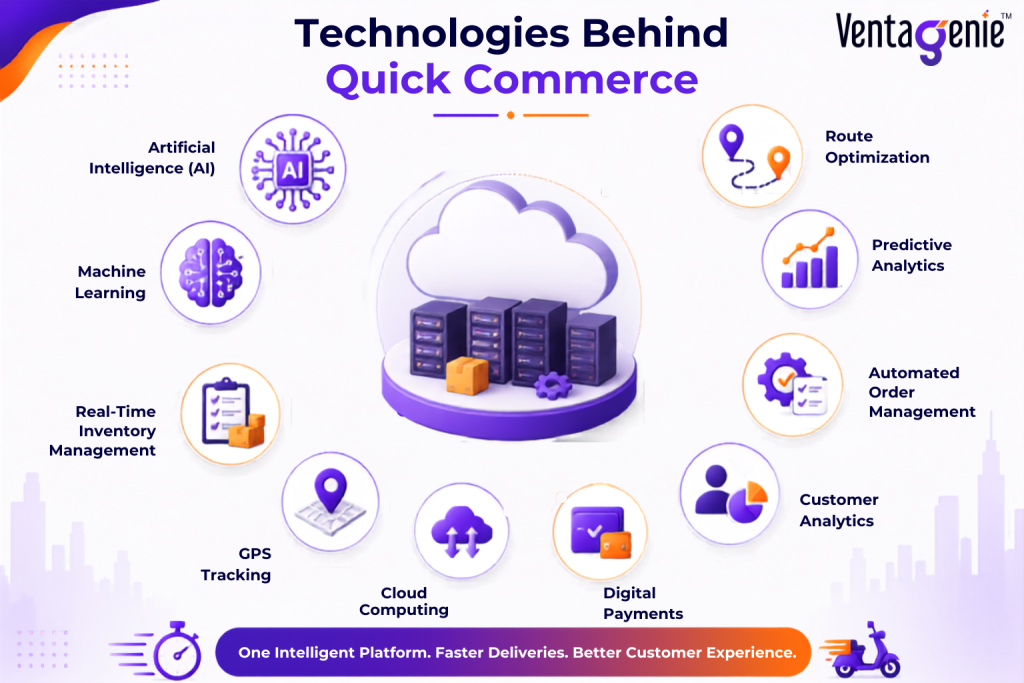
Quick Commerce is much more than just fast delivery—it is powered by a combination of advanced technologies that work together to ensure speed, accuracy, and efficiency. Every order placed by a customer triggers a series of intelligent processes, from checking product availability to assigning the nearest delivery partner and selecting the fastest delivery route. Technologies such as Artificial Intelligence (AI) and Machine Learning (ML) help businesses forecast demand, automate decision-making, and personalize customer experiences. Real-time inventory management ensures that only available products are displayed, reducing order cancellations and improving customer satisfaction. Meanwhile, GPS tracking and route optimization enable delivery partners to navigate the quickest routes, ensuring timely deliveries even during peak hours.
Behind the scenes, cloud computing allows businesses to manage thousands of orders simultaneously while maintaining seamless communication between warehouses, delivery partners, and customers. Predictive analytics helps businesses anticipate buying patterns, optimize inventory levels, and minimize stock shortages. Automated order management systems streamline the entire fulfillment process by instantly processing orders and assigning them to the nearest fulfillment center. Additionally, customer analytics provides valuable insights into shopping behavior, enabling businesses to offer personalized recommendations and improve service quality. Combined with secure digital payment solutions that facilitate quick and hassle-free transactions, these technologies create a seamless shopping experience while helping businesses reduce operational costs, improve efficiency, and scale their Quick Commerce operations effectively.
Benefits of Quick Commerce
For Customers
- Faster deliveries
- Greater convenience
- Reduced travel time
- Real-time order tracking
- Better shopping experience
- Easy digital payments
- Access to everyday essentials anytime
For Businesses
Quick Commerce creates new growth opportunities.
Benefits include:
- Higher customer retention
- Increased order frequency
- Better inventory utilization
- Improved customer satisfaction
- Stronger competitive advantage
- Increased revenue opportunities
- Data-driven business decisions
Businesses that consistently deliver exceptional customer experiences are more likely to build long-term loyalty.
Challenges of Quick Commerce
Despite its rapid growth, Quick Commerce also presents challenges.
1.Maintaining Profitability
Ultra-fast deliveries require investment in warehouses, technology, and logistics.
Balancing customer expectations with operational costs remains a key challenge.
2.Inventory Accuracy
Even small inventory errors can result in canceled orders and disappointed customers.
Real-time inventory synchronization is essential.
3.Last-Mile Logistics
Traffic congestion, weather conditions, and delivery workforce availability can impact delivery performance.
4.Sustainability
Frequent deliveries increase packaging waste and transportation emissions.
Many companies are now exploring:
- Electric delivery vehicles
- Eco-friendly packaging
- Route optimization
- Sustainable fulfillment practices
Real-World Examples: Quick Commerce Around the World
India: A Fast-Growing Market
India has become one of the world’s leading Quick Commerce markets, with companies like Blinkit, Zepto, Swiggy Instamart, and BigBasket BB Now delivering groceries, medicines, electronics, beauty products, and other essentials in just 10–30 minutes. The rapid growth of digital payments, smartphone adoption, and hyperlocal delivery networks has made India a global leader in instant delivery.
United States: Expanding Convenience
In the United States, platforms such as Gopuff, Instacart, and Amazon are transforming convenience shopping by offering rapid delivery of groceries, household essentials, and everyday products. Their investment in advanced logistics and fulfillment networks continues to strengthen the Quick Commerce ecosystem.
United Kingdom: Meeting Urban Demand
The United Kingdom has also embraced Quick Commerce, with companies like Getir, Zapp, Tesco Whoosh, and Sainsbury’s Chop Chop providing fast deliveries of groceries and household essentials. These services cater to busy urban consumers who value speed and convenience in their daily shopping.
Expert Insight
"Customers don't simply buy products anymore—they buy convenience, speed, and reliability. Businesses that invest in intelligent fulfillment and seamless delivery experiences today are better positioned to earn customer trust tomorrow."
The Future of Quick Commerce
Quick Commerce is rapidly evolving from a grocery-focused service into a comprehensive retail ecosystem. As technology advances and customer expectations continue to rise, businesses are adopting innovative solutions to deliver products faster, more efficiently, and with greater convenience. Here are some key trends shaping the future of Quick Commerce:
1. AI-Powered Demand Forecasting
Artificial Intelligence (AI) is helping businesses predict customer demand by analyzing purchasing patterns, seasonal trends, and local preferences. This enables companies to stock the right products at the right locations, reducing stockouts, minimizing waste, and ensuring faster order fulfillment.
2. Warehouse Automation
Automation technologies, such as smart sorting systems and automated picking solutions, are making warehouses more efficient. By reducing manual effort and speeding up order processing, businesses can fulfill customer orders more accurately and in less time.
3. Electric Delivery Fleets
To reduce carbon emissions and operating costs, many Quick Commerce companies are adopting electric scooters and delivery vehicles. This shift supports sustainability goals while offering a more environmentally friendly approach to last-mile delivery.
4. Drone and Autonomous Delivery
Several companies are experimenting with drones and autonomous delivery robots to make deliveries even faster. Although still in the early stages, these technologies have the potential to reduce delivery times, lower operational costs, and improve efficiency in the future.
5. Expansion into Tier-2 and Tier-3 Cities
Quick Commerce is no longer limited to metropolitan areas. As internet access, smartphone usage, and digital payments continue to grow, businesses are expanding their services into Tier-2 and Tier-3 cities, unlocking new customer markets and driving the next phase of industry growth.
6. Personalized Shopping Experiences
Using customer data and AI, Quick Commerce platforms can recommend products based on individual preferences, previous purchases, and shopping habits. Personalized recommendations not only improve the customer experience but also increase customer engagement and repeat purchases.
7. Subscription-Based Convenience Services
Many Quick Commerce businesses are introducing subscription plans that offer benefits such as free deliveries, exclusive discounts, and priority service. These membership programs encourage customer loyalty while providing businesses with a steady and predictable revenue stream.
Looking Ahead
As technology continues to evolve, Quick Commerce will become faster, smarter, and more customer-centric. Businesses that embrace innovations such as AI, automation, and sustainable delivery solutions will be better positioned to meet changing consumer expectations and remain competitive in the rapidly growing digital retail landscape.
How Businesses Can Prepare for the Quick Commerce Era
Businesses looking to succeed in this rapidly evolving landscape should focus on:
- Building hyperlocal fulfillment capabilities
- Investing in AI-powered inventory management
- Optimizing last-mile logistics
- Delivering consistent customer experiences
- Leveraging real-time analytics
- Integrating scalable Quick Commerce technology
Companies that embrace digital transformation today will be better prepared for tomorrow’s customer expectations.
How Ventagenie Supports Quick Commerce Businesses
Launching a successful Quick Commerce business requires more than just fast delivery—it requires the right technology ecosystem.
Ventagenie provides businesses with intelligent Quick Commerce solutions designed to simplify operations, streamline order management, optimize deliveries, and enhance customer experiences. From real-time inventory management and smart dispatching to delivery partner management and customer engagement tools, businesses can efficiently manage every stage of the fulfillment journey while scaling their operations with confidence.
Instead of building complex delivery systems from scratch, businesses can leverage a modern technology platform that supports faster operations, improved efficiency, and sustainable growth.
Key Takeaways
- Quick Commerce delivers products within minutes rather than days.
- Consumer demand for speed and convenience is driving rapid adoption.
- Hyperlocal fulfillment centers and dark stores enable ultra-fast deliveries.
- AI, automation, and real-time inventory management power operational efficiency.
- Quick Commerce is expanding beyond groceries into multiple retail categories.
- Businesses investing in intelligent delivery technology will be better positioned for long-term growth.
Final Thoughts
Quick Commerce is no longer just a trend—it’s a fundamental shift in how consumers shop and how businesses deliver value. As customer expectations continue to evolve, speed, convenience, and operational efficiency will become essential competitive advantages rather than optional features.
For businesses, adopting Quick Commerce isn’t simply about delivering products faster; it’s about creating seamless customer experiences backed by smart technology, data-driven decisions, and scalable operations. Those who embrace this transformation today will be well-positioned to meet the demands of tomorrow’s digital-first consumers.
Frequently Asked Questions
Quick Commerce is an e-commerce model that delivers products such as groceries, medicines, and household essentials within 10–30 minutes using hyperlocal fulfillment centers and optimized delivery networks.
Traditional e-commerce focuses on product variety and scheduled deliveries, while Quick Commerce prioritizes speed, convenience, and immediate customer needs.
Groceries, dairy products, snacks, medicines, personal care items, pet supplies, household essentials, electronics accessories, and more.
The growth is driven by changing consumer expectations, urban lifestyles, smartphone adoption, digital payments, AI-powered logistics, and hyperlocal delivery infrastructure.
AI, machine learning, GPS tracking, route optimization, cloud computing, predictive analytics, real-time inventory management, and automated order processing.
No. Today, Quick Commerce supports industries including healthcare, beauty, electronics, food delivery, pet care, gifting, and retail.
Yes. With the right technology platform, even small and medium-sized businesses can implement Quick Commerce capabilities and provide fast, reliable deliveries.

Mr. Aniket D is a seasoned digital marketer with over 10 years of experience in market research, content strategy, and performance marketing.
He specializes in analyzing consumer behavior, identifying emerging market trends, and translating insights into actionable digital strategies.
His work focuses on blending research-driven content with SEO and lead generation to drive measurable business growth.
Known for his data-first mindset, Aniket helps brands make smarter, audience-focused decisions in competitive markets.