Top 14 Food Delivery Apps in the USA (2026): What to Learn Before Building an App Like DoorDash
Top 14 food delivery apps in the USA 2026, highlighting key market insights, business models, and opportunities.
What Do Americans Really Want From a Food Delivery App?
Let’s start with a simple question:
Why do people pay more to have a $20 meal delivered when they could drive to the restaurant themselves?
The obvious answer is convenience.
But convenience is only part of the story.
For a customer working late in Manhattan, a parent ordering dinner in Dallas, a student in Los Angeles, or someone who simply doesn’t want to deal with traffic and parking, delivery is buying something more valuable than food:
time, certainty and less friction.
That’s why food delivery in the United States has become much bigger than restaurant ordering.
The leading platforms are moving into groceries, convenience products, reservations, AI-powered discovery and increasingly automated delivery. Recent US consumer research also shows how closely delivery and dining are becoming connected: 64% of surveyed consumers said they would prefer one app for delivery, pickup and reservations, while 22% said they had already used AI to help choose a restaurant.
At the same time, the technology behind delivery is changing.
Uber is partnering with Zipline to bring autonomous drone delivery to Uber Eats, targeting one million drone deliveries per day by the end of 2029. Grubhub is expanding sidewalk-robot delivery through a partnership with Serve Robotics.
So if you’re simply looking for the best food delivery apps in the USA, there are plenty of choices.
But if you’re a restaurant owner, entrepreneur, technology investor or startup founder thinking:
“Can I build a food delivery app like DoorDash or Uber Eats?”
the more interesting question is:
What are these companies doing right—and what should a new delivery platform do differently?
Let’s look at the market from that perspective.
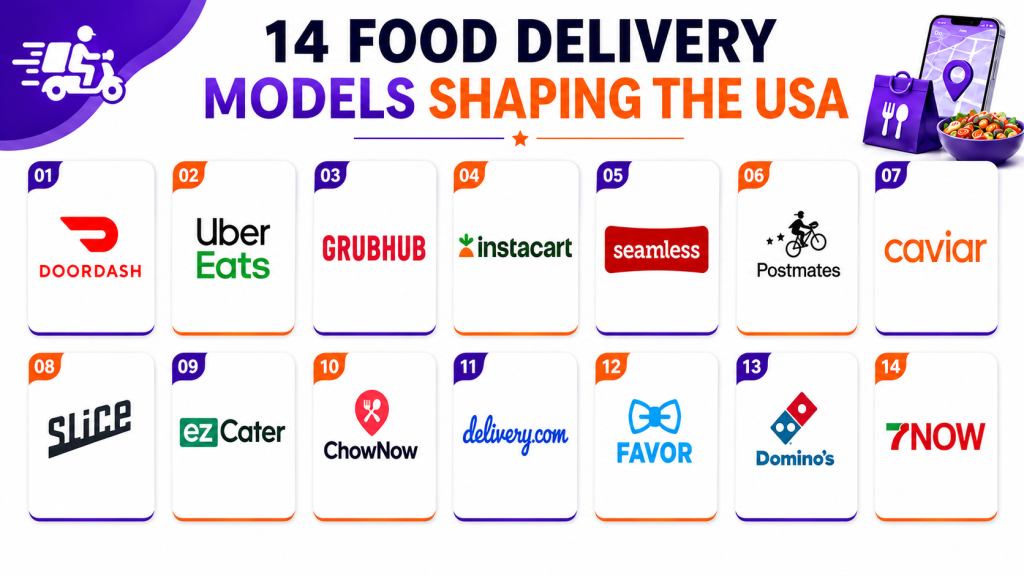
Top 14 Food Delivery Apps in the USA in 2026
Rank | Food Delivery App | What Makes It Interesting | Business Model |
1 | DoorDash | Local commerce + delivery scale | Marketplace |
2 | Uber Eats | Food + mobility + autonomous delivery | Marketplace |
3 | Grubhub | Restaurant marketplace + automation | Marketplace |
4 | Instacart | Grocery fulfillment | Marketplace |
5 | Seamless | Urban restaurant ordering | Marketplace |
6 | Postmates | Multi-category local delivery | Marketplace |
7 | Caviar | Curated restaurant discovery | Premium marketplace |
8 | Slice | Independent pizza specialization | Vertical marketplace |
9 | ezCater | Corporate food ordering | B2B marketplace |
10 | ChowNow | Restaurant-owned ordering | SaaS + ordering |
11 | Delivery.com | Local delivery ecosystem | Marketplace |
12 | Favor | Regional delivery | Regional marketplace |
13 | Domino’s | Brand-owned delivery | Direct-to-consumer |
14 | 7NOW | Convenience delivery | Retail delivery |
Important: “Top” doesn’t necessarily mean every app is competing for exactly the same customer. Some specialize in restaurants, some in groceries, some in corporate catering, some in regional markets, and some focus on helping restaurants own their digital ordering relationship.
That difference is actually where the biggest lessons are.
1. DoorDash — The Delivery App That Became a Local-Commerce Platform
If you want to understand the US delivery market, start with DoorDash.
But don’t look at it simply as a restaurant delivery app.
Look at it as a local-commerce infrastructure.
The platform has expanded beyond restaurant meals into groceries, convenience and other local categories. That’s strategically important because delivery infrastructure becomes more valuable when the same customer can use it for multiple everyday needs.
And consumer demand remains resilient. Recent US reporting found that consumers are continuing to use delivery platforms despite broader caution around discretionary spending.
The interesting lesson
DoorDash’s advantage isn’t simply:
“We deliver food.”
It’s closer to:
“We make local things available on demand.”
What businesses can learn
If you’re planning to build a food delivery app, don’t automatically limit the architecture to restaurants.
Ask whether the same infrastructure could eventually support:
- Grocery
- Convenience
- Pharmacy
- Bakery
- Pet supplies
- Local retail
- Courier services
That’s how a food delivery app can evolve into a broader delivery platform.
2. Uber Eats — Where Food Delivery Meets Autonomous Delivery
Uber Eats has an unusual advantage: it sits inside a much larger mobility ecosystem.
But its most interesting 2026 development isn’t simply food ordering.
It’s how the order gets delivered.
Uber and Zipline announced a strategic partnership in August 2026 to bring autonomous drone delivery to Uber Eats, with first deployments planned later in 2026 and an ambition to scale toward one million drone deliveries per day by the end of 2029.
Think about what that means.
A future delivery platform may not ask:
“Which driver should deliver this?”
It may ask:
“Which delivery method is most efficient for this order?”
That could mean:
Car → Bike → Scooter → Robot → Drone
depending on location, order size, distance and operating conditions.
What businesses can learn
When you create a food delivery app, don’t hard-code the business around one delivery method.
Build an architecture that can evolve.
3. Grubhub — The Automation Experiment
Grubhub remains an important name in the US food delivery ecosystem, but its 2026 story has another interesting dimension: robotics.
Serve Robotics announced a partnership with Grubhub to deploy sidewalk delivery robots, initially expanding into markets including Los Angeles, Chicago and Alexandria.
This is important because automation doesn’t simply remove the delivery driver.
It changes the technology requirements around the driver—or robot.
The platform needs to understand:
1.Order readiness
2.Pickup location
3.Robot availability
4.Route
5.Delivery zone
6.Customer location
7.Handoff
8.Exceptions
The takeaway
Automation doesn’t remove complexity. It moves complexity into the technology layer.
That is something anyone planning a food delivery app development project should understand.
4. Instacart — Proof That Delivery Isn't Just About Restaurants
Instacart operates primarily around grocery shopping and delivery.
Its importance to the food delivery industry is simple:
Consumers don’t necessarily separate “food delivery” and “grocery delivery” in their minds.
They think:
“I need something. I want it brought to me.”
That is a much broader concept.
What this means for app development
A scalable delivery platform may need to handle:
1.Different product types
2.Inventory availability
3.Substitutions
4.Scheduled delivery
5.Shopping workflows
6.Multiple fulfillment models
This is why a multi-vendor food delivery app should be architected carefully if future expansion is part of the plan.
5. Seamless — The Urban Delivery Lesson
Seamless has long been associated with online restaurant ordering, particularly in dense urban markets.
And dense cities teach an important delivery lesson:
Geography changes the economics of delivery.
A platform operating in Manhattan doesn’t have the same operational requirements as one serving suburban Texas.
Urban delivery can benefit from:
1.Shorter distances
2.High restaurant density
3.Walking and bicycle delivery
4.Higher order density
Suburban markets may require:
1.Larger delivery zones
2.Vehicle-based delivery
3.Better route planning
4.Different driver economics
Expert takeaway
When you build a food delivery app, don’t define the delivery model without defining the geography.
6. Postmates — Think Beyond Food
Postmates helped popularize a broader interpretation of local delivery.
Food is only one category.
The same underlying infrastructure can potentially move:
Food + groceries + convenience + local products
This is particularly relevant to entrepreneurs exploring food delivery software that may eventually become a quick-commerce or local-delivery platform.
The lesson
Build for the business you want to become—not only the business you are launching today.
7. Caviar — You Don't Have to Serve Everyone
Caviar represents a different philosophy.
Instead of competing purely on maximum restaurant coverage, a curated marketplace can focus on restaurant quality and discovery.
That creates a valuable strategic lesson:
You don’t always need more merchants.
You may need better differentiation.
A startup could focus on:
1.Fine dining
2.Healthy restaurants
3.Vegan food
4.Halal restaurants
5.Corporate meals
6.Local independent restaurants
7.Premium meal delivery
Instead of becoming another generic marketplace.
8. Slice — The Power of Going Vertical
Slice is one of the clearest examples of specialization.
Rather than trying to become everything for everyone, its model is built around independent pizzerias.
That’s a powerful strategy for a startup.
Imagine launching:
“The delivery platform built specifically for independent pizza restaurants.”
Now your technology, marketing, integrations and customer experience can be optimized around one business category.
This can be easier than competing with DoorDash.
You don’t need to beat the largest marketplace everywhere.
You need to become the obvious platform for one specific audience.
9. ezCater — Food Delivery Isn't Always B2C
A corporate office ordering 100 lunches has completely different requirements from one person ordering a burger.
That’s where B2B food delivery becomes interesting.
Corporate food platforms may require:
1.Bulk ordering
2.Scheduled delivery
3.Recurring orders
4.Business accounts
5.Invoicing
6.Approval workflows
7.Multiple locations
8.Centralized reporting
Business lesson
Before you create an app like DoorDash, decide whether you actually want a consumer marketplace.
A B2B food delivery platform can have a completely different opportunity.
10. ChowNow — The Restaurant-Owned Alternative
Here’s a question restaurant owners increasingly need to consider:
Who owns the customer relationship?
A marketplace can provide customer reach.
But a restaurant-owned ordering platform can provide greater control over:
1.Branding
2.Customer experience
3.First-party customer relationships
4.Loyalty
5.Ordering data
6.Promotions
This creates two very different product categories.
Marketplace
Customer → Marketplace → Restaurant
First-party platform
Customer → Restaurant
And a third option:
Hybrid
Customer → Marketplace for discovery
Customer → Restaurant platform for retention
For many restaurant businesses, that hybrid strategy is worth considering.
11. Delivery.com — The Local-Service Model
Delivery.com demonstrates another approach: using delivery infrastructure across multiple local services.
The broader lesson is that the delivery engine can become more valuable as more categories are added.
A properly designed food delivery platform can potentially expand into:
1.Grocery
2.Pharmacy
3.Convenience
4.Courier
5.Local retail
without rebuilding its entire technology foundation.
12. Favor — Regional Can Be a Competitive Advantage
Favor offers another important lesson:
You don’t have to launch nationwide on day one.
A regional delivery business can focus intensely on:
1.Local restaurant relationships
2.Delivery density
3.Customer acquisition
4.Driver availability
5.Local partnerships
6.Market-specific operations
This is particularly useful for startups.
Instead of saying:
“We’ll build a food delivery app for the entire USA.”
Try:
“We’ll dominate one city first.”
Once the model works, expand.
13. Domino's — Own the Digital Customer Journey
Domino’s is fundamentally different from a marketplace.
The restaurant brand controls the relationship from:
Discovery → Order → Kitchen → Delivery → Loyalty
That gives restaurant chains an important alternative to third-party marketplaces.
If you already have strong brand recognition, you may not need someone else to own the customer interface.
Lesson for restaurant businesses
The question isn’t:
“Should we use DoorDash?”
It may be:
“How much of our customer relationship should belong to us?”
That is a much better strategic question.
14. 7NOW — The Speed Economy
7NOW represents the growing demand for fast delivery of convenience products.
And this highlights a larger shift.
The customer increasingly doesn’t care whether a platform calls itself:
Food Delivery
Quick Commerce
Convenience Delivery
or
Local Commerce
They care about one thing:
“Can I get what I need quickly?”
That is why food delivery technology is increasingly relevant to broader on-demand commerce.
What Do These 14 Apps Actually Have in Common?
At first glance, they look completely different.
But underneath, many successful delivery businesses depend on the same basic ecosystem.
Customer
Find → Select → Order → Pay → Track → Receive → Review
Restaurant / Merchant
Manage products → Receive order → Prepare → Update status → Fulfill
Delivery Partner
Accept → Navigate → Pickup → Deliver → Confirm
Platform Owner
Manage → Dispatch → Monitor → Analyze → Optimize
The customer sees an app.
The business operates a technology network.
That distinction is critical when you start thinking about food delivery app development.
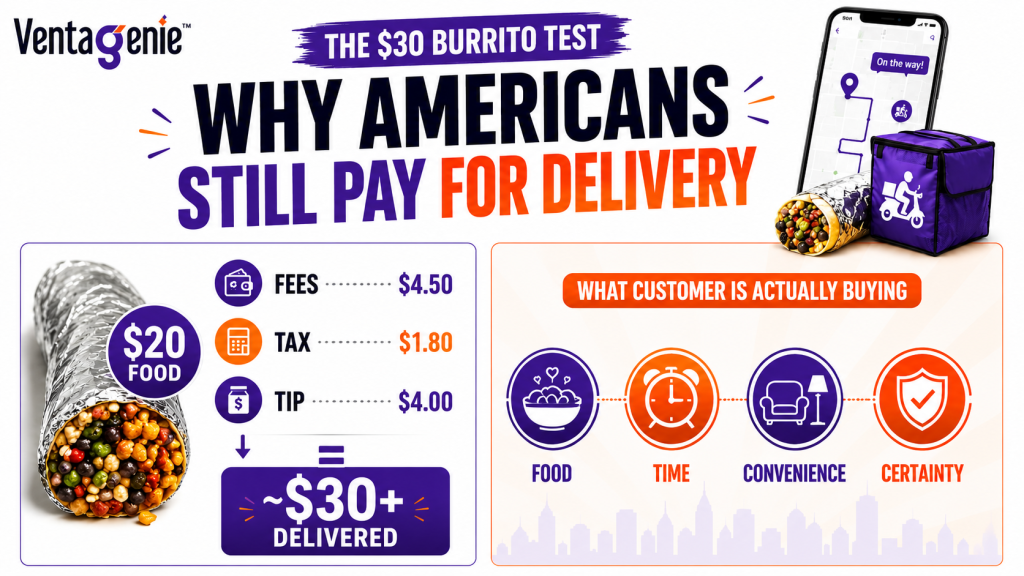
The $30 Burrito Test: Why Americans Still Pay for Delivery
Here’s a useful way to understand the US market.
Imagine:
Meal: $20
Taxes: $2
Fees: $5
Tip: $4
The customer is now paying around $31 for a meal that may have cost $20 at the restaurant.
Why would they do it?
Because the customer isn’t only buying food.
They’re buying:
- Time
- Convenience
- No driving
- No parking
- Predictability
- No waiting
- Doorstep delivery
Recent reporting indicates that US consumers continue to use food delivery despite broader caution around spending, highlighting how strongly convenience can influence purchasing decisions.
The lesson for delivery businesses
Don’t build your entire value proposition around:
“We are cheaper.”
Build around:
“We make ordering dramatically easier.”
Price matters.
But friction matters too.
The Biggest Change in Food Delivery: Customers Are Starting With AI
Here’s where the market gets particularly interesting in 2026.
A customer may no longer open an app and scroll through 50 restaurants.
They might simply ask:
“Find me a good Thai restaurant within 20 minutes, under $30, with vegetarian options.”
That’s already becoming a real product direction.
DoorDash introduced Ask DoorDash, a conversational search experience where users can describe what they want in natural language rather than manually browsing. DoorDash says its system can search across a very large inventory of menu items and grocery products.
Separately, DoorDash’s 2026 restaurant research reported that 22% of surveyed US consumers had already used AI tools such as ChatGPT or Google Gemini to help choose a restaurant.
This changes food delivery app development.
The future interface may be:
AI → Recommendation → Restaurant → Order
instead of:
App → Search → Filter → Scroll → Compare → Order
What should a modern food delivery app prepare for?
Structured restaurant data.
Accurate:
- Menus
- Price
- Ingredients
- Dietary information
- Allergens
- Opening hours
- Location
- Delivery zones
- Reviews
- Availability
AI can only make good recommendations when the underlying information is reliable.
The 2026 Food Delivery Technology Stack
If you are planning to build a food delivery app, think beyond the mobile interface.
A serious platform usually requires multiple interconnected systems.
1. Customer App
The customer should be able to:
- Register
- Search
- Browse
- Customize orders
- Pay
- Track
- Review
- Reorder
- Manage addresses
- Receive notifications
2. Restaurant App or Dashboard
Restaurants need:
- Menu management
- Order management
- Availability control
- Preparation-time updates
- Sales reporting
- Promotions
- Payout information
3. Delivery Partner App
Drivers need:
- Availability
- Order assignment
- Navigation
- Pickup confirmation
- Delivery status
- Earnings
- Delivery history
4. Admin Panel
The platform operator needs:
- Customer management
- Restaurant management
- Driver management
- Order management
- Commission management
- Payment management
- Promotions
- Refunds
- Reports
- Analytics
5. Delivery Engine
This is where things get more interesting.
A strong delivery platform needs to coordinate:
Restaurant readiness + driver availability + location + distance + traffic + delivery priority
This is where route optimization and intelligent dispatch become important.
What Features Should a Modern Food Delivery App Have?
A useful feature set goes beyond “login, cart and payment.”
Customer-side features
- Restaurant discovery
- Advanced search
- AI recommendations
- Dietary filters
- Real-time tracking
- Multiple payment options
- Scheduled ordering
- Reviews
- Loyalty
- Offers
- Reordering
- Push notifications
Restaurant-side features
- Menu management
- Order acceptance
- Preparation-time management
- Inventory/availability
- Offers
- Analytics
- Settlement reports
Delivery-side features
- Smart order assignment
- Route optimization
- Navigation
- Earnings
- Delivery history
- Proof of delivery
- Availability scheduling
Admin-side features
- Multi-vendor management
- Commission configuration
- Delivery-zone management
- Payment management
- Refund management
- Customer support
- Analytics
- Fraud monitoring
- Business intelligence
Don't Copy DoorDash: Build the Right Business Model
This is perhaps the most important advice for anyone searching:
“How to build a food delivery app like DoorDash?”
Don’t start by copying the screens.
Start by deciding why someone would use your platform instead of DoorDash or Uber Eats.
You could compete through:
Hyperlocal delivery
Focus on one city or neighborhood.
Vertical specialization
Build specifically for pizza, healthy food, ethnic cuisine, corporate meals or another niche.
Restaurant-owned ordering
Help restaurants build direct customer relationships.
B2B delivery
Focus on corporate catering and recurring business orders.
Combine food with grocery and convenience.
AI-first discovery
Let customers describe what they want instead of manually searching.
Premium delivery
Focus on higher-value restaurants and experiences.
The opportunity isn’t necessarily to build another DoorDash.
The opportunity is to solve a problem that DoorDash doesn’t solve perfectly.
Can You Build a Food Delivery App Like DoorDash?
Yes.
But a DoorDash clone app should be understood as a starting architecture—not a complete business strategy.
A basic clone may reproduce:
- Customer ordering
- Restaurant listings
- Driver management
- Payments
- Tracking
- Admin management
But a production-ready platform needs much more.
It needs to account for:
- Scalability
- Delivery economics
- Restaurant operations
- Dispatch logic
- Security
- Payments
- Location services
- Customer retention
- Analytics
- Notifications
- Support
- Multiple markets
So what does “clone” really mean?
A DoorDash clone can reproduce a proven product structure.
It does not automatically reproduce DoorDash’s network effects.
That’s an important distinction.
What Makes a Food Delivery App Successful in the USA?
If I had to reduce the entire industry to seven factors, they would be:
1. Reliable delivery
Customers forgive many things.
They don’t easily forgive late food.
2. Good restaurant selection
More isn’t always better.
Relevant is better.
3. Simple ordering
Every unnecessary step increases friction.
4. Accurate ETAs
Customers want to know when their order will arrive.
5. Smart discovery
AI and personalization can reduce the effort of finding something to eat.
6. Strong retention
The first order is acquisition.
The tenth order is the business.
7. Efficient operations
A beautiful app cannot rescue an inefficient delivery network.
What the Next Food Delivery App Could Look Like
Imagine opening an app and typing:
“I’m working late. Find me something healthy, under $25, high in protein, within 30 minutes.”
The system understands the request.
It checks:
- Restaurants
- Menus
- Ingredients
- Dietary information
- Customer history
- Distance
- Current preparation times
- Driver availability
Then it recommends three options.
You choose one.
The system selects the most efficient delivery method.
Maybe that’s a driver.
Maybe it’s a robot.
Maybe, eventually, it’s a drone.
You never need to understand the complexity underneath.
That’s the real goal of good delivery technology: make a complicated operation feel simple.
What Should Businesses Learn From the Top 14 Food Delivery Apps?
Platform | Key Lesson |
DoorDash | Build a local-commerce network |
Uber Eats | Prepare for multiple delivery modes |
Grubhub | Automation is becoming operational infrastructure |
Instacart | Delivery can extend beyond prepared food |
Seamless | Geography changes delivery economics |
Postmates | Build for category expansion |
Caviar | Niche positioning can work |
Slice | Vertical specialization creates differentiation |
ezCater | B2B delivery is a separate opportunity |
ChowNow | Restaurants want more ownership |
Delivery.com | One delivery engine can support multiple categories |
Favor | Regional density can beat premature expansion |
Domino’s | Owning the customer journey has strategic value |
7NOW | Speed and convenience are becoming broader expectations |
The Real Opportunity Isn't Another Food Delivery App
Here’s my biggest takeaway after looking at these platforms.
The US market doesn’t necessarily need another app with restaurant cards, a shopping cart and a checkout button.
It needs better solutions to specific delivery problems.
Maybe that’s:
A better platform for independent restaurants.
A better corporate food delivery experience.
A better regional marketplace.
A better AI-powered ordering experience.
A better restaurant-owned ordering system.
A better quick-commerce network.
A better delivery operating system.
That’s where new businesses can differentiate.
Building a Food Delivery App? Start With the Business, Not the Screens.
If you’re planning to build a food delivery app, the first conversation shouldn’t be about colors, buttons or app screens.
It should be about:
Who is the customer?
Who supplies the food?
Who delivers it?
How does the platform make money?
What makes customers return?
What happens when order volume increases 10X?
Can the platform expand to other cities or delivery categories?
Once those questions are answered, the technology becomes much easier to design.
VentaGenie approaches delivery platforms from that perspective.
Its delivery app development solutions can be structured around different models, including food delivery, grocery delivery, pharmacy delivery, courier delivery and quick-commerce, with capabilities such as real-time tracking, route optimization and AI-powered recommendations.
The objective isn’t to create a copy of someone else’s application.
It’s to create a delivery platform that fits your business model—and is capable of growing with it.
Final Takeaway: The Future of Food Delivery Is Bigger Than Food
The first generation of delivery apps solved one problem:
“How can I order food without going to the restaurant?”
The next generation is solving a much bigger problem:
“How can I get what I need, from the right place, at the right time, with as little effort as possible?”
That’s why the industry is moving toward:
AI-powered discovery
Personalized ordering
Multi-category delivery
Smarter logistics
Real-time visibility
Restaurant-owned digital channels
Robots
Drones
And eventually, increasingly autonomous delivery networks.
For entrepreneurs, restaurant groups and startups, that creates a much bigger opportunity than simply building another food ordering app.
The winning question isn’t:
“How can I build a DoorDash clone?”
It’s:
“What can my delivery platform do better, faster or more intelligently than the platforms customers already use?”
Answer that first.
Then build the technology around it.
Frequently Asked Questions
Start by defining the business model, target market, restaurant network, delivery model and revenue strategy. Then design the customer, restaurant, delivery-partner and admin systems around those requirements.
The cost varies according to features, platforms, integrations, customization, geographic coverage and backend complexity. A multi-vendor platform costs significantly more to develop than a simple restaurant ordering application.
A basic MVP can be developed faster than a full-scale marketplace. A production platform with customer, restaurant, driver and admin systems, real-time tracking, payments, analytics and advanced logistics requires considerably more planning and development.
Yes. You can create a DoorDash-style marketplace with customer ordering, restaurant management, delivery management, payments and tracking. However, copying the interface is not enough; the business model and operational infrastructure are equally important.
Yes. An Uber Eats-style platform can include restaurant discovery, ordering, payments, delivery-partner management, real-time tracking and location-based services. Additional capabilities such as grocery, subscriptions and advanced logistics can be added depending on the business model.
A DoorDash clone app is a customized food delivery platform based on the general marketplace structure used by DoorDash. It typically connects customers, restaurants and delivery partners through a centralized platform.
A clone should be treated as a functional starting point, not as a literal copy of another company’s proprietary branding, design or intellectual property.
Core features include restaurant discovery, menus, ordering, checkout, payment processing, order management, delivery assignment, real-time tracking, notifications, ratings, restaurant management, delivery-partner management and an admin dashboard.
Advanced platforms can add AI recommendations, route optimization, demand forecasting, loyalty, business intelligence and automated delivery support.
Yes. AI can support restaurant discovery, personalized recommendations, customer service, demand forecasting, fraud detection, delivery optimization and retention.
AI-powered restaurant discovery is already becoming relevant in the US. DoorDash reported that 22% of surveyed US consumers had used AI to help choose a restaurant in its 2026 research.
Yes, if the platform is architected for multiple product categories and fulfillment workflows. The underlying delivery infrastructure can potentially support food, grocery, pharmacy, convenience and other local-commerce models.
It depends on your business. Ready-made or customizable food delivery software can reduce time to market, while fully custom development provides greater control over unique workflows and technology.
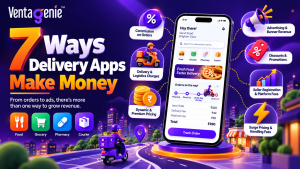
Common revenue models include:
- Restaurant commissions
- Delivery fees
- Customer subscriptions
- Restaurant advertising
- Featured listings
- Convenience fees
- B2B plans
- Technology or SaaS fees
Many platforms combine multiple revenue streams.
An app is the customer-facing interface.
A platform includes the broader technology ecosystem behind the business: customers, restaurants, delivery partners, payments, dispatch, analytics, administration and integrations.
For a serious delivery business, platform thinking is more important than app thinking.

Mr. Aniket D is a seasoned digital marketer with over 10 years of experience in market research, content strategy, and performance marketing.
He specializes in analyzing consumer behavior, identifying emerging market trends, and translating insights into actionable digital strategies.
His work focuses on blending research-driven content with SEO and lead generation to drive measurable business growth.
Known for his data-first mindset, Aniket helps brands make smarter, audience-focused decisions in competitive markets.