Let’s do a quick exercise. Pull up your last Zomato or Swiggy payout on your phone right now.
Look at the total your customers paid. Now look at what actually landed in your account. That gap in between — that’s not a fee. That’s rent. You’re paying rent every single day to reach people who already know your food, already like it, and would happily order from you again if they had an easy way to.
Here’s the thing nobody tells new restaurant owners: aggregators were never built to make you rich. They were built to make themselves the front door to every restaurant in India. You’re just the kitchen behind that door.
Key Takeaways
- Every order through Zomato or Swiggy costs you 25–35% once commission, GST on commission, platform fees, and payment charges are all added up
- On a ₹500 order, you keep roughly ₹330–370 through an aggregator — versus ₹485 through your own website
- Aggregators own the customer relationship, not you — no phone number, no email, no way to reach a regular customer directly
- Google often shows a Zomato page instead of your own when someone searches your restaurant's name — with competitors suggested right below it
- The goal isn't to quit aggregators — they're still useful for first-time discovery — it's to stop relying on them for repeat orders
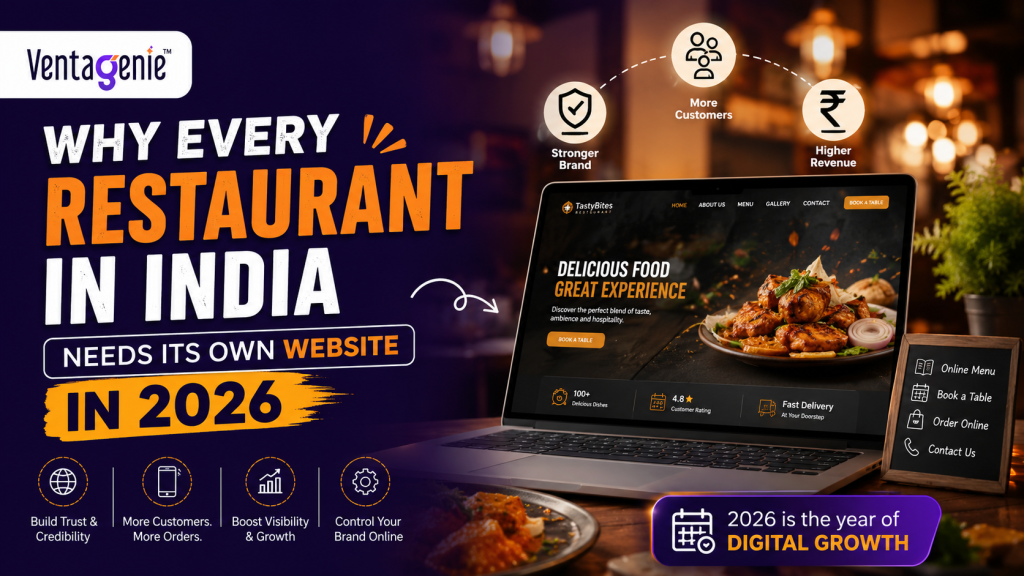
- A restaurant website doesn't need to be complicated: a fast menu, easy payment, Google/Maps visibility, and a WhatsApp button cover the essentials
- The real money isn't in new customers — it's in getting your existing regulars to order directly instead of through an app every time
So what's actually happening to your money?
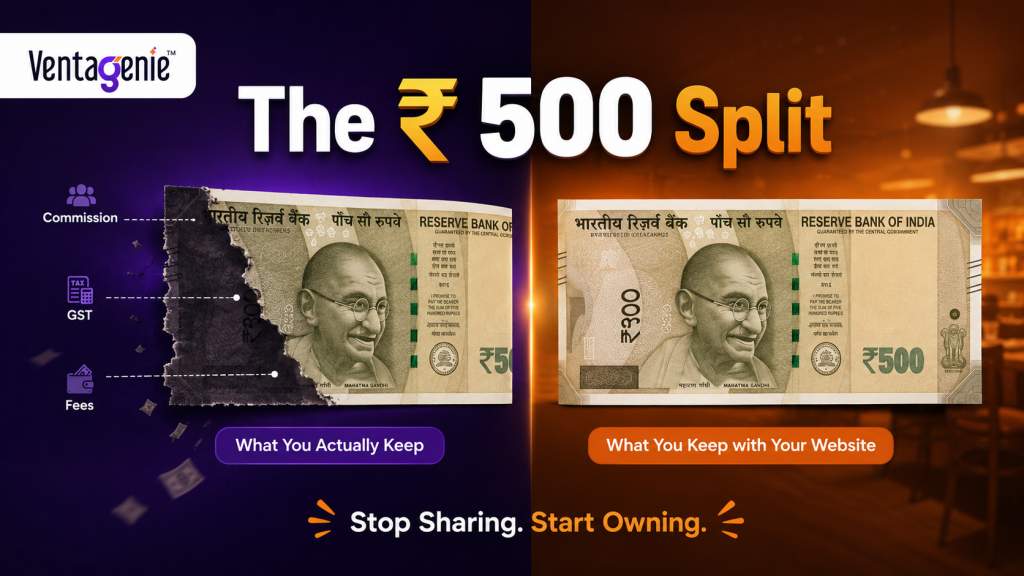
Take a ₹500 order. Zomato or Swiggy pull out somewhere between 17-28% as commission. Then there’s GST charged on top of that commission — yes, tax on their fee, not just your food. Add a flat platform fee of around ₹17.58, plus a small cut for payment processing, and you’re looking at keeping roughly ₹330–370 out of that ₹500.
Now imagine that same order came through your own website instead. Same customer, same dish, same effort in the kitchen. You’d keep close to ₹485.
That ₹150 difference doesn’t sound huge on one order. Multiply it by every order, every day, every month — and suddenly it’s the difference between a restaurant that’s “doing okay” and one that’s actually profitable.
Here's what really bothers most owners once they realize it
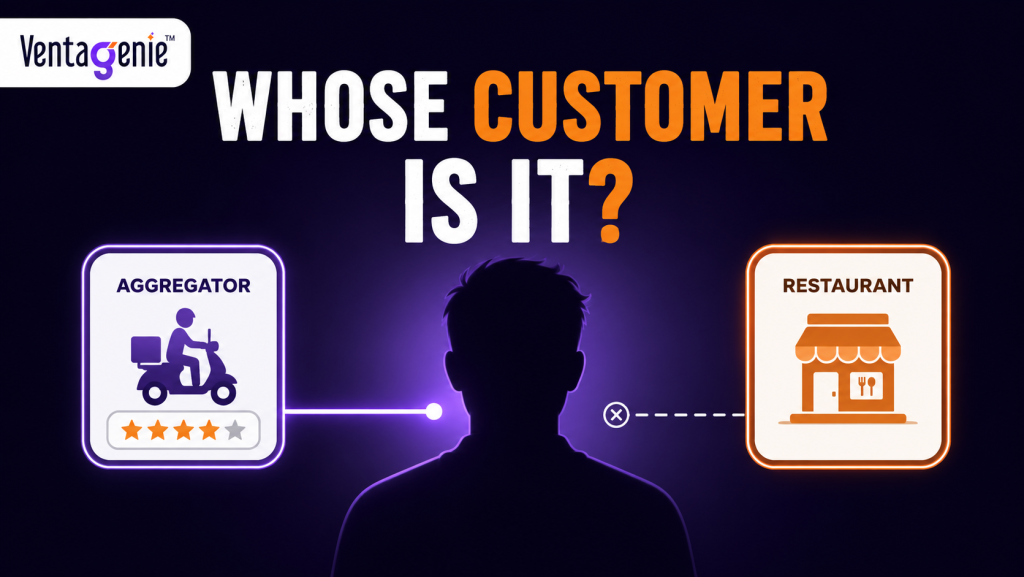
You don’t actually know your customers.
Think about the person who’s ordered your butter chicken four times this month through Zomato. You’d probably love to send them a message — “hey, we just added something new, come try it.” You can’t. You don’t have their number. Zomato does. That customer belongs to the app, not to you, even though you’re the one who fed them.
Build your own website, and that changes overnight. Every order that comes through it leaves you their name, number, and address. That’s yours to keep, forever — not something you’re borrowing from a platform that could change its rules tomorrow.
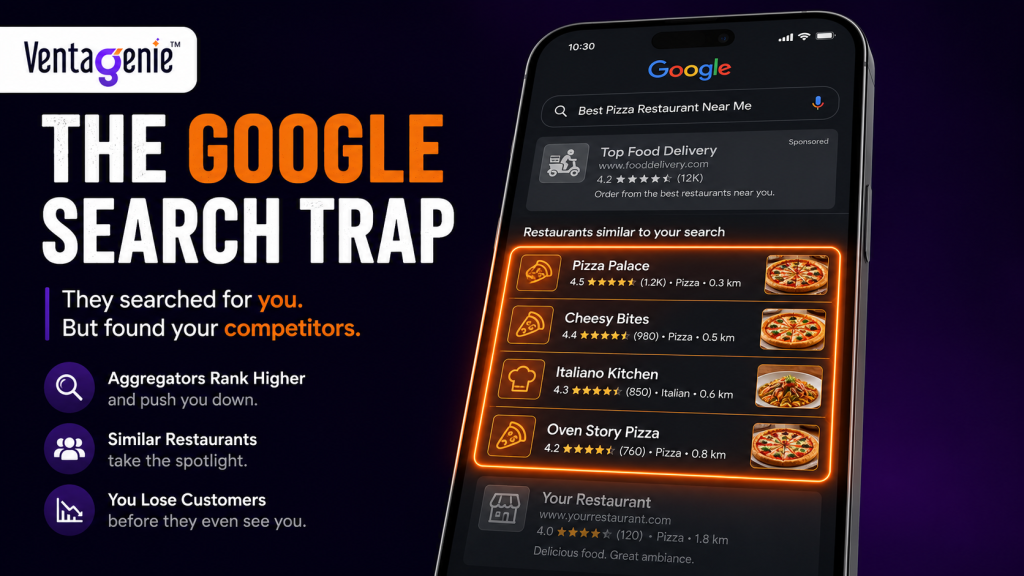
And here's the part almost nobody talks about: Google doesn't know you exist
Try this — Google your own restaurant’s name right now. See what comes up first.
If it’s a Zomato page instead of anything you own, notice what’s sitting right underneath it. A row of “similar restaurants nearby.” That’s Google — and Zomato — quietly suggesting your competitors to someone who searched for you by name.
A website fixes that. It gives Google something that’s actually yours to show people — your menu, your photos, your reviews, your story. Not a template shared with a thousand other restaurants that all look the same.
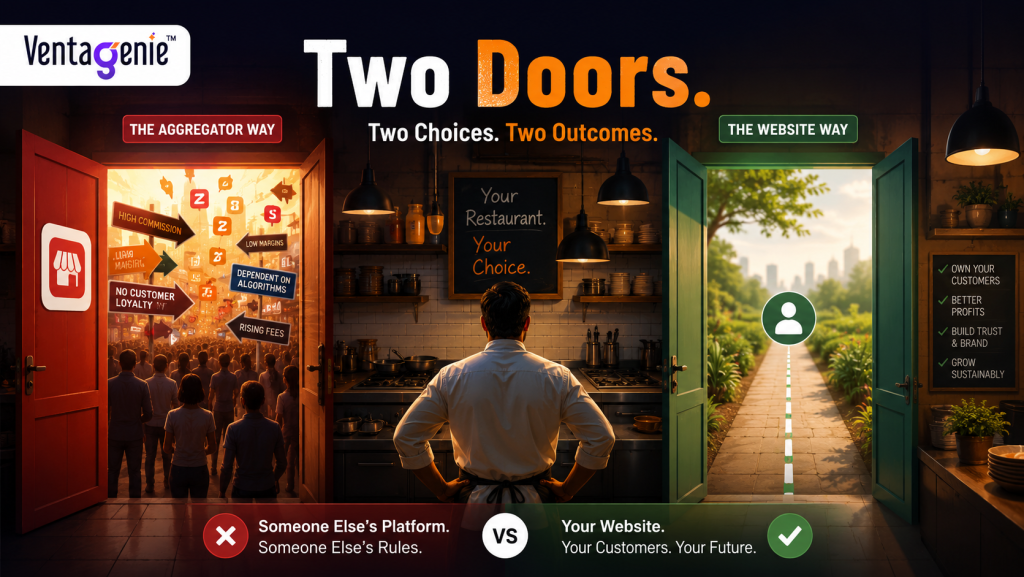
Why Is a Website the Only Channel You Actually Own?
Aggregator ranking algorithms change without warning. An outlet sitting on page one for its area can wake up on page three with no notification and no recourse, especially once competitors start paying for sponsored slots above you.
A website doesn’t work that way. Nobody can demote your page because a rival paid for placement. Traffic from Google, an Instagram bio link, a QR code on your packaging, or a WhatsApp broadcast all lands on property that’s genuinely yours — the SEO value compounds over time, and no third party can switch it off.
Restaurants that print a website QR code on their delivery packaging and ask for the second order directly regularly redirect a meaningful share of repeat business away from aggregator commissions within a single quarter.
What Does a Restaurant Website in India Actually Need?
Skip the 50-page corporate site fantasy. A restaurant website that works in India needs to get a handful of things right:
- A menu that loads fast on an average Android phone over 4G
- An ordering flow with UPI, card, and cash-on-delivery support
- A Google Business Profile connection so the site strengthens local search and Maps
- A WhatsApp button for reservations, bulk orders, and quick queries
- A mobile-first layout — the large majority of web traffic in India is mobile
- Basic local SEO: restaurant name, neighbourhood, city, and cuisine in your page titles and meta tags
Should you drop Zomato and Swiggy then?
No. Genuinely, don’t. They’re still one of the easiest ways for someone who’s never heard of you to find you for the first time. That’s worth something.
Think of it less like “aggregators vs. website” and more like this: Zomato brings you a stranger. Your website is what turns that stranger into a regular. The first order might cost you 30% in fees — that’s fine, that’s the cost of discovery. But the fifth order from that same customer? On your own site, that costs you almost nothing. That’s where restaurants actually start making money.
What does a website even need to do?
Nothing complicated. Genuinely — a menu that loads fast, a simple way to pay, your restaurant properly listed so Google and Maps can find you, and a WhatsApp button so people can just message you. That’s it. That’s the whole list. Everything fancy can wait.
One honest question to ask yourself
If 30% of your regulars — the people who already order from you every week — shifted to ordering directly instead of through an app, what would that be worth to your restaurant every month?
Take your average order value. Multiply it by how many repeat orders you get in a week. That number is roughly what you’re leaving on the table right now.
The Bottom Line
Indian restaurants lose real margin to aggregator commissions every single month, and the platform sits between you and knowing who your own customers actually are. A website — with a direct ordering system behind it — moves your repeat business to a channel where you keep the vast majority of every order, own the customer relationship, and control your own brand.
Keep aggregators for discovery. Build your own channel for everything after the first order.
Want to actually see that number for your restaurant?
Ventagenie builds fast, simple restaurant websites with direct ordering built in — so the next time a regular customer wants your food, they come straight to you.
we’ll walk through what it would look like, and save you, for your restaurant specifically
Frequently Asked Questions
Yes — not instead of them, but alongside them. Aggregators are great for getting discovered by new customers. A website is what lets you keep more of the money and the relationship once someone already knows and likes your food.
It depends on your order volume, but the math is simple: every order that moves from an aggregator to your own site keeps you roughly 25–35% more of that order’s value. If even a quarter of your regulars start ordering directly, that adds up fast — often tens of thousands of rupees a month for a mid-sized restaurant.
Increasingly, yes — especially your regulars. UPI made direct payment just as fast as ordering through an app, and once someone already knows they like your food, all they need is an easy link, usually shared on WhatsApp, Instagram, or your packaging.
No. Keep them for what they’re good at — bringing in people who’ve never ordered from you before. Your website’s job is different: turning those first-time customers into regulars who order directly.
Just the essentials — a fast-loading menu, a simple checkout with UPI/card/cash on delivery, your restaurant properly listed on Google so people can find you, and a WhatsApp button so customers can reach you directly. Nothing complicated.
Yes. Right now, when someone searches your restaurant’s name, a Zomato page often shows up instead — with competitors suggested right underneath it. A website gives Google something that’s actually yours to show people, which keeps that search result pointing to you, not away from you.
For most single-restaurant setups, a proper website with direct ordering built in can go live in a few weeks — not months.

Mr. Aniket D is a seasoned digital marketer with over 10 years of experience in market research, content strategy, and performance marketing.
He specializes in analyzing consumer behavior, identifying emerging market trends, and translating insights into actionable digital strategies.
His work focuses on blending research-driven content with SEO and lead generation to drive measurable business growth.
Known for his data-first mindset, Aniket helps brands make smarter, audience-focused decisions in competitive markets.