How Can Delivery Businesses Reduce Fuel Costs Without Compromising Delivery Speed ?
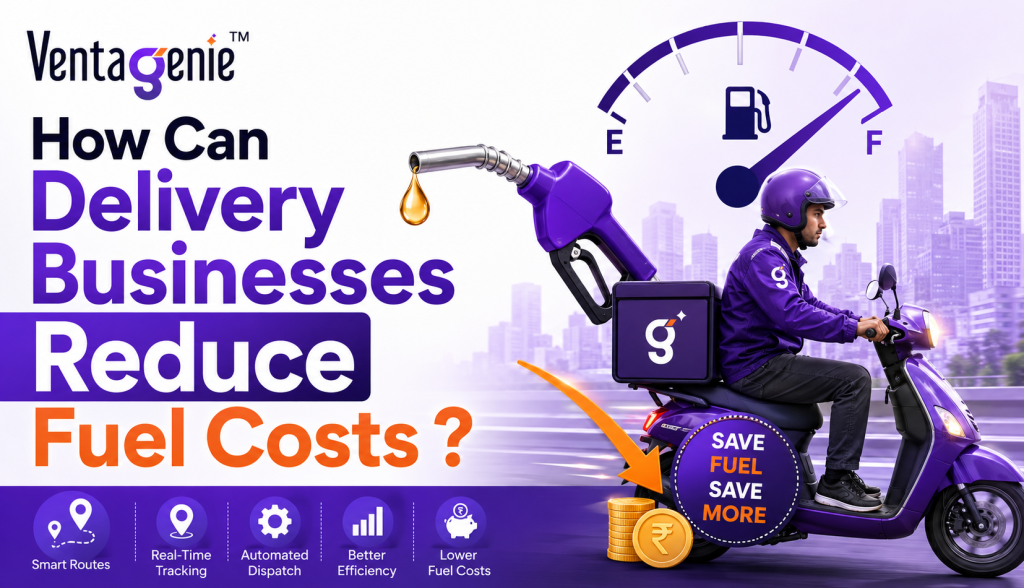
Fuel has always been one of the biggest operating expenses for delivery businesses. Whether you run a food delivery service, a grocery delivery platform, a pickup-and-drop operation, or an on-demand transportation business, fuel costs directly affect your profit margins.
In recent years, businesses around the world have witnessed how quickly fuel prices can change. A geopolitical conflict, supply chain disruption, economic uncertainty, or global market fluctuation can send fuel prices soaring almost overnight. While these events may happen thousands of miles away, their impact is felt immediately by delivery businesses operating in cities and neighborhoods every day.
The challenge is simple:
customers still expect fast deliveries, businesses still need to remain competitive, and riders still need to complete deliveries efficiently. However, when fuel costs rise, maintaining that balance becomes increasingly difficult.
The reality is that most delivery businesses cannot control fuel prices. What they can control is how efficiently they use fuel.
This distinction is important because many businesses focus on the wrong problem. They spend time worrying about fuel prices while overlooking operational inefficiencies that quietly increase fuel consumption every single day.
The good news is that reducing fuel costs doesn’t necessarily mean reducing deliveries, cutting service quality, or slowing down operations. In many cases, it simply means making smarter decisions about how deliveries are planned, assigned, tracked, and completed.
Let’s explore how delivery businesses can reduce fuel costs without compromising delivery speed or customer experience.
The Fuel Cost Problem Most Businesses Misunderstand
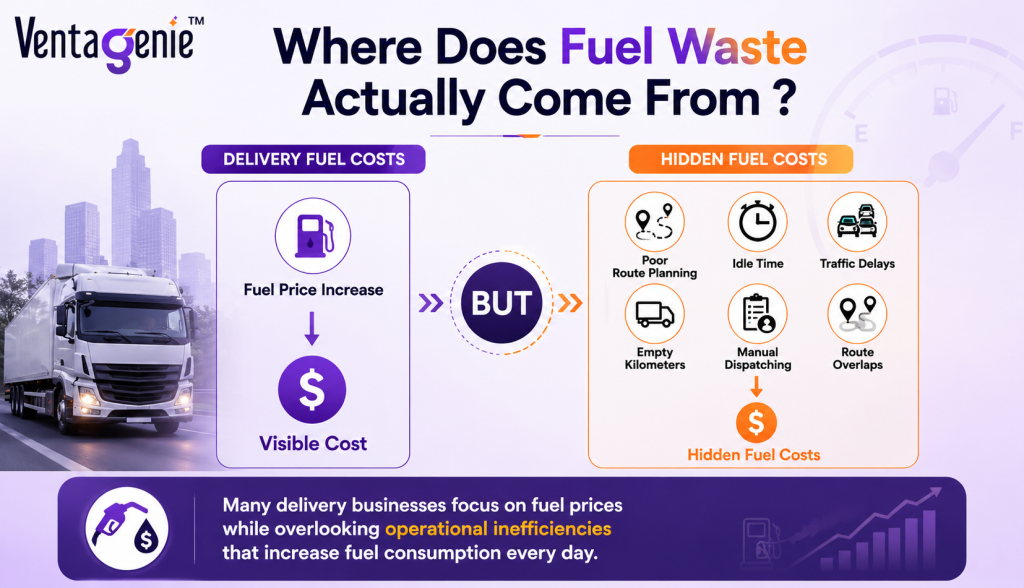
When fuel expenses increase, the immediate assumption is often that rising fuel prices are entirely to blame.
However, let’s consider a simple scenario.
Imagine a food delivery business completes 300 deliveries per day.
The management team sees the number of completed deliveries, customer ratings, and revenue figures. Everything appears normal.
What they may not see is :
- Riders taking longer routes than necessary
- Multiple riders covering overlapping delivery zones
- Excessive waiting time at restaurants
- Drivers stuck in traffic without route adjustments
- Orders assigned inefficiently
- Vehicles traveling without active deliveries
These hidden inefficiencies can increase fuel consumption significantly.
In many cases, businesses are not just paying for fuel—they are paying for wasted fuel.
That is where the real opportunity lies.
Why Fuel Costs Matter More Than Ever ?
Fuel costs influence almost every aspect of delivery operations.
When fuel prices increase, businesses often experience :
- Higher operational expenses
- Reduced profit margins
- Increased delivery costs
- Pressure to raise delivery fees
- Greater difficulty scaling operations
For startups and growing delivery businesses, these challenges can become especially difficult.
A large enterprise may be able to absorb temporary cost increases. A smaller food delivery startup or grocery delivery business may not have the same flexibility.
As a result, fuel efficiency is no longer simply a cost-saving initiative. It has become a critical part of long-term business sustainability.
Businesses that learn how to operate efficiently during periods of fuel volatility often gain a competitive advantage over those that don’t.
The Hidden Fuel Leaks in Delivery Operations
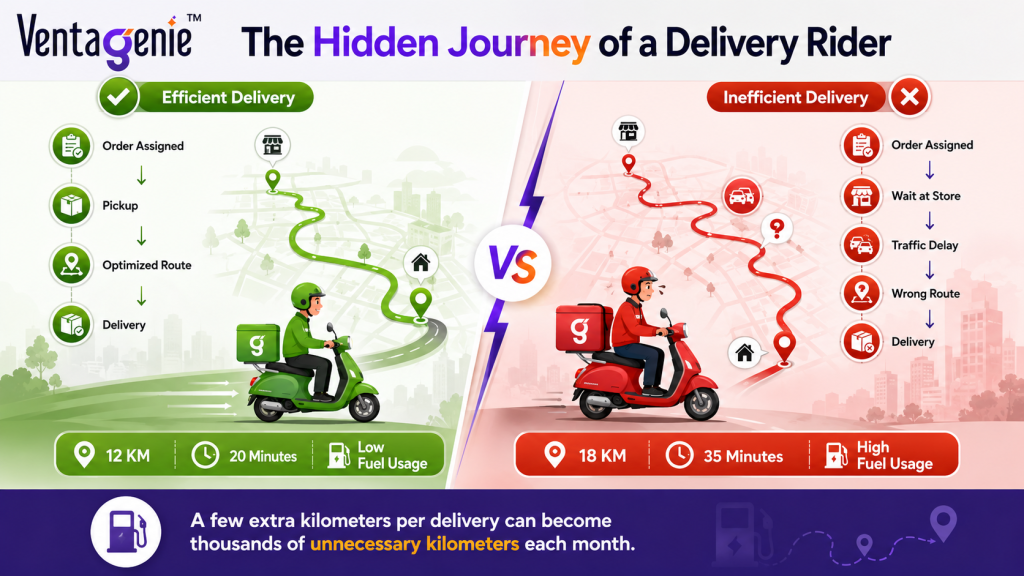
Most delivery businesses don’t have a fuel problem.
They have an efficiency problem.
Let’s look at some of the most common hidden fuel leaks.
1. Unnecessary Route Overlaps
This happens more often than many businesses realize.
Two riders may be delivering to the same neighborhood within a short period.
Instead of consolidating deliveries, both riders travel separately, consuming additional fuel.
While this may seem insignificant for a single delivery, the cumulative impact across hundreds of deliveries each week can be substantial.
2. Excessive Idle Time
A rider arrives at a restaurant only to discover the order isn’t ready.
Five minutes pass.
Then ten.
The engine remains running.
The rider waits.
Fuel continues to be consumed.
Now multiply this scenario across dozens of riders every day.
Suddenly, idle time becomes a meaningful contributor to fuel expenses.
3. Poor Delivery Sequencing
Imagine a rider completing deliveries in a random order rather than following the most efficient sequence.
The rider may end up crossing the same streets multiple times, increasing both travel distance and fuel usage.
Better sequencing creates smoother routes and lower operational costs.
4. Empty Kilometers
Every kilometer traveled without an active delivery is a cost.
A rider who travels several kilometers to reach the next pickup location consumes fuel without generating revenue.
Many businesses underestimate how frequently this occurs.
Reducing empty kilometers can significantly improve fuel efficiency.
Why Traditional Dispatching No Longer Works ?
Many growing delivery businesses begin with manual dispatching methods.
Orders are assigned through phone calls, spreadsheets, messaging apps, or simple dispatch systems.
This approach may work when handling a small number of deliveries.
However, as order volumes increase, inefficiencies become more visible.
Manual dispatching often results in :
- Delayed rider assignments
- Route duplication
- Uneven workload distribution
- Increased travel distance
- Reduced rider productivity
The challenge is that humans can only process a limited amount of information at once.
Modern delivery environments involve hundreds of variables, including traffic conditions, rider locations, delivery priorities, customer expectations, and order volume fluctuations.
Managing all of this manually becomes increasingly difficult.
Route Optimization : One of the Most Effective Ways to Reduce Fuel Costs
When businesses think about reducing fuel expenses, route optimization is often one of the first strategies discussed.
However, many people misunderstand what route optimization actually means.
It isn’t simply about finding the shortest route.
The shortest route isn’t always the most efficient route.
A route that appears shorter on a map may involve :
- Heavy traffic
- Frequent stops
- Road construction
- Congestion during peak hours
In contrast, a slightly longer route may allow a rider to maintain a more consistent speed and avoid delays.
Effective route optimization considers :
- Traffic conditions
- Delivery windows
- Rider locations
- Road restrictions
- Order priorities
- Delivery clusters
The result is lower fuel consumption and improved delivery performance.
The Power of Delivery Clustering
One strategy that many successful delivery businesses use is delivery clustering.
Instead of treating every order independently, businesses group nearby deliveries together.
Let’s consider a grocery delivery example.
Five customers place orders within the same neighborhood.
Without proper planning, five separate trips may be made.
With delivery clustering, those orders can be grouped into a more efficient route.
This reduces :
- Total travel distance
- Fuel consumption
- Delivery costs
- Rider workload
At the same time, businesses can often complete more deliveries with fewer resources.
Smart Order Assignment Makes a Bigger Difference Than Most People Think
Many businesses assume assigning the nearest rider will always produce the best outcome.
In reality, delivery operations are far more complex.
A rider who is technically closer may already be heading in the opposite direction.
Another rider may have a route that naturally aligns with the new order.
Smart order assignment considers multiple factors simultaneously.
These include :
- Rider availability
- Current route
- Distance
- Traffic conditions
- Delivery deadlines
- Order density
When businesses make smarter assignment decisions, fuel savings often follow naturally.
Rider Behavior Also Impacts Fuel Consumption
Technology plays an important role in reducing fuel costs, but human behavior matters too.
Driving habits can significantly affect fuel efficiency.
Common fuel-wasting behaviors include :
- Harsh acceleration
- Sudden braking
- Excessive speeding
- Aggressive driving
- Long periods of idling
Many businesses focus exclusively on route planning while overlooking rider performance.
Even small improvements in driving habits can produce noticeable fuel savings over time.
The goal is not to pressure riders but to provide visibility and encourage more efficient driving practices.
Last-Mile Delivery : Where Fuel Costs Add Up Quickly?
For food delivery, grocery delivery, and hyperlocal services, the last mile represents one of the most expensive stages of the delivery process.
This is because last-mile deliveries involve :
- Frequent stops
- Traffic congestion
- Narrow delivery windows
- Urban navigation challenges
- Customer communication
Every additional minute spent during the last mile increases operational costs.
Businesses that improve last-mile efficiency often achieve significant fuel savings without changing the number of deliveries completed.
This is why many delivery companies are investing heavily in technologies designed specifically for last-mile optimization.
Real-Time Visibility Changes Everything
One of the biggest challenges in delivery management is operating without visibility.
If managers cannot see what is happening in real time, they are forced to make decisions based on assumptions.
Real-time visibility provides insights into :
- Rider locations
- Delivery progress
- Delays
- Route deviations
- Order status
This information enables faster decision-making and helps businesses respond proactively to operational challenges.
Instead of discovering problems after they occur, businesses can address them while deliveries are still in progress.
Fuel Efficiency Is No Longer Just About Saving Money
Many businesses view fuel efficiency as a cost-reduction strategy.
While that is certainly true, the benefits extend much further.
Fuel-efficient operations often result in :
- Faster deliveries
- Better rider utilization
- Improved customer satisfaction
- Lower operational stress
- Greater scalability
- Increased profitability
In other words, reducing fuel consumption often improves overall business performance.
This is why many successful delivery companies view efficiency as a growth strategy rather than simply a budgeting exercise.
How Technology Is Reshaping Delivery Operations ?
The delivery industry is evolving rapidly.
Businesses are moving away from reactive decision-making and adopting smarter operational models.
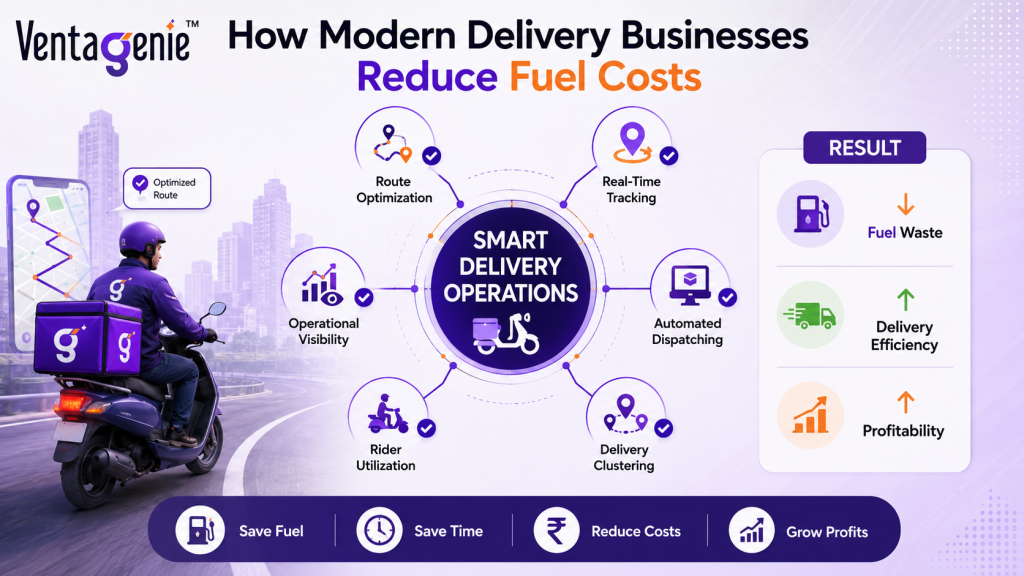
Modern delivery management solutions can help businesses :
- Optimize routes automatically
- Assign orders intelligently
- Track riders in real time
- Monitor delivery performance
- Improve delivery visibility
- Reduce unnecessary travel
These capabilities allow businesses to identify inefficiencies that would otherwise remain hidden.
As fuel costs continue to fluctuate, technology provides a practical way to improve operational resilience.
What Forward-Thinking Delivery Businesses Are Doing Differently ?
The most successful delivery businesses are not waiting for fuel prices to stabilize.
They understand that fuel volatility is likely to remain part of the business landscape.
Instead of focusing solely on external factors, they focus on improving what they can control.
They ask questions such as :
- Are our riders taking the most efficient routes ?
- Are deliveries being assigned intelligently ?
- Are we minimizing empty kilometers ?
- Do we have visibility into operational performance ?
- Are we using data to improve decision-making ?
These businesses recognize that long-term success depends on operational efficiency.
How Vantagenie Helps Businesses Improve Delivery Efficiency ?
Managing fuel costs starts with understanding delivery operations at a deeper level.
For food delivery services, grocery delivery businesses, pickup-and-drop companies, and on-demand delivery platforms, visibility and efficiency are essential.
Vantagenie helps businesses streamline delivery operations through features such as :
- Real-time rider tracking
- Smart order management
- Automated dispatching
- Route optimization
- Performance monitoring
- Operational visibility
By helping businesses reduce unnecessary travel and improve delivery coordination, Vantagenie supports more efficient and cost-effective delivery operations.
Final Thoughts
Fuel prices may rise and fall. Markets may fluctuate. Global events may continue to create uncertainty.
These factors are largely outside the control of delivery businesses.
What remains within their control is how efficiently they operate.
Every unnecessary kilometer, every delayed assignment, every overlapping route, and every minute of idle time represents an opportunity for improvement.
The delivery businesses that succeed in today’s environment are not simply those that spend less on fuel. They are the ones that use fuel more intelligently.
Reducing fuel costs is no longer about finding shortcuts. It is about building smarter delivery operations, making better decisions, and creating systems that support efficiency at every stage of the delivery journey.
In an increasingly competitive delivery market, that approach may prove far more valuable than any temporary drop in fuel prices.
Fuel Costs Are Rising. Operational Efficiency Should Too.
Every unnecessary kilometer, delayed assignment, and inefficient route adds to your delivery costs. The good news is that modern delivery management technology can help businesses identify and eliminate these inefficiencies.
See how Vantagenie helps delivery businesses simplify operations, optimize routes, and improve delivery performance through one powerful platform.

Mr. Aniket D is a seasoned digital marketer with over 10 years of experience in market research, content strategy, and performance marketing.
He specializes in analyzing consumer behavior, identifying emerging market trends, and translating insights into actionable digital strategies.
His work focuses on blending research-driven content with SEO and lead generation to drive measurable business growth.
Known for his data-first mindset, Aniket helps brands make smarter, audience-focused decisions in competitive markets.