The Rules of Delivery Business Growth Have Changed
The delivery industry has always been built on solving everyday problems.
Whether it’s delivering a meal to a busy professional, groceries to a family, medicines to someone who can’t leave home, or parcels to customers expecting next-day service, the goal has always been simple: help people get what they need, when they need it.
While that goal hasn’t changed, the way delivery businesses achieve it certainly has.
Ten years ago, offering delivery itself was often enough to attract customers. Businesses focused primarily on expanding their coverage areas, increasing fleet capacity, and fulfilling orders as quickly as possible. Customer expectations were relatively straightforward, and many operations could still be managed using manual processes, spreadsheets, phone calls, and small dispatch teams.
Today’s environment looks very different.
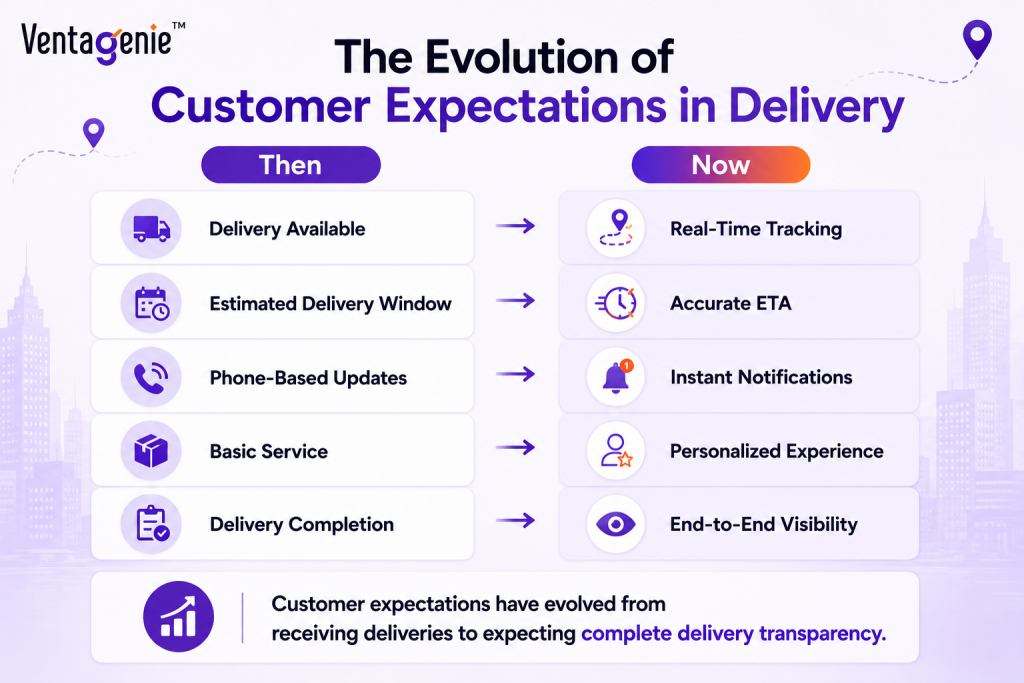
Customers have become accustomed to the convenience offered by companies like Uber, DoorDash, Careem, Zomato, Swiggy, Instacart, and Amazon. As a result, expectations have shifted far beyond simply receiving an order. Customers now expect real-time tracking, instant notifications, accurate delivery estimates, seamless communication, and a consistent experience every time they place an order.
At the same time, delivery businesses are managing significantly more complexity than ever before. Growing order volumes, rising operational costs, driver management challenges, route optimization requirements, customer service expectations, and expansion into multiple cities or regions have transformed the way modern delivery operations function.
From our experience, attracting customers is no longer the biggest challenge facing delivery businesses.
Managing growth is.
Many companies have strong demand, expanding customer bases, and ambitious growth plans. However, as delivery volumes increase, operational complexity grows just as quickly. Processes that worked perfectly at 100 deliveries per day often become difficult to manage at 10,000 deliveries per day. Visibility becomes harder. Coordination becomes more challenging. Customer expectations continue rising.
This is where many businesses discover that growth and scalability are not the same thing.
Growth is about creating demand.
Scaling is about building the operational foundation required to support that demand consistently.
The businesses growing fastest today are not simply investing in marketing, customer acquisition, or fleet expansion. They’re investing in smarter systems, automation, visibility, and technology that can support growth long before operational challenges begin slowing them down.
Because in today’s delivery economy, opportunities rarely disappear.
More often, growth slows when the infrastructure behind the business isn’t prepared for the success it creates.
From startups in India building the next Porter to logistics firms in the UAE inspired by Careem delivery models, companies everywhere are investing in digital logistics infrastructure.
Customers no longer compare your courier service to local competitors.
They compare you to the delivery experience offered by Amazon, Uber, FedEx, and DHL.
And those expectations are only getting higher.
Key Takeaways
- The delivery businesses growing fastest today are not necessarily the ones with the largest fleets—they're the ones building the strongest operational foundation.
- Customer expectations have evolved beyond delivery itself. Customers now expect real-time visibility, convenience, transparency, and reliability with every order.
- Growth and scalability are not the same. Acquiring customers creates opportunity, but sustainable growth requires systems capable of supporting increasing operational complexity.
- As delivery volumes increase, challenges such as route inefficiencies, rising fuel costs, manual dispatching, and limited operational visibility can directly impact profitability.
- Successful companies invest in operational readiness before bottlenecks begin affecting performance, customer experience, and expansion plans.
- AI-powered delivery software, smart logistics software, delivery automation systems, and fleet management solutions are becoming essential tools for modern delivery operations.
- Businesses that consistently solve customer problems, build trust, and deliver reliable experiences are more likely to achieve long-term growth than those focused solely on expansion.
- The future of delivery belongs to companies that combine customer-centric thinking with scalable technology and operational excellence.
Quick Insight
Businesses that cannot provide faster delivery experiences risk losing customers to competitors offering instant fulfillment.
Why Are Some Delivery Businesses Scaling Rapidly While Others Seem Stuck?
Over the years, we’ve had countless conversations with founders, operations managers, and logistics leaders who all share remarkably similar goals. They want to expand into new cities, increase daily delivery volumes, improve customer retention, and build businesses that can compete in an increasingly demanding market. On paper, many of these companies appear to have everything needed for success. They serve similar customers, operate in comparable markets, offer similar services, and often face the same competitive landscape.
Yet their growth stories often look very different.
Some businesses seem to gain momentum year after year. They expand into new regions, onboard more customers, and handle increasing delivery volumes without major disruptions. Others experience strong initial growth but eventually reach a point where progress starts slowing down. Despite having demand, customers, and market opportunities, scaling becomes far more difficult than expected.
What’s interesting is that the difference is rarely a lack of ambition. Most delivery founders are highly motivated and growth-focused. The difference is often found behind the scenes, in the systems, processes, and technology supporting the business.
In the early stages of growth, many operational challenges remain hidden. Dispatch teams can manually assign orders. Route planning is relatively straightforward. Customer inquiries remain manageable. Managers have clear visibility into daily operations because delivery volumes are still within a comfortable range. Even if certain processes aren’t perfect, teams can often compensate through extra effort and close coordination.
Success has a way of changing that.
As order volumes increase and delivery networks expand, the business begins generating more activity, more customer interactions, more delivery exceptions, and more operational decisions. What once felt manageable starts requiring significantly greater coordination across teams. Dispatchers must handle more assignments, managers need deeper visibility into performance, and customer support teams face growing expectations for faster responses and real-time updates.
This is often the stage where many businesses begin exploring solutions such as delivery management software, last-mile delivery software, and route optimization software. Not because they suddenly need more customers, but because they need better ways to manage increasing operational complexity.
This is where an important distinction emerges.
Generating growth and sustaining growth are two very different challenges.
Growth creates opportunity. Scaling requires the infrastructure to support that opportunity consistently.
The businesses that continue expanding successfully are often the ones that invest in a scalable delivery platform before operational bottlenecks begin affecting performance. They recognize that every new customer, every additional delivery zone, and every increase in order volume adds another layer of complexity that cannot be managed efficiently through manual processes alone.
Increasingly, high-growth companies are turning to AI-powered delivery software, smart logistics software, and delivery automation systems to streamline dispatching, improve route planning, automate workflows, and gain real-time operational visibility. At the same time, a robust fleet management solution helps them monitor drivers, vehicles, and delivery performance more effectively as operations expand.
In many cases, the companies that scale fastest are not necessarily the ones with the biggest fleets or the largest budgets. They’re the ones that build the right operational foundation early, supported by technology that can grow alongside the business.
Because sustainable growth isn’t just about acquiring more customers.
It’s about ensuring your operations are ready when those customers arrive.
The Part of Growth Nobody Talks About Until It Starts Affecting Profitability
Most founders spend a significant amount of time thinking about customer acquisition, market expansion, and revenue growth. That’s understandable. After all, every delivery business needs a steady flow of customers to grow. What often receives far less attention is what happens when those growth efforts start working.
Growth has a way of exposing operational weaknesses that may have gone unnoticed during the early stages of a business. Processes that seemed efficient when managing a few hundred deliveries can become increasingly difficult to sustain as order volumes multiply. A delivery route that once looked cost-effective may start creating unnecessary expenses. A dispatching process that worked perfectly for a small team may struggle to keep pace with a larger fleet. Customer support teams that previously handled inquiries comfortably can suddenly find themselves overwhelmed by growing expectations for real-time updates and faster resolutions.
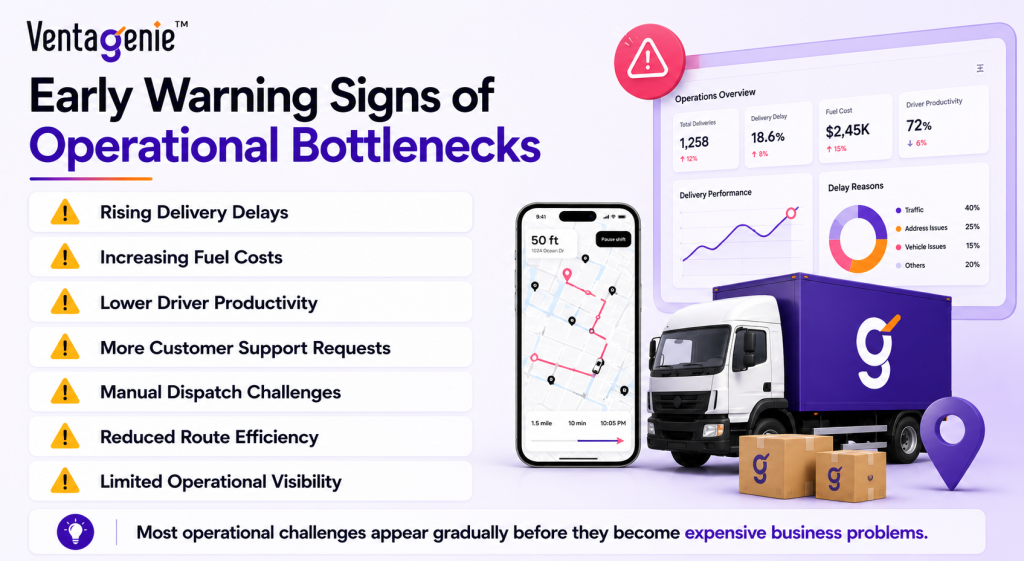
What’s particularly challenging is that these issues rarely appear all at once. They tend to emerge gradually, often disguised as everyday operational problems.
Common Signs That Growth Is Beginning to Create Operational Strain
- Delivery delays are becoming more frequent
- Driver productivity is becoming difficult to track
- Fuel costs are increasing faster than order volumes
- Customer inquiries about delivery status are rising
- Dispatch teams are spending more time coordinating deliveries manually
- Managers are focusing on operational issues instead of business growth
- Expansion into new delivery zones feels increasingly difficult
Many businesses initially treat these challenges as isolated incidents. In reality, they’re often indicators of something much larger. The business has reached a stage where manual processes and disconnected systems are no longer capable of supporting growth efficiently. What worked at one level of scale may no longer be effective at the next.
One logistics founder described it perfectly during a conversation with our team:
“The problem wasn’t that we were getting too many orders. The problem was that our operations were still designed for the business we were six months earlier.”
That’s a challenge many growing delivery companies can relate to.
As delivery networks become more complex, businesses are recognizing the importance of having technology that can automate routine tasks, improve operational visibility, and support faster decision-making.
A modern fleet management solution or scalable delivery platform doesn’t simply help businesses operate more efficiently. It helps them maintain service quality, customer satisfaction, and profitability while managing increasing delivery volumes.
The businesses that scale successfully are rarely the ones that wait for operational challenges to become serious problems. More often, they’re the companies that recognize these warning signs early and invest in the systems needed to support the next stage of growth.
Because sustainable growth isn’t just about handling more deliveries.
It’s about handling more complexity without sacrificing efficiency, customer experience, or profitability.
Customer Expectations Have Changed More in the Last Five Years Than in the Previous Twenty
A decade ago, simply offering delivery created a competitive advantage.
Today, delivery itself is expected.
Customers assume you can deliver.
What they care about now is how well you deliver.
- Can they track their order in real time?
- Can they trust the estimated delivery time?
- Will they receive proactive updates if something changes?
- Will the experience feel effortless?
These expectations weren’t created by a single industry.
They were created by companies like Uber, Amazon, DoorDash, Careem, Swiggy, and Zomato. Every time a customer receives a seamless delivery experience from one platform, their expectations increase for every other platform they use.
This means a pharmacy delivery company is no longer competing only with other pharmacy delivery businesses.
A grocery delivery platform is no longer competing only with grocery delivery providers.
Customers compare every delivery experience against the best delivery experience they’ve ever had.
That shift has fundamentally changed the competitive landscape.
Today, customer loyalty is built through consistency. Businesses that can reliably provide transparency, speed, convenience, and communication often create stronger customer relationships than competitors focused solely on expanding delivery capacity.
What Are High-Growth Delivery Businesses Doing Differently?
One pattern consistently appears among businesses that continue scaling year after year.
They prepare for growth before they desperately need to.
Instead of waiting for operational challenges to emerge, they proactively strengthen the infrastructure supporting the business.
- They invest in route optimization before fuel costs become problematic.
- They improve visibility before managers begin struggling to track performance.
- They implement automation before administrative work starts slowing operations.
- They adopt scalable delivery platforms before entering new markets.
This approach often appears unnecessary during periods of moderate growth. However, the companies that scale most successfully understand that operational bottlenecks become significantly more expensive to fix once growth has already exposed them.
In many ways, scaling is less about reacting to challenges and more about anticipating them.
The fastest-growing delivery businesses aren’t necessarily making better decisions because they’re larger.
They’re larger because they built systems that allowed them to make better decisions consistently.
So What Does It Actually Take to Scale a Delivery Business 10X?
There isn’t a single answer.
Every delivery business operates differently. Food delivery platforms face different challenges than courier companies. Pharmacy delivery services operate differently from transportation businesses. Grocery delivery startups have different operational requirements than large logistics providers.
Yet despite these differences, most successful delivery businesses eventually build around the same foundation.
- They prioritize visibility.
- They prioritize automation.
- They prioritize customer experience.
And increasingly, they prioritize intelligent decision-making powered by technology.
The businesses growing fastest today understand that every operational decision has a direct impact on customer trust. A delayed delivery isn’t simply an operational issue. It’s a customer experience issue. An inefficient route isn’t simply a logistics problem. It’s a profitability problem. Poor visibility isn’t merely a management challenge. It’s a growth challenge.
This is why scalable delivery platforms, fleet management solutions, delivery automation systems, and AI-powered delivery software are becoming central to growth strategies rather than just operational tools.
They’re helping businesses create the foundation necessary to support future expansion without sacrificing efficiency or customer satisfaction.
How Ventagenie Helps Delivery Businesses Scale 10X Faster
As delivery businesses grow, managing operations becomes far more complex than simply handling more orders. Increasing delivery volumes, expanding service areas, rising customer expectations, and growing fleets can quickly create operational bottlenecks that slow growth.
This is where Ventagenie helps.
Built for delivery startups, logistics companies, courier services, transportation businesses, and last-mile delivery providers,
Whether it’s automating dispatching, optimizing delivery routes, improving real-time tracking, or providing complete fleet visibility, Ventagenie helps businesses reduce manual effort and make smarter operational decisions.
How Ventagenie Supports Growth
- Automates delivery and dispatch workflows
- Optimizes routes to improve efficiency
- Provides real-time tracking and visibility
- Simplifies fleet and driver management
- Supports multi-city and multi-location expansion
- Enhances customer experience and transparency
At its core, Ventagenie is a scalable delivery platform designed to help businesses grow without letting operational complexity get in the way. Because sustainable growth isn’t about working harder—it’s about building systems that make growth easier.
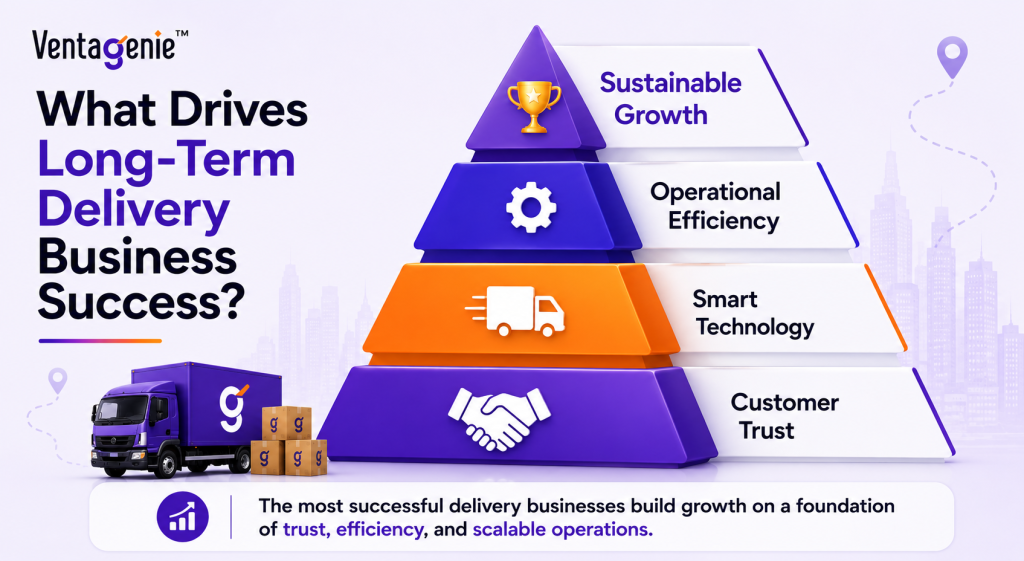
The Future Belongs to Delivery Businesses Built Around Customer Trust
The delivery industry has never been short on opportunity. Across food delivery, grocery delivery, pharmacy delivery, courier services, transportation, and last-mile logistics, customer demand continues to grow. Yet demand alone is no longer enough to guarantee success.
What separates high-growth delivery businesses from the rest isn’t simply their ability to attract customers. It’s their ability to consistently deliver on the promises they make.
If there’s one lesson businesses can learn from companies like Uber, Careem, DoorDash, Swiggy, Zomato, and other industry leaders, it’s that long-term growth rarely comes from technology alone. It comes from understanding customer problems deeply enough to solve them consistently. Technology simply makes that possible at scale.
Customers don’t think about route optimization, fleet visibility, dispatch automation, or logistics infrastructure when they place an order. They think about whether their food will arrive on time, whether their groceries will be delivered as expected, or whether their package will reach its destination without delays.
Behind every successful delivery business is an operation capable of delivering that trust every single day.
As customer expectations continue rising and delivery networks become more complex, the businesses that thrive will be the ones that invest not only in growth but also in the operational foundation required to support it. They’ll build systems that create visibility, improve efficiency, and remove friction from both the customer experience and internal operations.
Because ultimately, customers don’t remain loyal to delivery companies because they have the largest fleets or the most advanced technology.
They remain loyal because those businesses consistently make life easier.
And the companies that can do that reliably, efficiently, and at scale will be the ones shaping the future of delivery.
Frequently Asked Questions
The biggest difference is often operational readiness. While many businesses focus on acquiring more customers, high-growth delivery companies invest in scalable processes, automation, and technology that can handle increasing order volumes without creating operational bottlenecks.
As delivery volumes increase, businesses often struggle with route inefficiencies, dispatch management, fleet visibility, rising operational costs, and customer service demands. Without the right systems in place, growth can create complexity that affects profitability and customer satisfaction.
AI-powered delivery software helps automate repetitive tasks such as dispatching, route planning, delivery tracking, and operational monitoring. This allows businesses to improve efficiency, reduce manual effort, and make faster data-driven decisions as they grow.
A scalable delivery platform is designed to support increasing delivery volumes, larger fleets, multiple delivery zones, and business expansion without requiring significant operational restructuring. It helps businesses grow while maintaining performance and customer experience.
Delivery automation reduces manual intervention across dispatching, order management, notifications, tracking, and reporting. This improves operational efficiency, minimizes errors, and allows teams to focus on strategic growth rather than routine administrative tasks.
Smart logistics software helps businesses optimize routes, improve delivery planning, reduce fuel consumption, increase driver productivity, and gain real-time visibility into operations. These improvements contribute directly to better customer experiences and lower operational costs.
A fleet management solution provides real-time visibility into vehicles, drivers, delivery status, route performance, and operational metrics. It helps businesses monitor fleet activity, improve utilization, and maintain efficient delivery operations at scale.
Businesses should consider delivery management software before operational challenges begin affecting customer experience and profitability. Investing early allows companies to build a strong foundation for future growth and expansion.
Yes. Modern delivery management platforms can support food delivery, grocery delivery, pharmacy delivery, courier services, parcel delivery, transportation companies, retail logistics, and last-mile delivery businesses through customizable workflows and operational tools.
Ventagenie provides an AI-powered delivery software platform that combines delivery automation, smart logistics capabilities, route optimization, real-time tracking, and fleet management tools. It helps delivery businesses streamline operations, improve efficiency, and support sustainable growth as delivery volumes increase.
Successful delivery businesses scale by combining strong customer experience with efficient operations. Technologies such as AI-powered delivery software, delivery automation systems, smart logistics software, and fleet management solutions help businesses manage growth, improve efficiency, and maintain service quality as delivery volumes increase.

Mr. Aniket D is a seasoned digital marketer with over 10 years of experience in market research, content strategy, and performance marketing.
He specializes in analyzing consumer behavior, identifying emerging market trends, and translating insights into actionable digital strategies.
His work focuses on blending research-driven content with SEO and lead generation to drive measurable business growth.
Known for his data-first mindset, Aniket helps brands make smarter, audience-focused decisions in competitive markets.