How to Start a Meat Delivery Business in 2026: A Simple, Honest Guide
If you’ve read a few guides on starting a meat delivery business and still feel confused, you’re not alone. Most articles treat this like any other delivery business — pick a name, build an app, run some ads, done. But meat is different from pizza or groceries, and treating it the same way is one reason many meat delivery businesses struggle early on.
This guide explains things in plain language — the way a friend who understands this business would explain it to you over coffee. No jargon, no fluff, and examples from around the world, not just one market.
Why Do You Want to Start This Business?
Before you think about apps or licenses, ask yourself one honest question: what makes you different?
Maybe you already run a butcher shop and customers keep asking if you deliver. Maybe you know a farm with great quality meat that nobody else works with. Maybe you’ve done delivery before, just not for meat yet.
Whatever it is, that’s your starting point. Just knowing that “meat delivery is growing” isn’t enough — everyone can see that. What matters is why customers should trust you instead of someone else. And trust is everything in this business, because people are buying something they can’t see, touch, or smell before it arrives.
Is This Business Worth Starting in 2026?
Yes — if you do it the right way. Here’s the thing about meat: people are more careful about it than almost anything else they buy online. If a delivery arrives late, or the packaging feels warm, or the meat doesn’t look right, most customers won’t order from you again. They won’t give you a second chance the way they might with a bag of vegetables.
That might sound scary, but it’s actually good news. It means you don’t need to be the biggest or the flashiest company to win. You just need to never get the basics wrong. Do the simple things right, every single time, and customers will keep coming back.
You can see this pattern all over the world, not just in one country:
In India
TenderCuts built its name on getting the basics right. Their biggest strength isn’t low prices or flashy ads — 85% of their customers order again every month, and their revenue grew 40% in one year. That tells you people who trust you once will keep coming back.
In the United States
ButcherBox grew into a household name almost entirely through the subscription model — customers get curated boxes of meat delivered monthly, with no need to think about ordering each time. Their strategy focused heavily on transparency about sourcing (grass-fed, humanely raised) as the main reason customers trust and stay with them.
Also in the US
Crowd Cow took a different angle — connecting customers directly to specific small farms and ranchers, letting people know exactly which farm their meat came from. This “know your farmer” positioning built a loyal, premium customer base willing to pay more for that transparency.
In the United Kingdom
Farmison & Co built its business around native, rare-breed meats and next-day delivery, positioning itself as the online alternative to a proper traditional butcher rather than a supermarket replacement.
In Germany and parts of Europe
several regional meat delivery services have grown by combining local butcher partnerships with app-based ordering — similar to a marketplace model, letting small local butchers reach far more customers than their physical shop ever could.
The common thread across every single one of these, in every country: they didn’t win by being the cheapest. They won by being the most trustworthy in a category where trust is hard to earn and easy to lose.
Choose the Type of Meat Delivery Business You Want to Build
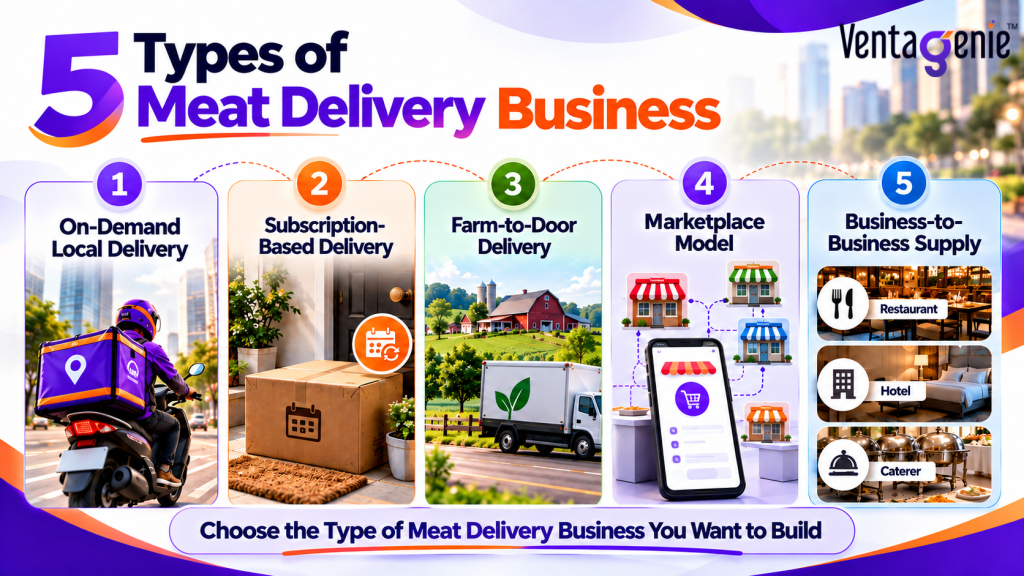
Before you build anything, decide what kind of business this actually is. Trying to be everything at once is one of the fastest ways to burn out early. Here are the main types, and how they usually work:
1. On-demand local delivery:
You deliver fresh cuts within an hour or two, similar to how quick grocery apps work. This is the easiest model for customers to understand and try, but it needs strong local operations from day one, since people expect both speed and freshness together.
2. Subscription-based delivery:
Customers sign up for a weekly or monthly box instead of ordering each time. This is how brands like ButcherBox grew into major businesses — it turns a one-time buyer into a repeat customer automatically, and gives you predictable income you can actually plan around.
3. Farm-to-door delivery
You work directly with a small number of trusted farms and sell that story of quality and transparency, similar to Crowd Cow. This model can charge more, but it usually grows more slowly since your supply is tied to specific farm relationships.
4. Marketplace model
You bring multiple local butchers or sellers onto one platform instead of selling your own meat. Customers order through your app, and each seller fulfills their own orders. You earn through commission or delivery fees. This lets you grow into new areas faster since you’re not holding your own inventory.
5. Business-to-business supply
You deliver to restaurants, hotels, or caterers instead of individual households. This means fewer, bigger orders and steadier income, but usually requires more relationship-building and patience before contracts close.
Most successful businesses pick one of these as their main focus and only add a second one later, once the first is working smoothly. Trying to launch all five at once usually means none of them get done well.
Get These Basics Right Before You Even Think About an App
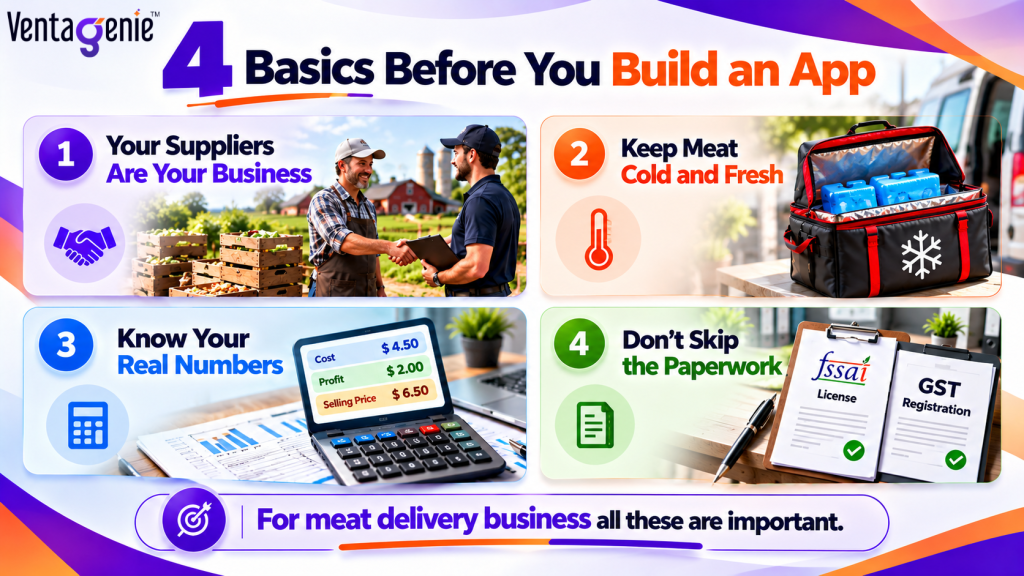
Everyone wants to jump straight to building an app. Slow down. The businesses that struggle the most almost always skipped these steps first.
1. Your Suppliers Are Your Business
This is the single most important part. If you can’t give customers the same good quality every time, nothing else will save you. Talk to a few different suppliers before choosing one. Ask simple but important questions: How do they keep meat fresh? What do they do if something goes wrong with a batch? This step feels boring, but it decides whether your business survives.
2. Keeping Meat Cold and Fresh Is Not Optional
Every step — from the supplier, to storage, to packing, to the delivery rider’s bag — needs to keep the meat at a safe temperature. This isn’t just a rule to follow; it’s what keeps customers coming back. The FDA and USDA both stress this: quick delivery, good packaging, and correct temperatures at every stage. One delivery that arrives warm can lose you a customer forever — and this holds true whether you’re operating in Mumbai, Manchester, or Minnesota.
3. Know Your Real Numbers Before You Grow
It’s easy to get excited about how many orders you’re getting. But more orders don’t always mean more profit. Add up everything it actually costs you — the meat itself, packaging, delivery, wasted product, and fees — and compare that to what you charge. For example: if your true cost per order is around $13 and you sell it for $15, you’re only making about $2 per order. A business doing 50 orders a day profitably is in a much better position than one doing 500 orders a day and losing money on each one.
4. Don't Skip the Paperwork
Getting the right licenses feels like a boring formality, but it protects both you and your customers. In India, this usually means an FSSAI license and GST registration. In the US, the rules depend on your state and whether you process the meat yourself. In the UK and EU, food businesses generally need to register with local authorities and follow HACCP-based food safety procedures. Wherever you are, check what applies to you before you launch — not after.
What Should Your App Actually Do?
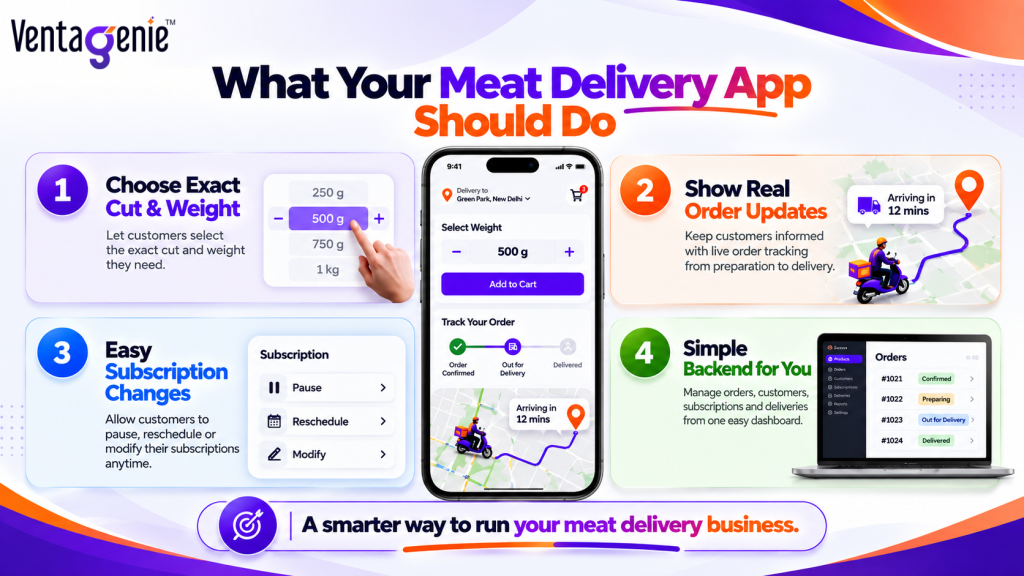
Think of your app as a digital version of a good butcher. A good butcher lets you pick exactly what you want, tells you honestly what’s fresh, and makes you feel confident about what you’re buying. Your app needs to do the same thing.
Here’s what actually matters:
Let customers choose exactly what they want:
People want to pick the weight and type of cut, just like they would at a counter — not choose from a few fixed options that don’t match what they actually need.
Show customers what's really happening with their order:
A simple “your order is on the way” isn’t enough. People feel more confident when they can see real updates about their delivery.
Make subscriptions easy to change:
If someone wants to skip a week, change what’s in their box, or pause for a while, they should be able to do it in a few taps — not by calling someone.
Keep the backend simple for you to manage:
You should be able to see orders, update prices, and manage deliveries without needing to call a developer every time something small changes.
Many new business owners either use a generic delivery app that wasn’t made for meat, or they try to build something too complicated to actually run. The businesses that do well build their app around how they actually work — not the other way around.
Don't Build Everything at Once — Go Phase by Phase
This is one of the biggest mistakes new business owners make: trying to launch with every feature, every product, and every delivery area all at the same time. It feels productive, but it usually just creates more things that can go wrong at once. A smarter approach looks like this:
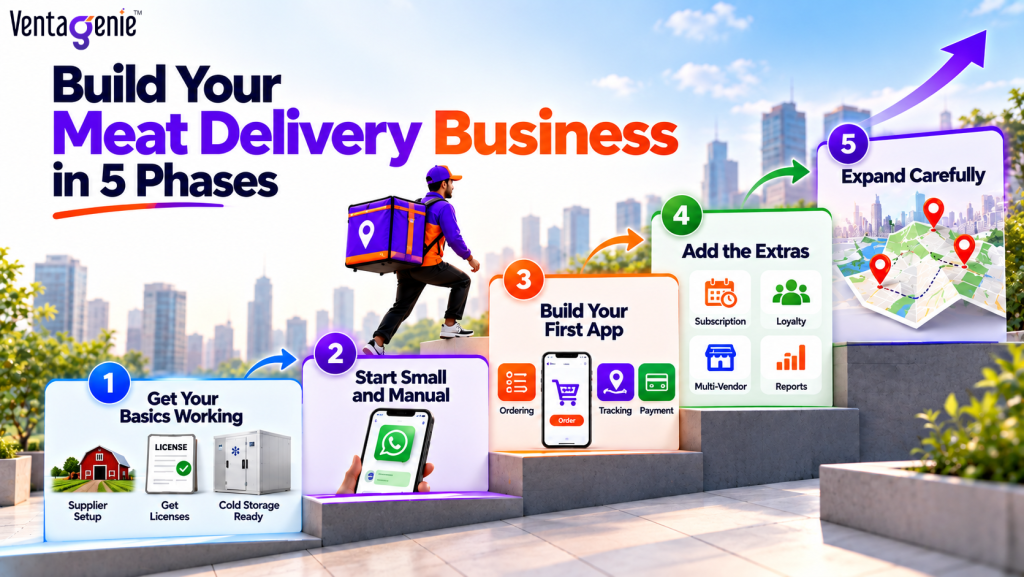
Phase 1 — Get your basics working.
Confirm your suppliers, sort out your licenses, and set up simple cold storage. Don’t touch technology yet.
Phase 2 — Start small and manual.
Take orders through WhatsApp, a phone number, or a simple website in one small area. This lets you learn what customers actually want before you spend money building an app around guesses.
Phase 3 — Build your first proper app.
Once you know your product range, pricing, and delivery process actually work, build an app with the essentials — ordering, tracking, and payments. Don’t add every possible feature yet.
Phase 4 — Add the extras.
Subscriptions, loyalty programs, multiple vendors, advanced reporting — these come once your core business is stable and you actually know which of these your customers will use.
Phase 5 — Expand carefully.
Add new areas, new products, or new business models (like adding a subscription option to an on-demand business) only once your current operation runs smoothly without you having to fix problems every day.
Going step by step like this means every phase teaches you something before you spend more money on the next one. Businesses that skip ahead usually end up rebuilding things they built too early and too fast.
How Ventagenie Helps You Bring This All Together
Once you know your business model and how you’ll source and handle your meat, the next step is connecting everything — orders, delivery, and customer trust — into one simple system. That’s what Ventagenie is built for, and it’s also about more than just handing you software.
Ventagenie helps you build the right ecosystem. Instead of a single app that only handles customer orders, you get a connected system where everyone — your customers, your store or vendor team, your delivery riders, and you as the owner — all work from the same platform:
Customer orders through the app → the store or vendor prepares it → the admin keeps track of everything → a delivery partner picks it up and delivers it.
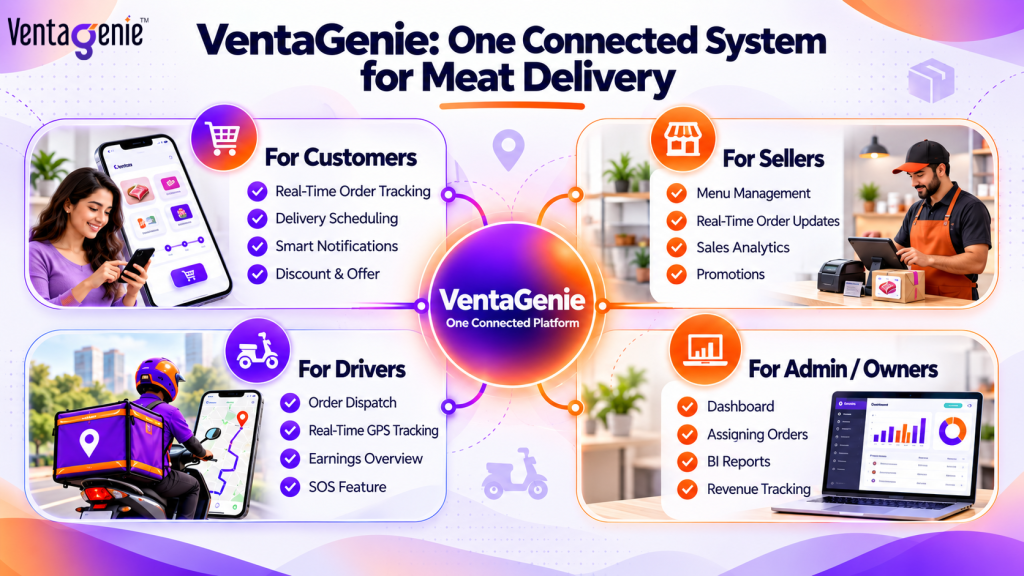
What this actually includes:
- Tracking your stock — so you always know what you have and nothing sits around too long
- Letting customers pick their own cut and weight — just like a real butcher counter
- Managing orders smoothly — from the moment someone orders to the moment it's delivered
- Organizing delivery areas — so drivers aren't wasting time driving all over the city
- Live order tracking — so customers always know where their order is
- Support for multiple stores or sellers — useful if you want more than one shop on your platform
- Easy discounts and offers — for subscriptions, referrals, or seasonal deals
- A simple view of your customers — so you know who's ordering, how often, and what they like
- Reports that actually make sense — so you can see what's working and what isn't
- Flexibility for different business types — whether you're doing quick local delivery, subscriptions, farm-to-door, or working with multiple vendors
Ventagenie also guides you on the right approach, not just the technology. Because so many meat delivery businesses fail by rushing — building too much too soon, or picking the wrong business model for their market — part of working with Ventagenie is talking through your specific situation first: which business model fits you, which phase you should actually start at, and what to build now versus what to leave for later. The goal isn’t to sell you the biggest possible app. It’s to help you build the right thing, in the right order, so your technology grows with your business instead of getting ahead of it.
Grow Slowly, On Purpose
The businesses that do best in meat delivery aren’t the ones that expand the fastest — they’re the ones that get really good in one small area first.
Start in one neighborhood or area you can manage well. Get to know your customers there. Figure out which products people actually want and which ones just sit around unsold. Make sure your deliveries are on time and predictable before you think about expanding.
A lot of new businesses try to cover an entire city too soon, and that’s usually when things start going wrong — deliveries get late, quality becomes inconsistent, and customers who had one bad experience don’t come back. Growing slowly here isn’t a weakness. It’s the smart way to build something that lasts, and it’s exactly what the successful examples above — in India, the US, and the UK — all have in common.
How Much Does It Cost to Start?
There’s no single number — it really depends on how you set things up and which country or city you’re in. You’ll need to budget for licenses, cold storage, packaging, your first batch of inventory, staff, delivery, marketing, and your app. A small local delivery business costs a lot less to start than a big multi-vendor platform. The smartest way to plan your budget is based on how many orders you realistically expect, not just how much the app costs to build.
Mistakes That Actually Hurt These Businesses
- Growing your delivery area faster than you can actually manage
- Competing only on cheap prices instead of trust and quality
- Ignoring wasted stock, which quietly eats away at your profit
- Treating delivery like an afterthought instead of a core part of your business
- Building an app only for customers and forgetting about your delivery team and store staff
- Trying to build every feature and cover every area on day one instead of growing phase by phase
- Making claims like "farm fresh" or "chemical-free" without being able to prove them
Ready to Start Your Meat Delivery Business?
Get your business basics right first — your suppliers, your cold storage, and how you’ll deliver — then build your technology around that, one phase at a time. Ventagenie helps meat and food businesses build the right ecosystem for their specific model, and guides you on the right way to approach it — not just handing you an app, but helping you figure out what to build now and what to save for later.
If you’d like to talk through what this could look like for your business, we’re happy to help.
Frequently Asked Questions
Yes, but only if you manage your costs carefully — sourcing, cold storage, delivery, and waste all add up fast. The businesses that make good money usually rely on repeat customers and subscriptions, not just one-time orders.
It depends on your setup and location. A small, local delivery business needs a lot less money to start than a large platform with many sellers. Base your budget on how many orders you expect, not just the cost of the app.
Yes, wherever you are. In India, that usually means an FSSAI license and GST registration. In the US, it depends on your state and whether you process the meat yourself. In the UK and EU, registration with local food authorities and HACCP-based procedures are generally required. Always check your local rules before you start.
It depends on your goals. Subscription gives you more predictable income and works well if you want steady growth, like ButcherBox. On-demand works well if convenience and speed are what your local customers want most. Many businesses start with one and add the other later.
At the least: the ability to choose exact cuts and weights, real delivery tracking, easy-to-manage subscriptions, and a simple way for you to manage everything from the back end. Regular delivery apps usually don’t have any of this.
In phases, always. Start manual and small, build your first simple app once you understand your customers, then add extra features like subscriptions or multi-vendor support once your core business is stable.

Mr. Aniket D is a seasoned digital marketer with over 10 years of experience in market research, content strategy, and performance marketing.
He specializes in analyzing consumer behavior, identifying emerging market trends, and translating insights into actionable digital strategies.
His work focuses on blending research-driven content with SEO and lead generation to drive measurable business growth.
Known for his data-first mindset, Aniket helps brands make smarter, audience-focused decisions in competitive markets.