How Much Does Swiggy & Zomato Commission Really Cost You- How Restaurants Stay Profitable? (And Build Their Own Delivery App)
Three numbers decide whether a restaurant survives its first year on Swiggy and Zomato: the commission rate on the invoice, the GST hiding on top of it, and the percentage of orders still coming from the aggregator by month twelve. Get the third number down, and the first two stop being a crisis and start being a line item. This piece is the maths behind that shift — and the exact playbook, including where a platform like Ventagenie fits, that restaurants are using to keep it.
Key Takeaways
- Swiggy and Zomato charge 15–30% base commission — add GST on commission and the flat platform fee, and the real cost lands closer to 25–35% per order
- A restaurant doing ₹4 lakh a month through aggregators alone hands over ₹1–1.4 lakh before rent, staff, or a single ingredient is paid for
- Shifting 25–30% of orders to a direct channel typically recovers ₹30,000–₹60,000 a month for a mid-size kitchen
- Restaurants that survive past 18 months rarely have one trick — they layer direct ordering, dual pricing, weekly food-cost checks, and a leaner menu, together
- This isn't only an India story — DoorDash, Uber Eats, Deliveroo, foodpanda, and Grab run the same commission model worldwide, at similar 15–30% rates
What Swiggy & Zomato Commission Actually Costs You, Order by Order ?
Take a restaurant in Koramangala, Bengaluru, running a ₹500 average order value at a 22% commission — a fairly typical mid-tier rate.
Line item | Amount |
Order value | ₹500.00 |
Base commission (22%) | −₹110.00 |
GST on commission (18% of ₹110) | −₹19.80 |
Platform fee (flat, per order) | −₹17.58 |
Packaging (restaurant-funded) | −₹18.00 |
Net received | ₹334.62 |
That’s before food cost. A dish running 30% food cost eats another ₹150, leaving roughly ₹185 to cover rent, wages, and electricity — with whatever’s left counting as profit. At 80–100 orders a day, this works. At 25–30 orders a day, a kitchen is quietly running at a loss and won’t see it until the month-end P&L lands.
Example : The Pune Cloud Kitchen That Cracked the Commission Problem
A cloud kitchen operator in Baner, Pune, opened in late 2025 running entirely on Swiggy and Zomato. By the second month’s payout, the commission line alone had eaten ₹96,000 out of ₹4 lakh in revenue. Instead of waiting it out, he started collecting customer phone numbers at checkout and pushing a WhatsApp reorder link with every delivery.
By month five, 24% of his orders were coming in direct — no commission, no platform fee, just a payment gateway charge of about 4%. That shift alone put back roughly ₹22,000 a month that would otherwise have gone to the aggregator. He didn’t discover a loophole. He just moved earlier than most kitchens do.
5 Proven Strategies to Protect Your Restaurant's Margin in 2026
1. Build Your Own Delivery App — Not Just a WhatsApp Number
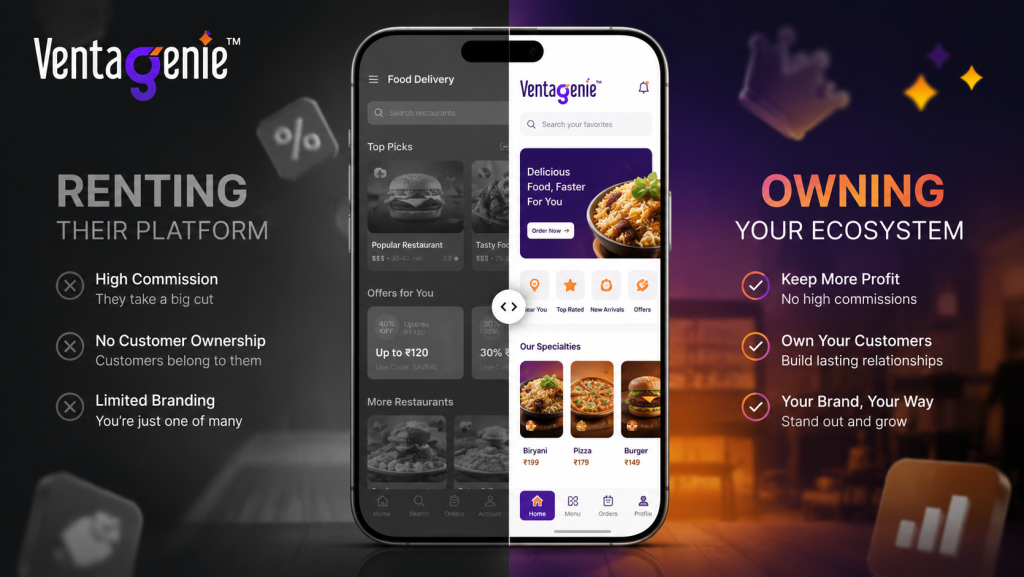
A phone number scribbled at checkout caps out fast. What actually holds repeat customers is a real ordering experience — saved addresses, one-tap reorder, live tracking — which is exactly the gap Ventagenie’s delivery app development platform is built to close. Restaurants get a branded app that feels like their own product, with customer data staying in-house instead of living inside someone else’s marketplace. Direct orders typically cost 4–6% all-in, against 22–28% on an aggregator order — an 18–22 point margin recovery on every order that shifts.
2. Run Smart Dual Pricing
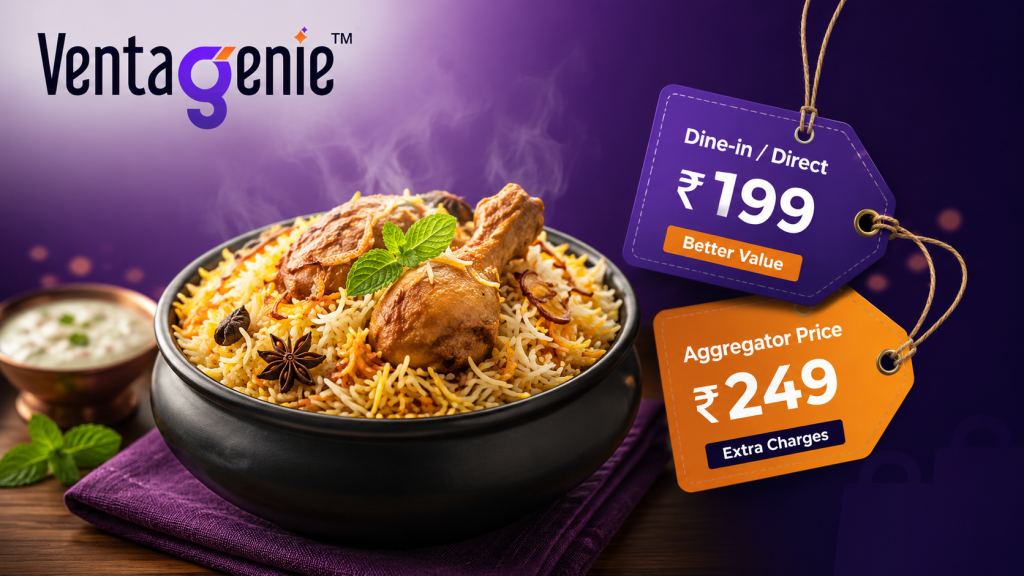
Profitable restaurants routinely price the delivery menu 12–18% above dine-in. It isn’t overcharging — it’s the built-in offset for a commission that’s coming regardless. Push the markup too high and the algorithm buries the listing; keep it too low and the restaurant is subsidizing the platform from its own margin. Most owners find the right number by watching order frequency for two to three weeks after any change.
3. Track Food Cost Weekly, Not Monthly
Ingredient prices move faster than most monthly reports catch. A restaurant that only checks food cost at month-end can run three or four weeks at an inflated cost percentage before anyone notices — by which point the damage is already ₹15,000–₹20,000 deep. Weekly checks catch the same spike at ₹4,000–₹6,000.
4. Prune Your Menu to Your Real Bestsellers
A 40-item menu where 25 items get fewer than two orders a week isn’t offering more choice — it’s tying up cash in ingredients that mostly expire unused. Pruning to top sellers routinely drops food cost 5–8 percentage points within a couple of months.
5. Negotiate Your Commission Rate Directly
Commission rates aren’t as fixed as they look. Restaurants doing 50+ orders a day with a strong average order value have real leverage — a call backed by order volume and rating data commonly shaves 2–4 percentage points off. Nobody calls proactively to ask, which is exactly why the rate stays high.
Real Numbers: A Sample Restaurant P&L, Channel by Channel
A mid-size restaurant doing ₹6 lakh a month, with 75% of revenue from aggregators and 25% from a direct channel :
Line item | Amount (₹) | % of revenue |
Total revenue | 6,00,000 | 100% |
Aggregator commission + fees (≈27% on ₹4.5L) | 1,21,500 | 20.3% |
Direct channel costs (5% on ₹1.5L) | 7,500 | 1.3% |
Food cost (30%) | 1,80,000 | 30% |
Rent | 45,000 | 7.5% |
Staff salaries | 70,000 | 11.7% |
Utilities | 20,000 | 3.3% |
Packaging | 28,000 | 4.7% |
Marketing | 12,000 | 2% |
Net profit | 1,16,000 | 19.3% |
Push the mix to 90% aggregator and net margin slides to around 16%. Push direct orders to 40% instead, and margin climbs past 22% — same revenue, same rent, same food cost. Only the channel changed.
Beyond India : How Delivery Commission Works Globally
The commission squeeze isn’t unique to Swiggy and Zomato — the same model runs on delivery platforms worldwide, and restaurants everywhere are fighting the same battle for margin.
Platform | Market | Typical commission |
Swiggy / Zomato | India | 15–30% |
DoorDash | United States | 15–30% |
Uber Eats | Global | 15–30% |
Deliveroo | UK / Europe | 20–30% |
foodpanda | Asia-Pacific | 15–25% |
Grab | Southeast Asia | 15–25% |
Restaurant owners from Austin to Manchester to Manila are running the same playbook: keep the aggregator for discovery, build a direct app to keep the repeat customer. It’s the reason platforms built for on-demand delivery app development, including Ventagenie, work the same way for a biryani kitchen in Pune as they do for a pizzeria in London or a bubble tea shop in Manila — the commission math is nearly identical everywhere, and so is the fix.
Should You Quit Aggregators Entirely ? A Month-by-Month Roadmap to Your Own App Ecosystem
Should You Quit Aggregators Entirely? A Month-by-Month Roadmap to Your Own App Ecosystem
Quitting would be a mistake for almost every restaurant, and it’s worth saying plainly. A new cloud kitchen in Madhapur, Hyderabad, or Aundh, Pune, has zero customer base on day one — the aggregator is what puts it in front of thousands of nearby diners immediately. Discovery is genuinely valuable. The problem isn’t the aggregator relationship itself. The problem is when that relationship quietly becomes 90% of revenue with no owned channel underneath it, and discovery turns into total dependency.
The restaurants that get this right don’t quit aggregators — they build their own app ecosystem alongside them, one quarter at a time.
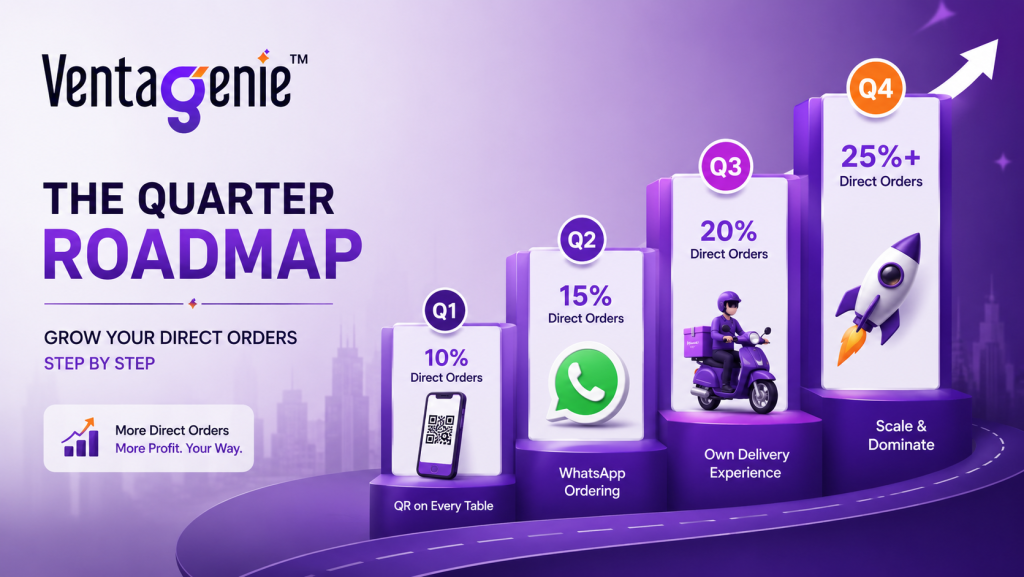
1ST QUARTER- 85–90%- AGGREGATOR DEPENDENCY :
This is normal, not a failure, for a brand-new kitchen. There’s no customer base to build a direct channel on yet, so the job isn’t to fight the aggregator — it’s to use it fully. Every order in this window is doing double duty: feeding the kitchen and building the star ratings and review volume that decide whether the restaurant even shows up in search results next month. The one habit that pays off later starts here too — capturing every customer’s phone number at the point of delivery, even by hand if there’s no system for it yet. This is also the quarter to start scoping a proper delivery app development solution like Ventagenie, so the direct channel is ready to launch the moment the kitchen has enough repeat customers to justify it — instead of starting that build from zero once the commission bill finally hurts enough to act.
2ND QUARTER- 25–30%- DIRECT ORDERS
By now the kitchen has a base of repeat customers, and this is the quarter that base gets activated. A QR code on every packaging bag, pointing straight to a WhatsApp number or an ordering link, turns “I liked this food” into “I can order this again without opening Swiggy.” A weekly WhatsApp broadcast — a new dish, a small discount, a simple “we’re open” reminder — keeps the kitchen top of mind between orders. None of this requires the customer to change their address book or download something new; it just requires the kitchen to make the direct route as easy as the aggregator route. The restaurants that hit 25–30% direct by this stage are almost always the ones that started collecting numbers in quarter one instead of waiting.
3RD QUARTER- 35–45%- DIRECT ORDERS
This is where the shift stops being an experiment and starts being the business model. A branded delivery app — not just a WhatsApp link — goes live for nearby areas, with saved addresses, one-tap reorder, and loyalty offers that only exist on the app itself. Some kitchens add a dedicated rider for their closest 3–4 km radius at this stage, since aggregator delivery fees rarely make sense once there’s enough direct volume to justify running it in-house. At 35–45% direct, blended commission across all revenue falls to roughly 12–15% — a number most kitchens can absorb comfortably while still clearing 20–25% net margin. This is the actual target: not zero aggregator dependency, just enough of an owned channel that the next platform fee hike is an annoyance instead of an emergency. The kitchen owns the customer relationship now, not the aggregator — and that’s the difference between renting a customer base and owning one.
The Bottom Line
The commission isn’t disappearing, in India or anywhere else it’s charged. The restaurants staying profitable in 2026 are the ones treating it like a cost to plan around — pricing for it, tracking food cost weekly, trimming the menu, and steadily building their own app ecosystem instead of staying dependent on someone else’s algorithm. That last piece is the one with the most durable payoff: every order that moves to a direct app stays off aggregator commission for good.
Figures and rates referenced above reflect general industry patterns as of 2026 and vary by city, restaurant category, platform, and individual agreements. Confirm current terms directly with each platform before making pricing decisions.
Ventagenie builds branded, on-demand delivery apps for restaurants and cloud kitchens — helping operators everywhere from India to the US, UK, and Southeast Asia turn aggregator customers into direct, repeat ones.
Fuel Costs Are Rising. Operational Efficiency Should Too.
Ready to stop renting your customers back from Swiggy and Zomato ? Ventagenie builds the branded delivery app that lets you own the relationship, not just the order.
Own your customers. Own your margin
Frequently Asked Questions
Base commission typically falls between 15% and 30%, depending on city tier, cuisine category, and negotiated terms. Add 18% GST on the commission itself plus a flat per-order platform fee, and the effective cost usually lands closer to 25–35%.
Yes. DoorDash, Uber Eats, Deliveroo, foodpanda, and Grab all run commission models in the same broad 15–30% range as Swiggy and Zomato, which is why direct-ordering strategies work almost identically across markets.
It depends on repeat order frequency. If a meaningful share of customers order more than once a month, a branded app pays for itself quickly — every order that moves off the aggregator saves 18–22 percentage points in commission, indefinitely.
Generally 28–32%. Past 35%, there’s very little margin left once commission, packaging, rent, and staff costs are subtracted.
Come to the account manager with hard numbers — daily order count, average order value, and current rating. Restaurants doing 50+ orders a day with a strong AOV routinely negotiate 2–4 percentage points off.
No. The quoted rate is before GST. An 18% GST charge applies on top of the commission amount itself — the most commonly overlooked cost when pricing a delivery menu.

Mr. Aniket D is a seasoned digital marketer with over 10 years of experience in market research, content strategy, and performance marketing.
He specializes in analyzing consumer behavior, identifying emerging market trends, and translating insights into actionable digital strategies.
His work focuses on blending research-driven content with SEO and lead generation to drive measurable business growth.
Known for his data-first mindset, Aniket helps brands make smarter, audience-focused decisions in competitive markets.