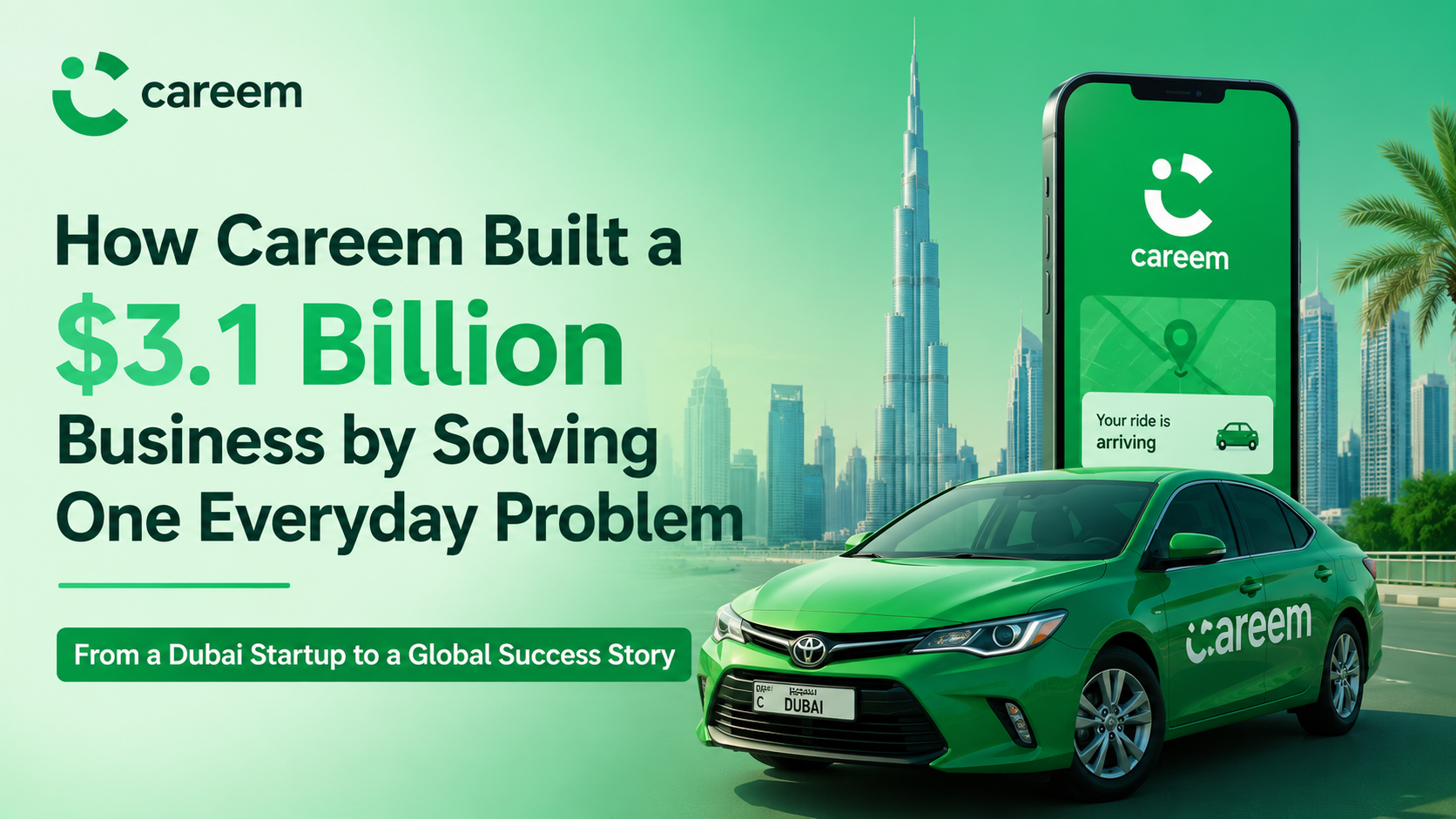
Careem Success Story : How a Ride-Hailing App Became a $3.1 Billion Super App
What Entrepreneurs Can Learn from One of the Middle East's Biggest Startup Success Stories.
What is Careem ?
Careem is a ride-hailing and super app founded in Dubai, UAE, in 2012 by Mudassir Sheikha and Magnus Olsson.
Initially launched as a transportation platform, Careem allowed customers to book rides through a mobile application. Over time, the company expanded into food delivery, grocery delivery, payments, courier services, and other everyday solutions.
Today, Careem is considered one of the most successful technology companies in the Middle East and is often compared to Uber. In 2019, Uber acquired Careem for $3.1 billion, making it one of the largest technology acquisitions in the region.
For entrepreneurs looking to build an app like Careem, the company's journey offers valuable lessons about customer experience, scalability, and ecosystem growth.
The Problem That Inspired Careem
Before Careem, transportation options existed across the Middle East.
The real challenge was reliability.
Customers frequently faced :
-
Unpredictable driver arrivals
-
Poor customer support
-
Limited ride visibility
-
Inconsistent service quality
Mudassir Sheikha and Magnus Olsson noticed that people across multiple countries shared the same frustrations.
Instead of asking :
"What startup should we build?"
They asked :
"Why does this problem still exist?"
That simple question became the foundation of Careem.
Who Founded Careem ?
Careem was founded by :
Mudassir Sheikha
-
Stanford University graduate
-
Former McKinsey consultant
Magnus Olsson
-
Swedish engineer
-
Former McKinsey consultant
During years of travel across the UAE, Saudi Arabia, Egypt, Jordan, and Pakistan, they observed recurring transportation challenges and recognized an opportunity to improve the customer experience.
Key Strategies Behind Careem's Success
Careem's journey from a startup in Dubai to a $3.1 billion acquisition wasn't accidental.
The company didn't win because it had the most advanced technology or the biggest funding.
It won because it executed a series of smart strategies that solved real customer problems and created long-term loyalty.
1.Solving a Trust Problem, Not a Transportation Problem
Most people believe Careem entered the transportation industry.
In reality, Careem entered the trust industry.
-
Cars already existed.
-
Drivers already existed.
-
Taxis already existed.
The real challenge was uncertainty.
Customers constantly worried about :
-
Whether the driver would arrive
-
Whether pricing would be fair
-
Who to contact if something went wrong
Careem focused on removing these uncertainties.
Features like driver details, ride tracking, estimated arrival times, and customer support helped create confidence.
The lesson :
The most successful companies don't always solve obvious problems. They solve the frustrations hidden behind those problems.
2. Building Trust Before Chasing Growth
Many startups make the mistake of prioritizing growth before credibility.
Careem did the opposite.
Instead of immediately targeting millions of users, the company focused on customers who valued reliability the most :
-
Hotels
-
Corporate clients
-
Business travelers
-
Airport transfers
These customers generated recurring demand and had high service expectations.
This approach allowed Careem to refine operations, improve service quality, and establish a trusted reputation before expanding to the broader market.
The strategy was simple:
Earn trust first. Scale second.
3. Deep Localization Instead of Copying Global Models
One of Careem's biggest advantages was understanding local behavior.
Many global companies enter new markets with the same product and expect customers to adapt.
Careem adapted to customers instead.
The company introduced :
-
Cash Payments
While digital payments were growing globally, many customers across the Middle East preferred cash transactions.
Careem embraced local payment habits instead of forcing change.
-
Arabic Language Support
Providing a localized user experience helped customers feel comfortable and understood.
-
Regional Operations
Each city had different regulations, customer expectations, and transportation challenges.
Careem customized its operations accordingly.
This localization created strong customer loyalty and made it difficult for competitors to replicate the experience.
4. Creating a Strong Driver-Centric Culture
Many ride-hailing companies focus heavily on customers.
Careem understood that customer experience begins with drivers.
Instead of calling drivers "Drivers," Careem called them "Captains."
This small change carried significant meaning.
The term created :
-
Respect
-
Professional identity
-
Pride
-
Ownership
Captains felt like partners rather than workers.
This helped improve service quality and strengthen the platform's network.
A simple naming decision became part of the company's culture.
5. Expanding City by City, Not Country by Country
One of Careem's most underrated strategies was disciplined expansion.
Many startups expand too quickly and struggle with operational complexity.
Careem focused on mastering one city before entering the next.
The expansion looked like this :
-
Dubai
-
Riyadh
-
Jeddah
-
Cairo
-
Karachi
Each city became a repeatable operational model.
Once the company achieved reliability and strong unit economics in one location, it moved to the next.
This reduced risk and improved execution quality.
The lesson :
Scale what works instead of expanding what is unfinished.
6. Building an Ecosystem Instead of a Single Product
Most startups stop after achieving product-market fit.
Careem viewed product-market fit as the beginning.
Leadership realized that transportation alone limited customer engagement.
A customer might use ride-hailing once or twice a day.
But customers needed many other services every day.
This led to expansion into :
-
Food Delivery
-
Grocery Delivery
-
Courier Services
-
Digital Payments
The company transformed from a ride-hailing platform into a super app.
This strategy increased :
-
Customer Retention
-
Revenue per user
-
Platform engagement
-
Competitive advantage
The ride became the entry point.
The ecosystem became the business.
7. Using Technology to Improve Experience, Not Replace It
Many startups market themselves as technology companies.
Careem viewed technology differently.
Technology was not the product.
Technology was the enabler.
The company invested heavily in :
-
Smart Driver Matching
Reducing wait times and improving ride efficiency.
-
Route Optimization
Helping captains complete more rides effectively.
-
Demand Forecasting
Ensuring sufficient supply during peak hours.
-
Customer Analytics
Understanding behavior and improving user experience.
The focus was always on making life easier for customers and captains.
Technology served the experience.
The experience drove growth.
8. Continuous Problem Solving
Perhaps the most important strategy behind Careem's success was its mindset.
The company never stopped asking :
"What problem should we solve next ?"
First, it solved transportation.
Then food delivery.
Then groceries.
Then payments.
Every expansion originated from a customer need.
Not from a trend.
Not from investor pressure.
Not from copying competitors.
This customer-first mindset helped Careem evolve from a startup into one of the most successful technology companies in the Middle East.

The Biggest Lesson From Careem
Most businesses focus on building products.
Careem focused on solving problems.
Most businesses focus on acquiring customers.
Careem focused on earning trust.
Most businesses build apps.
Careem built an ecosystem.
And that difference ultimately turned a transportation startup into a $3.1 billion success story.

Careem Business Model
Careem generates revenue through multiple streams.
Ride-Hailing
Commission from completed rides.
Food Delivery
Restaurant commissions and delivery fees.
Grocery Delivery
Product margins and service fees.
Digital Payments
Transaction fees and financial services.
Corporate Transportation
Business contracts and enterprise solutions.
This diversified model transformed Careem from a transportation company into a digital ecosystem.

Why Did Uber Acquire Careem ?
Between 2013 and 2019, Uber and Careem competed aggressively throughout the Middle East.
Careem developed :
-
Strong market share
-
Customer loyalty
-
Regional expertise
-
Brand recognition
Uber ultimately acquired Careem for $3.1 billion in 2019 rather than continuing the competition.
The acquisition validated Careem's business model and market leadership.
What Can Entrepreneurs Learn from Careem ?
The biggest lesson from Careem is simple :
Customers don't buy apps. They buy solutions.
Careem didn't win because it built a ride-booking platform.
It won because it solved customer frustrations and continuously expanded into adjacent services.
What started as transportation evolved into a complete ecosystem.
Want to Build an App Like Careem ?
Many entrepreneurs today are looking to build :
-
Apps like Careem
-
Uber-like apps
-
Taxi booking apps
-
Ride-hailing platforms
-
Delivery apps
-
Super apps
However, Careem's success shows that technology alone is not enough.
The real opportunity lies in building an ecosystem that solves multiple customer problems through a connected platform.
How Ventagenie Helps Businesses Build Apps Like Careem
At Ventagenie, we help startups and enterprises transform ideas into scalable digital platforms.
Our expertise includes :
-
Ride-Hailing App Development
-
Taxi Booking Applications
-
Delivery Platforms
-
Logistics Solutions
-
Marketplace Development
-
OTT Platforms
-
Super App Development
We don't just build applications.
We help businesses design ecosystems that create long-term customer value.

Final Thoughts
Careem's journey proves that the most successful businesses are not always the most innovative. They are often the ones that understand customer frustrations the best. The next billion-dollar opportunity may not come from inventing something new. It may come from solving a problem that millions of people experience every day.
Ready to Build an App Like Careem?
Careem's success proves that great businesses are built by solving real customer problems and creating ecosystems around customer needs.
Whether you're planning to launch a :
Ride-Hailing App
Taxi Booking Platform
Delivery App
Logistics Solution
Marketplace
Super App
Ventagenie can help you transform your idea into a scalable digital business.
Let's Build Something Bigger Than Just an App
Talk to our experts and discover how to build the next Careem in your market.
Frequently Asked Questions
Careem is a Dubai-based ride-hailing and super app founded in 2012 by Mudassir Sheikha and Magnus Olsson. The platform started with transportation services and later expanded into food delivery, grocery delivery, payments, and courier services.
Careem became successful because it focused on solving customer frustrations, building trust, localizing its services, and expanding into a broader ecosystem rather than remaining a single-service platform.
Careem generates revenue through ride commissions, food delivery fees, grocery delivery services, digital payments, and corporate transportation solutions.
Uber acquired Careem in 2019 for $3.1 billion to strengthen its presence in the Middle East and North Africa while reducing direct competition in the region.
An app like Careem typically includes :
User App
Driver App
Admin Dashboard
Real-Time Tracking
Ride Scheduling
Multiple Payment Options
Ratings & Reviews
Push Notifications
Analytics & Reporting
The cost depends on features, platforms, integrations, and scalability requirements. A basic ride-hailing application may cost significantly less than a full super app with delivery, payments, and marketplace features.
Yes. Many entrepreneurs and businesses launch localized ride-hailing, delivery, and super-app platforms tailored to their market's specific needs and customer behavior.
While both companies offer ride-hailing services, Careem focused heavily on local market adaptation, cash payments, regional support, and building a super app ecosystem tailored to Middle Eastern customers.
A super app combines multiple services such as transportation, food delivery, payments, grocery delivery, and logistics into a single platform, allowing users to access different services from one application.
Yes. Ventagenie helps startups and enterprises design, develop, and scale ride-hailing apps, delivery platforms, marketplaces, and super apps while providing strategic consulting to ensure long-term business growth.