How Ventagenie Simplifies Multi-Vehicle Delivery Operations ?
A few years ago, scaling a delivery business was relatively straightforward.
More orders came in. More vehicles were added. More drivers were hired. The equation seemed simple: increase capacity to meet demand.
Today, that equation no longer works.
Across the logistics industry, businesses are discovering that growth creates a new challenge—complexity. The problem isn’t handling more deliveries. It’s coordinating hundreds or thousands of moving decisions that happen every single day.
- A delivery vehicle gets stuck in traffic.
- A customer changes the delivery location.
- A driver calls in sick.
- A high-priority order arrives unexpectedly.
- A route planned in the morning suddenly becomes inefficient by afternoon.
Individually, these situations appear manageable. Collectively, they can disrupt an entire operation.
This is why many courier companies, logistics providers, delivery aggregators, and fleet operators find themselves in a frustrating position. They have more vehicles than ever before, yet maintaining efficiency feels harder than it did when the fleet was half the size.
- The challenge isn't fleet growth.
- The challenge is managing fleet complexity.
And increasingly, that’s where the difference between industry leaders and struggling operators is being created.
The Delivery Industry Has Quietly Changed
Most businesses still think about logistics in terms of physical assets.
- Vehicles
- Drivers
- Warehouses
- Distribution hubs.
These assets remain important, but they’re no longer the primary source of competitive advantage.
Customer expectations have changed dramatically.
Ten years ago, customers were happy knowing their order would arrive sometime during the day.
Today, they want precision.
They expect real-time tracking. They expect accurate ETAs. They expect instant notifications. They expect transparency throughout the delivery journey.
Companies like Amazon, DoorDash, Uber, Zomato, and Swiggy have played a significant role in shaping these expectations.
What’s interesting is that their success isn’t simply the result of having large delivery networks.
It’s the result of coordinating those networks exceptionally well.
When a customer places an order through a modern delivery platform, dozens of variables are evaluated in real time. Driver availability, traffic conditions, order preparation time, delivery priority, route efficiency, customer location, and delivery commitments all influence the final decision.
To the customer, it looks effortless.
Behind the scenes, it’s an orchestration problem.
And that same challenge now exists for delivery businesses of every size.
Why Adding More Vehicles Often Creates More Problems ?
Most logistics operators have experienced this firsthand.
The fleet grows from 10 vehicles to 30.
Everything still feels manageable.
Then it grows from 30 to 75.
Suddenly, the operation feels completely different.
- Dispatchers become busier.
- Customer inquiries increase.
- Drivers spend more time waiting for updates.
- Managers lose visibility into what's happening across the network.
The surprising part is that none of this happens because people are doing a poor job.
It happens because complexity grows faster than fleet size.
Every additional vehicle introduces new variables.
- Another route to optimize.
- Another driver to coordinate.
- Another delivery schedule to monitor.
- Another set of customer expectations to manage.
A fleet of 20 vehicles requires coordination.
A fleet of 100 vehicles requires orchestration.
That’s an important distinction.
Because at scale, logistics stops being a transportation challenge and becomes a decision-making challenge.
The Hidden Cost Most Delivery Businesses Never Measure
Ask a fleet manager about operational costs and the answers are usually predictable.
- Fuel
- Maintenance
- Insurance
- Driver salaries
- Vehicle depreciation
These expenses are visible and easy to track.
- What often goes unnoticed is the cost of operational inefficiency.
- How much fuel is wasted because routes aren't optimized ?
- How much productivity is lost because drivers wait for assignments ?
- How many support tickets are generated because customers lack visibility ?
- How many deliveries are delayed because dispatchers don't have complete information ?
These costs rarely appear as a single line item.
Instead, they are spread across the operation.
- A few extra minutes here.
- A few unnecessary kilometers there.
- A delayed assignment somewhere else.
Individually, they’re insignificant.
Collectively, they become expensive.
Research consistently highlights that the last mile remains the most expensive stage of logistics operations, accounting for a significant share of overall delivery costs. What makes this particularly challenging is that many of these costs are driven not by transportation itself, but by inefficiencies in coordination and execution.
In other words, the biggest cost isn’t always movement.
It’s friction.
What Companies Like DoorDash and Uber Learned Early ?
One reason platforms like DoorDash and Uber scaled so successfully is that they recognized a critical truth early on.
The future of logistics wouldn’t be determined by how many drivers they had.
It would be determined by how effectively they could coordinate those drivers.
This led to significant investments in dispatch algorithms, route optimization systems, demand forecasting, and real-time fleet visibility.
Their objective wasn’t simply to know where drivers were.
It was to understand what should happen next.
- Which driver should receive the next order?
- Which route would minimize delivery time?
- Which delivery was at risk?
- Which resource had unused capacity?
This shift from tracking to decision intelligence transformed delivery operations.
And increasingly, businesses outside the enterprise technology space are realizing they need similar capabilities.
Because the same coordination challenges exist whether you’re managing 50 vehicles or 5,000.
Why Traditional Fleet Management Is No Longer Enough ?
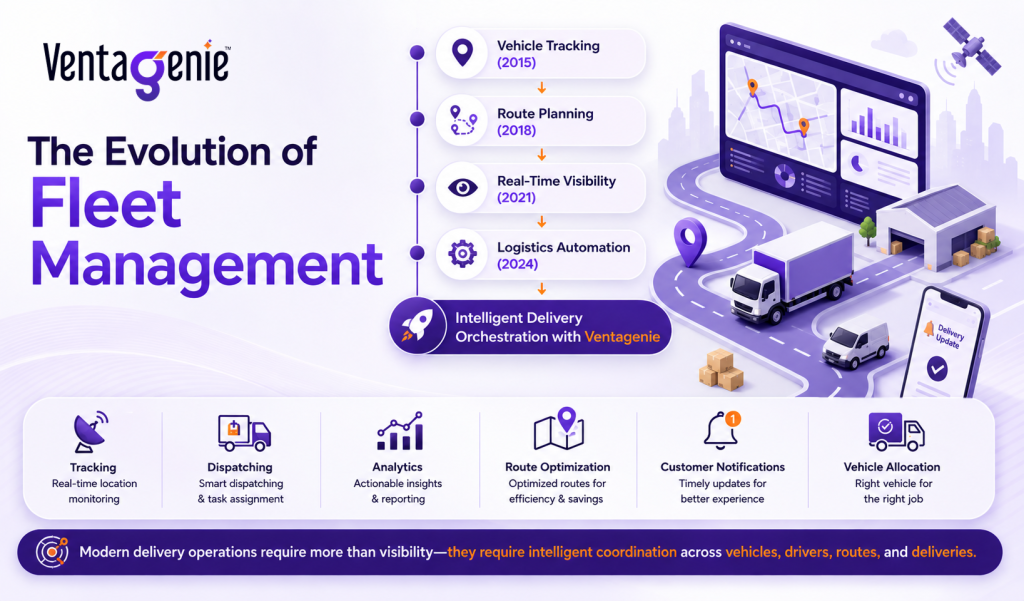
For many years, fleet management software focused primarily on visibility.
- Where is the vehicle ?
- When did it arrive ?
- How long was it stopped ?
These capabilities remain valuable.
But visibility alone doesn’t solve operational challenges.
- Knowing that a driver is delayed doesn't automatically prevent customer dissatisfaction.
- Knowing a vehicle's location doesn't tell a dispatcher which order should be assigned next.
- Knowing a route was inefficient doesn't improve tomorrow's deliveries.
Modern logistics operations require more than information.
They require action.
Businesses need systems capable of transforming operational data into operational decisions.
That’s where a new generation of delivery fleet software is changing the industry.
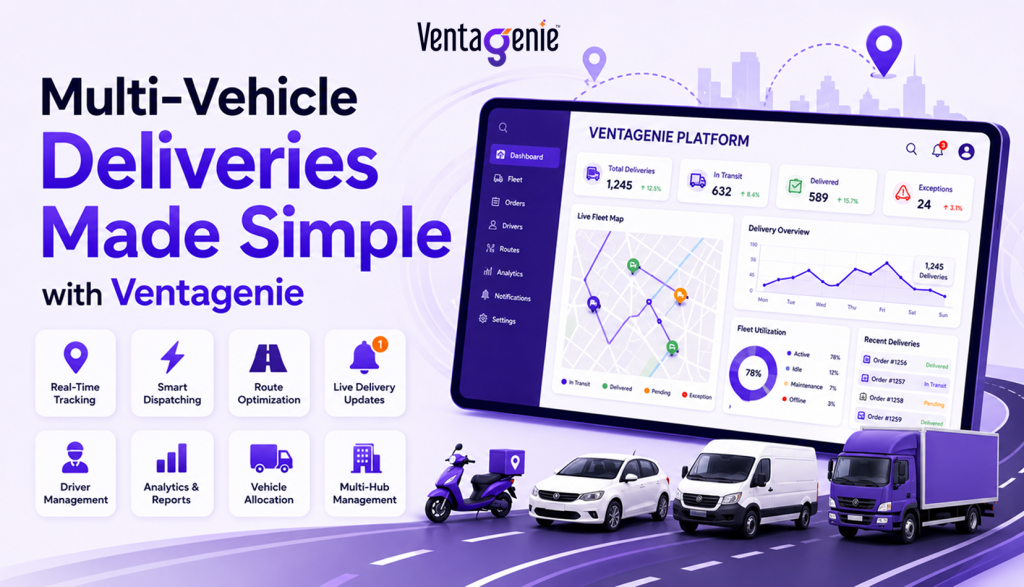
How Ventagenie Simplifies Multi-Vehicle Delivery Operations ?
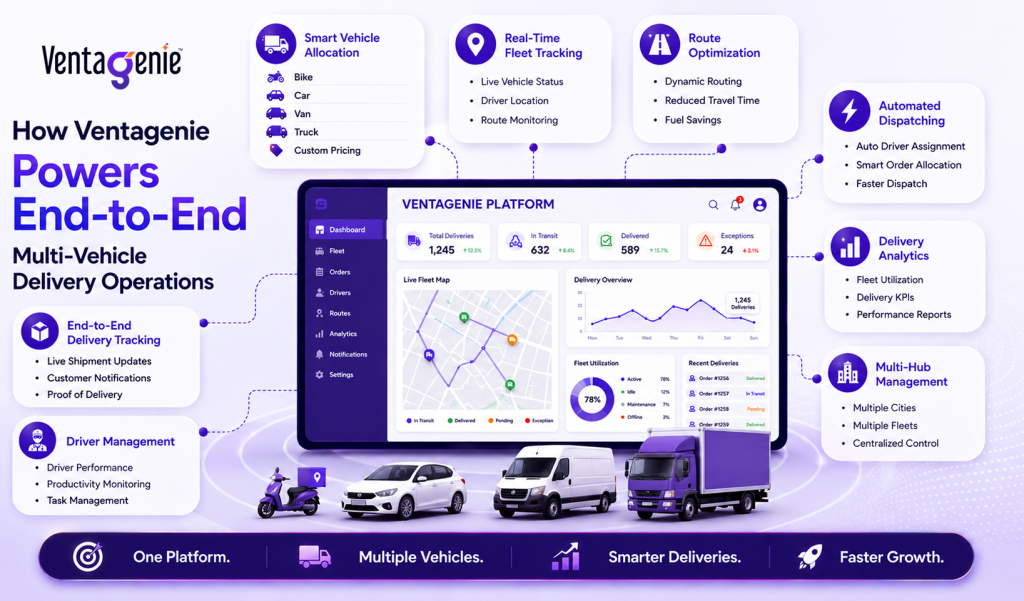
One of the biggest challenges in multi-vehicle delivery operations is that problems rarely happen in isolation. A delayed driver affects delivery schedules. Delivery delays increase customer inquiries. Customer inquiries consume support resources. What starts as a small operational issue can quickly impact the entire delivery network.
This is where Ventagenie brings structure to what often feels like operational chaos.
1. Smart Vehicle Allocation for Faster and More Profitable Deliveries
Managing a multi-vehicle fleet isn’t just about tracking drivers—it’s about assigning the right vehicle to the right delivery at the right price. Ventagenie enables businesses to configure multiple vehicle types, define custom delivery charges, and automate vehicle allocation based on order requirements. Similar to platforms like Uber and Ola, customers can choose from available vehicle options, while the system automatically displays pricing based on vehicle type, distance, and delivery needs. This helps businesses improve fleet utilization, streamline dispatching, and deliver a seamless booking experience.
2. Real-Time Fleet Visibility That Goes Beyond Vehicle Tracking
Many businesses already know where their vehicles are. The real question is whether those vehicles are operating efficiently.
Ventagenie provides a centralized view of the entire fleet, allowing dispatchers and managers to monitor vehicle movement, delivery progress, route adherence, and driver activity from a single dashboard. Instead of switching between multiple systems or relying on constant phone calls, operations teams gain a clear picture of what’s happening across the network in real time.
This level of visibility helps teams identify delays early, respond faster to disruptions, and maintain better control over daily operations.
3. Intelligent Route Optimization for Faster and More Cost-Effective Deliveries
Route planning has become significantly more complex than simply finding the shortest distance between two locations.
Traffic conditions change. Delivery priorities shift. New orders arrive throughout the day.
Ventagenie’s route optimization engine helps businesses create efficient delivery routes based on multiple operational factors, reducing unnecessary travel, improving delivery speed, and increasing vehicle utilization.
For businesses handling hundreds of deliveries daily, even small route improvements can translate into significant savings in fuel, driver hours, and operational costs.
4. Automated Dispatch Management
As delivery volumes grow, manual dispatching often becomes one of the biggest operational bottlenecks.
Dispatch teams are expected to assign deliveries quickly while considering driver availability, delivery priorities, service areas, vehicle capacity, and customer commitments.
Ventagenie simplifies this process through automated dispatch workflows that help assign deliveries intelligently and consistently.
Rather than spending hours coordinating assignments manually, dispatchers can focus on managing exceptions and maintaining service quality.
5. End-to-End Delivery Tracking
Customer expectations have evolved dramatically.
Today, customers expect the same visibility whether they are ordering food, groceries, retail products, or business shipments.
Ventagenie’s delivery tracking capabilities provide real-time shipment visibility, helping businesses improve communication and reduce customer uncertainty throughout the delivery journey.
For support teams, this often means fewer “Where is my order?” inquiries and improved customer satisfaction.
6. Driver Management and Performance Monitoring
Drivers remain one of the most important assets in any delivery operation.
Ventagenie helps businesses manage driver activities more effectively by providing visibility into delivery performance, route completion rates, productivity metrics, and operational efficiency.
This allows fleet managers to identify performance trends, improve accountability, and support continuous operational improvement.
7. Delivery Analytics That Support Better Decisions
Most logistics businesses generate large amounts of operational data.
The challenge is turning that data into actionable insights.
Ventagenie’s analytics and reporting capabilities help businesses understand delivery performance, fleet utilization, operational bottlenecks, driver productivity, and route efficiency.
Instead of relying on assumptions, decision-makers can use data to improve operational planning and long-term fleet strategy.
8. Multi-Hub and Multi-Fleet Operations Management
As businesses expand into new regions, managing multiple fleets, hubs, and delivery zones becomes increasingly difficult.
Ventagenie enables organizations to manage complex delivery networks from a centralized platform while maintaining visibility across locations, teams, and operations.
This creates a scalable foundation for growth without introducing unnecessary operational complexity.
The Future Belongs to Businesses That Manage Complexity Better
The logistics industry is entering a new era.
For decades, competitive advantage was largely driven by physical expansion.
More vehicles.
More drivers.
More infrastructure.
Today, the advantage is shifting toward operational intelligence.
Businesses that can see more clearly, respond faster, and coordinate resources more effectively are outperforming competitors with larger fleets and greater physical capacity.
That’s because modern delivery success is no longer determined by fleet size alone.
It’s determined by how intelligently that fleet operates.
For courier companies, logistics providers, delivery aggregators, and fleet operators, this represents both a challenge and an opportunity.
The challenge is that operational complexity will continue increasing.
The opportunity is that technology now makes that complexity manageable.
Solutions like Ventagenie aren’t simply helping businesses manage vehicles.
They’re helping businesses manage growth.
And in a delivery landscape where customer expectations continue rising and operational efficiency directly impacts profitability, that may be one of the most valuable capabilities a logistics organization can have.
Conclusion
As delivery networks grow, the challenge is no longer adding more vehicles—it’s managing the complexity that comes with them. From route planning and dispatching to real-time visibility and customer expectations, every moving part impacts operational performance.
The businesses leading the future of logistics aren’t simply expanding their fleets; they’re improving how those fleets operate. By combining route optimization, automated dispatching, fleet visibility, and delivery intelligence into one platform, Ventagenie helps courier, Grocery, Food, Medicine Businesses and logistics providers streamline multi-vehicle operations, reduce inefficiencies, and scale with confidence.
Because in today’s delivery landscape, success isn’t measured by how many vehicles you have—it’s measured by how effectively they work together.
Want to see how Ventagenie can transform your delivery operations?
Get in touch with our team today and discover how smarter fleet management can help you reduce costs, improve efficiency, and stay ahead in an increasingly competitive logistics landscape.
Frequently Asked Questions
Multi-vehicle delivery management is the process of managing multiple delivery vehicles, drivers, routes, and orders through a centralized platform to improve operational efficiency, visibility, and customer satisfaction.
Ventagenie allows businesses to create and manage multiple vehicle categories, including bikes, cars, vans, pickup trucks, and commercial vehicles. Administrators can define vehicle-specific pricing, delivery charges, capacity limits, and service areas based on business requirements.
Yes. Similar to ride-hailing platforms like Uber and Ola, Ventagenie enables customers to select from available vehicle options based on their delivery requirements. The platform automatically displays pricing according to the selected vehicle type, distance, and delivery conditions.
Ventagenie uses intelligent route optimization, automated dispatching, and efficient vehicle allocation to minimize fuel consumption, reduce driver idle time, improve fleet utilization, and lower overall operational costs.
Absolutely. Ventagenie is designed for courier companies, logistics providers, delivery aggregators, eCommerce businesses, hyperlocal delivery services, and fleet operators looking to streamline multi-vehicle delivery operations.
Route optimization helps identify the most efficient delivery routes by considering traffic conditions, delivery priorities, and vehicle availability. This reduces travel time, improves on-time deliveries, and increases driver productivity.
Yes. The platform offers real-time fleet tracking and live delivery updates, enabling businesses and customers to monitor delivery progress throughout the entire journey.
As delivery volumes increase, manual coordination becomes difficult and error-prone. Delivery fleet software helps businesses automate operations, optimize routes, improve visibility, enhance customer experience, and scale delivery operations more efficiently.

Mr. Aniket D is a seasoned digital marketer with over 10 years of experience in market research, content strategy, and performance marketing.
He specializes in analyzing consumer behavior, identifying emerging market trends, and translating insights into actionable digital strategies.
His work focuses on blending research-driven content with SEO and lead generation to drive measurable business growth.
Known for his data-first mindset, Aniket helps brands make smarter, audience-focused decisions in competitive markets.