Key Features Every Successful Marketplace App Must Have – 2026 Complete Guide
Introduction – Why Marketplace Apps Are the Future
Imagine a world where your customers can :
- Order food from multiple restaurants instantly.
- Get groceries delivered within 30 minutes.
- Book home services or healthcare products—all from a single app.
Today, customers expect choice, speed, and convenience in one unified platform. Businesses that provide this through multi-vendor marketplace apps dominate the market.
From Uber Eats, Zomato, Amazon, Alibaba Group, Instacart, to TaskRabbit, successful platforms share one thing in common—they integrate multiple vendors, services, and delivery systems under one roof.
- Did You Know ?
“Multi-category marketplace apps see 3x higher customer engagement than single-category apps because users prefer “all-in-one convenience.”
Myth vs Fact: Marketplace App Development
Myth | Fact |
Marketplace apps only work for food delivery | Multi-vendor marketplaces thrive across grocery, retail, pharmacy, B2B, and services |
You need massive investment like Amazon | With white-label solutions and scalable cloud infrastructure, startups can launch efficiently |
Managing multiple vendors is too complex | Automated dashboards, AI analytics, and commission engines simplify vendor management |
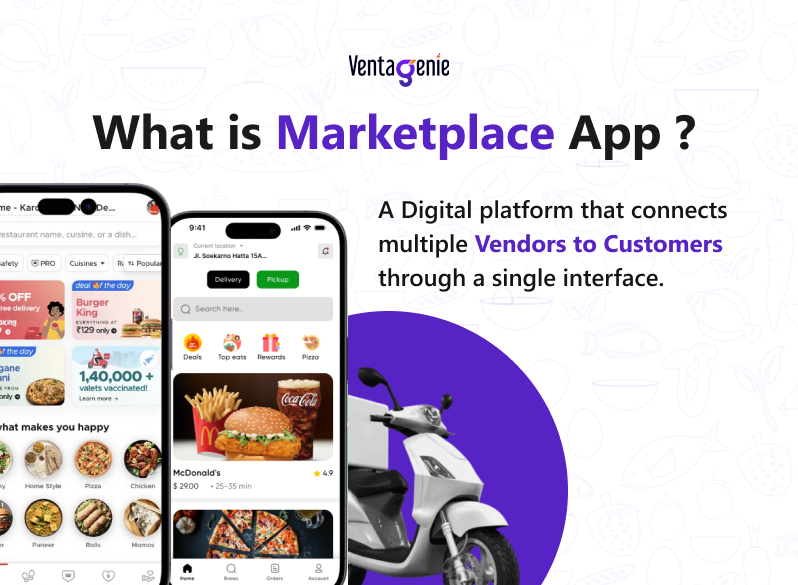
What is a Marketplace App ?
A marketplace app is a digital platform that connects multiple vendors to customers through a single interface. Unlike single-brand apps, a marketplace app allows users to browse, compare, order, and track items or services from multiple vendors.
Marketplace apps operate across industries, such as :
- Food & restaurant delivery (Uber Eats, DoorDash, Zomato)
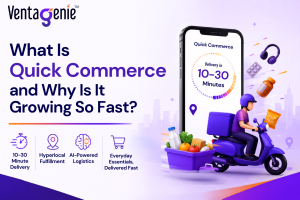
- Grocery & quick commerce (Instacart, Zepto, Getir)
- Retail & e-commerce (Amazon, Alibaba, Meesho)
- Pharmacy & healthcare delivery (PharmEasy, Capsule)
- Home services & maintenance (TaskRabbit, UrbanClap)
- B2B wholesale marketplaces (IndiaMART, Faire)
In simple terms : “One app that connects many shops to many customers through a single delivery system.”
Story:
In Brazil, iFood started with food delivery but scaled into groceries and convenience items—showing that multi-vendor apps can expand rapidly across categories.
- Did You Know ?
Amazon began as a single-category bookstore but grew into the world’s largest multi-vendor marketplace by strategically adding categories, vendors, and services.
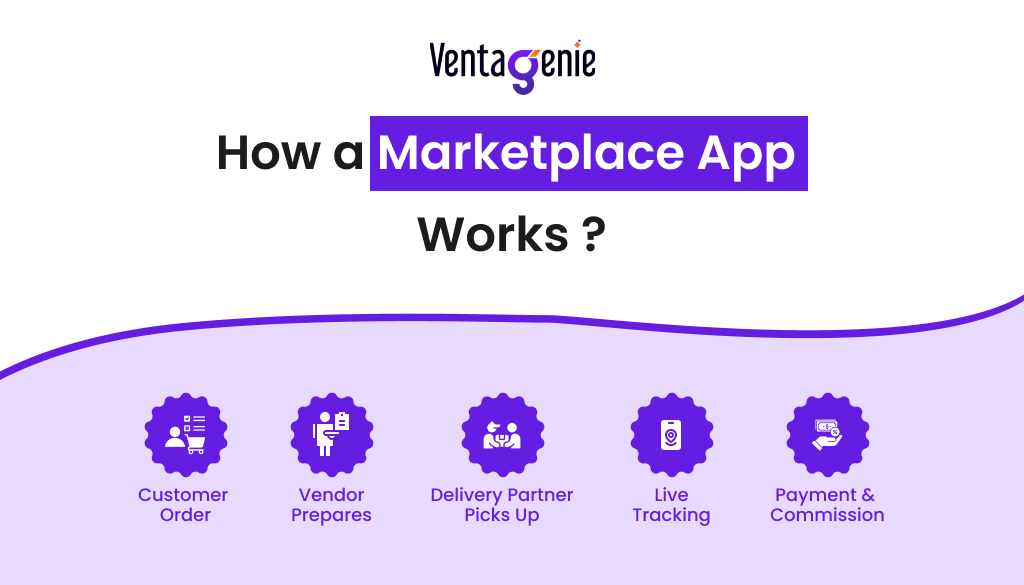
How a Marketplace App Works – Step by Step
Think of it as a digital shopping street in your pocket :
- Customer Orders – Browse multiple vendors, add items, pay securely.
- Vendor Prepares – Shop gets notified and prepares the order.
- Delivery Partner Picks Up – The nearest courier is assigned automatically.
- Live Tracking – Customers track deliveries in real-time.
- Payments & Commissions – Vendors earn, couriers earn, and the app earns a commission.
Visual Feature Map :
Customer App → Vendor Panel → Delivery Partner App → Admin Dashboard → Analytics & Growth
How a Marketplace App Works – Step by Step
Category | Global Leaders | Regional/Emerging Leaders |
Food Delivery | Uber Eats, Zomato, DoorDash, Deliveroo | iFood, GrabFood, PedidosYa |
Grocery & Quick Commerce | Instacart, Getir, Flink | Zepto, JOKR |
E-Commerce Marketplace | Amazon, Alibaba, eBay | Meesho, Joom |
Services & On-Demand | TaskRabbit, Fiverr | Thumbtack, UrbanClap |
Multi-Category Delivery | Glovo, Rappi, GoPuff | Gojek, Dunzo |
Key Features of a Successful Marketplace App
A marketplace app is more than a listing of vendors. The following core features define success :
1. Vendor Management System (VMS)
Example : Amazon Seller Central or Shopify Vendor Portal
A Vendor Management Software allows platform owners to manage vendor registration, onboarding, and performance. Key functionalities:
- Vendor registration & KYC verification
- Product/service listing & inventory management
- Commission tracking & payout management
- Vendor analytics & performance reports
Story : Zomato grew exponentially in India because it allowed thousands of restaurants to onboard quickly while maintaining quality via its vendor management system.
Why It Matters :
Efficient vendor management ensures operational smoothness, product quality, and platform credibility.
2. Delivery Tracking Software
Example : Uber Eats, DoorDash, Glovo
Real-time delivery tracking is crucial for customer satisfaction. Features include:
- GPS-based order tracking for customers
- Route optimization & traffic updates for delivery partners
- Delivery status notifications
- Analytics for delivery partner performance
Example : Uber Eats, DoorDash, Glovo
Real-time delivery tracking is crucial for customer satisfaction. Features include :
Myth vs Fact :
Myth: Delivery tracking is only for food apps.
Fact: Grocery, retail, pharmacy, and service marketplaces benefit equally from real-time tracking.
Why It Matters :
Transparency builds trust and drives repeat orders. Customers love knowing exactly where their package is.
3. Admin Dashboard
Example: Alibaba’s Merchant Dashboard, Rappi Admin Panel
The admin dashboard is the brain of the marketplace. Features include:
- Vendor approval & monitoring
- Product/service management
- Revenue & commission tracking
- Analytics and reporting
- Multi-category management
- Promo code & loyalty program management
Story : When Rappi expanded from food to groceries, pharmacy, and errands, its admin dashboard allowed seamless multi-category management without disrupting operations.
Did You Know ?
Platforms with AI-enabled admin dashboards report up to 30% faster decision-making and operational efficiency.
4. Customer App Features
Essential Features :
- Smart registration & social login
- Advanced search & filters by category, price, ratings, and location
- Multi-payment options (cards, wallets, UPI, COD)
- Ratings & reviews for vendors and services
- Push notifications for updates and offers
- In-app chat for support
Example : Instacart allows customers to compare grocery stores, apply coupons, and track deliveries all in one app — boosting user retention.
5. Delivery Partner App Features
Essential Features :
- Auto/manual order assignment
- GPS navigation & route optimization
- Earnings dashboard & incentives tracking
- Shift availability toggle
Story : DoorDash optimized its delivery partner routes using real-time traffic updates, reducing average delivery time by 20% and increasing customer satisfaction.
6. Advanced Features for Competitive Edge
- AI-powered product/service recommendations
- Dynamic pricing engine
- Loyalty & referral programs
- Multi-language & multi-currency support
- Subscription/Prime-style membership
- Cloud-based scalable infrastructure
- In-app chat and support system
Example: Amazon Prime offers loyalty programs and subscription benefits that increase repeat purchases and platform stickiness.
Advantages of Building a Marketplace App
- Multiple Revenue Streams – Commission, vendor fees, featured listings, delivery fees, ads.
- No Inventory Risk – Vendors handle their stock; you stay asset-light.
- High Scalability – Expand cities, categories, and vendors without rebuilding.
- Wider Customer Base – Network effect attracts more users & vendors.
- Faster Market Penetration – Aggregate existing businesses for instant availability.
- Multi-Category Expansion – Start with one vertical, expand into groceries, services, retail, and more.
- Data-Driven Growth – Analytics help with pricing, promotions, and vendor performance.
- Global Potential – Proven across regions and industries.
Why Partner with Ventagenie for Marketplace App Development ?
Building a multi-vendor marketplace requires expertise in scalable architecture, advanced analytics, and multi-category support. Ventagenie specializes in :
- Custom multi-vendor marketplace app development
- Vendor management system & admin dashboard solutions
- Multi-category delivery platforms
- White-label & fully customizable apps
- AI-driven analytics & logistics optimization
Partnering with Ventagenie ensures your marketplace is ready to scale globally, optimize vendor management, and deliver seamless experiences to customers.
Conclusion
A successful multi-vendor marketplace app is more than a digital storefront—it’s a scalable ecosystem connecting vendors, customers, and delivery partners.
With vendor management systems, delivery tracking software, admin dashboards, AI recommendations, and multi-category support, you can :
- Launch a platform like Uber Eats, Amazon, or DoorDash
- Maximize revenue with multiple streams
- Expand globally without inventory risks
- Gain actionable insights through analytics
- Build a future-proof digital marketplace
Myth vs Fact Recap :
Multi-vendor apps aren’t limited to food; modern technology makes them scalable, manageable, and profitable.
Partner with Ventagenie and turn your marketplace app vision into a scalable, revenue-generating reality.
CEOs Don’t Follow Trends—They Set Them. Will You
The multi-vendor, multi-category marketplace revolution is here. With Ventagenie, you can :
- Launch a scalable multi-category platform faster than your competitors
- Own the entire customer journey—from discovery to delivery
- Convert every category into a recurring revenue engine
FAQ – Marketplace App Features
A multi-vendor marketplace app is a digital platform that connects multiple independent vendors with customers while managing payments, logistics, and order fulfillment. Examples include Uber Eats, Amazon, Instacart, and Glovo. Unlike single-store apps, multi-vendor marketplaces offer variety, convenience, and scalability in one ecosystem.
A successful marketplace app typically includes:
- Vendor Management System – Vendor onboarding, product listing, inventory, and earnings tracking.
- Delivery Tracking Software – Real-time GPS tracking, route optimization, and delivery partner management.
- Admin Dashboard – Commission management, analytics, multi-category control, and dispute resolution.
- Customer Features – Smart registration, search filters, multiple payments, ratings, and push notifications.
- Advanced Features – AI recommendations, loyalty programs, referral systems, and multi-currency support.
- Single-Vendor Apps: One business sells products/services (e.g., a standalone restaurant app).
- Multi-Vendor Apps: Multiple vendors list products/services in one app (e.g., Amazon, Uber Eats, Glovo).
Multi-vendor apps offer more variety, higher revenue potential, and faster scalability.
Vendors are the backbone of your marketplace. A robust vendor management system ensures:
- Seamless onboarding
- Accurate inventory controlTransparent commission calculation
- Enhanced vendor engagement and retention
Real-time delivery tracking ensures transparency, faster deliveries, and reduced errors. Features like route optimization, live GPS updates, and availability management improve the customer experience, increase trust, and encourage repeat orders.
Yes! Multi-category marketplace apps allow expansion into food, groceries, pharmacy, retail, services, and more. Apps like Rappi, Glovo, and GoPuff demonstrate how starting with one category and scaling to multiple categories increases revenue and customer lifetime value.
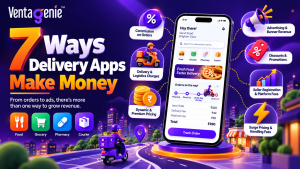
Marketplace apps earn through multiple streams:
- Commission per order
- Vendor subscription fees
- Featured listings & advertisements
- Delivery fees & surge pricing
- Subscription models (like Amazon Prime)
The admin dashboard is the control center. It allows platform owners to:
- Monitor vendor performance
- Track revenue and commissions
- Manage multi-category listings
- Analyze customer behavior and demand trends
- Resolve disputes and optimize operations
Yes! Modern white-label solutions and cloud-based architecture enable startups to launch quickly, manage multiple vendors efficiently, and scale gradually without massive upfront investment.
- Monitor vendor performance
- Track revenue and commissions
- Manage multi-category listings
- Analyze customer behavior and demand trends
- Resolve disputes and optimize operations
Ventagenie offers:
- Custom multi-vendor marketplace solutions
- Advanced vendor management and delivery tracking systems
- Multi-category platform development
- White-label apps for faster market launch
- Growth-ready analytics dashboards and support.