How Saudi Restaurants Can Cut Aggregator Fees with Their Own App
The Hidden Cost of Aggregator Apps
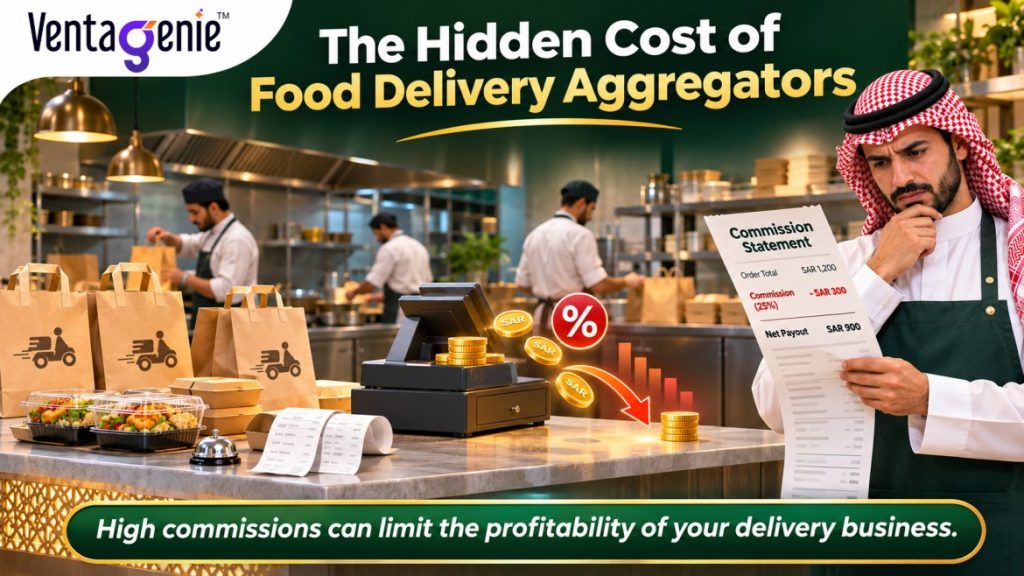
If you run a restaurant in Riyadh, Jeddah, Dammam, Dubai or Abu Dhabi, you already know the pattern. Orders come in through HungerStation, Jahez, ToYou, Talabat, Deliveroo or Noon Food, the kitchen is busy, sales look healthy, and yet the month-end profit feels thin.
Key Stats at a Glance
- SAR 16.2 billion : Saudi delivery-app sales in 2023, up from SAR 2.8 billion in 2018 (Argaam).
- 408 million : delivery orders in Saudi Arabia in 2025, up 79% from 2023 (Argaam).
- 15% to 35% : commission range reported for Jahez, HungerStation, Mrsool, Talabat and Deliveroo, depending on contract.
- Up to 80%+ : price gap found on some meals between delivery apps and restaurants' own apps in January 2026 (Argaam).
- 3 in 4: share of Gulf mobile food orders going through aggregators (Syrve, via AGBI).
The reason is simple: commission. Aggregators commonly charge restaurants a significant percentage of every order, often reported in the range of 15% to 30% or more depending on the contract, plus fees for delivery, promotions, ads and better placement. In a business where net margins are often only 5% to 15%, that commission can take away most of your profit on every delivery order.
There is a second cost that does not appear on any invoice: you do not own the customer. The aggregator holds the phone number, the order history and the relationship. When a competitor pays for a top banner, your regular customer sees their offer, not yours.
A branded restaurant app solves both problems.
What the Research Says: Saudi and UAE Delivery Data (2026)
Saudi delivery is now a 400-million-order market, and restaurants carry much of the cost through commissions, fees and promotions. Here is the evidence, with sources listed at the end.
1. Delivery apps have grown fast in Saudi Arabia
- Delivery-app sales rose from SAR 2.8 billion in 2018 to SAR 16.2 billion in 2023, lifting their share of the food service market from 3.5% to 14.4% (Argaam, Jan 2026).
- Total delivery orders grew from 228 million in 2023 to 408 million in 2025, a 79% rise (Argaam).
- Riyadh generated about 44% of 2025 orders, Makkah 22% and the Eastern Province 16% (Argaam). If you are choosing where to launch first, start with Riyadh, Jeddah/Makkah and Dammam/Khobar.
2. Commissions reported by industry sources
Exact rates depend on your contract, so treat these as ranges, not price lists.
Platform | Reported commission | Notes |
Jahez (KSA) | 15% to 25% typical; about 10% to 12% for large chains | Negotiable with volume (Menuviel). Another guide reports 22% to 28% (Qoyod) |
HungerStation (KSA) | 20% to 27% | Optional marketing fees on top (Qoyod) |
Mrsool (KSA) | Up to about 30% | Higher in some categories (Qoyod) |
Talabat (UAE) | 15% to 25%, or 20% to 30% | Two sources differ; exclusivity deals can lower it (Communicate Online, Menuviel) |
Deliveroo (UAE) | 25% to 35% | Depends on size, location and distance (Menuviel) |
Keeta (KSA, UAE) | Not publicly disclosed | Entered Saudi Arabia with a low-commission pitch (Communicate Online) |
3. The commission is not the only cost
Platforms typically take a commission and then add marketing, processing and service fees, according to AGBI. It also reports that search ranking is often tied to commission level or ad spend, and that promotions marketed as platform discounts are often paid for by the restaurant.
Customers pay too. Argaam found that HungerStation and Keeta show a 2% service fee (minimum SAR 0.5, maximum SAR 2), and average delivery fees ranged from about SAR 11.9 to SAR 15.7 across apps in January 2026.
4. Customers can pay less when ordering direct
Argaam compared January 2026 menu prices on delivery apps with restaurants’ own apps (no promotions applied). Several brands charged more on the aggregators:
Meal | Delivery apps (SAR) | Restaurant’s own app (SAR) |
Al Baik, 4 chicken pieces | 22 | 18 |
Herfy, chicken tortilla | 34 | 24 |
Al-Romansiah, mandi meat meal | 114 | 95 |
Falafel Themar, sabah sandwich | 13.75 | 10 |
McDonald’s, Big Mac | 19 | 19 |
Argaam reported price gaps of roughly 20% to over 80% on some orders. Price differences like these are a strong reason to promote your own app with a message such as “cheaper direct”, although each brand sets its own policy and aggregator contracts may restrict price differences.
5. Regulators across the Gulf are stepping in
- Saudi Arabia : the General Authority for Competition (GAC) issued guidelines on anti-competitive practices and fair pricing in March 2025, and its January 2026 study flagged price discrepancies between apps and restaurants' own prices (AGBI, Argaam).
- UAE : a September 2025 circular requires transparency in how listings are ranked, bans arbitrary pricing changes and stops platforms passing subscription costs on to restaurants (AGBI).
- Kuwait : in February 2026 the government fixed commissions and service fees for three years and banned exclusivity clauses (AGBI).
- Platform risk is real : the Shgardi app announced it would stop operating at the end of October 2025 (Argaam), a reminder that relying on a single channel is risky.
Rules may make aggregators fairer, but they do not give you the customer relationship. Only your own channel does.
6. UAE: aggregators dominate, but direct ordering exists
Aggregators such as Talabat, HungerStation and Deliveroo account for about three in four mobile food orders in the Gulf, according to hospitality-tech provider Syrve, quoted by AGBI. The rest flow through restaurant-owned ordering systems (Gulf News). AGBI also reports the UAE market is expected to approach $4 billion by 2030.
A Dubai agency’s worked example (illustrative, not an audited case): a restaurant with AED 150,000 of monthly delivery sales at a 22% commission pays AED 33,000 a month. Moving 25% of those orders to direct ordering cuts commission by about AED 8,250 a month (Wistech).
7. Market size estimates vary widely
Research firms disagree because they measure different things. IMARC puts Saudi online food delivery platforms at USD 1.66 billion in 2024, growing to USD 5.71 billion by 2033 (IMARC). Another report estimates USD 2.01 billion in 2025 and USD 6.71 billion by 2034 (Report Cubes). When you quote a figure in your own marketing, name the source and year.
What this means for your restaurant
- Delivery demand is large and still growing, so a direct channel is worth building now.
- Commission ranges of 15% to 35% leave little margin, so every order moved to your own app is higher-profit.
- Price gaps and hidden fees give you a clear message to win customers: order direct and pay less.
- Regulation is tightening, but only owning the customer relationship protects you from rule changes and platform exits.
Quick Math: What an Aggregator Really Costs You
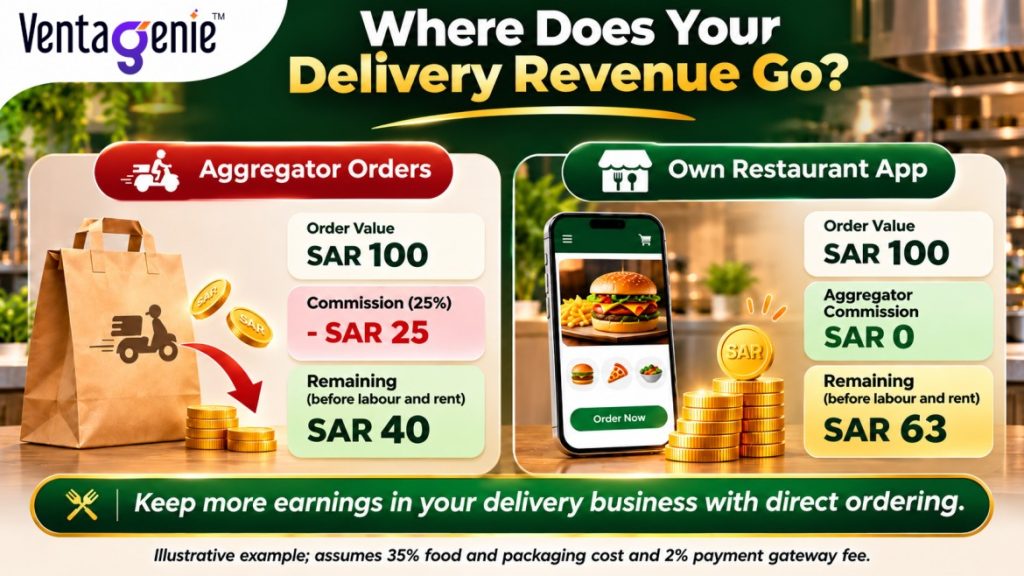
These numbers are illustrative. Replace them with your own contract terms.
| Aggregator order | Own-app order |
Order value | SAR 100 | SAR 100 |
Commission (assumed 25%) | SAR 25 | SAR 0 (only payment gateway fee, roughly 1–3%) |
Food and packaging cost (assumed 35%) | SAR 35 | SAR 35 |
Gateway fee (assumed 2%) | n/a | SAR 2 |
What you keep before labour and rent | SAR 40 | SAR 63 |
If you do 1,000 delivery orders a month at an average of SAR 100, shifting even 30% of those orders to your own app would put roughly SAR 6,900 back in your pocket every month in this example. Shift half and the saving grows further. The more loyal customers you convert, the faster the app pays for itself.
Why Saudi and UAE Restaurants Are Moving to Their Own Apps
1. The market is huge and digital-first
Saudi Arabia and the UAE have some of the highest smartphone penetration and online food ordering rates in the region. Customers are comfortable ordering through apps, which means they will download yours if you give them a reason.
2. Aggregator competition is getting more expensive
With many players such as HungerStation, Jahez, ToYou, Mrsool, Keeta and Ninja in Saudi Arabia, and Talabat, Deliveroo, Noon Food and Careem in the UAE, restaurants are pushed into paid visibility to stay on top of the list.
3. Brand loyalty is worth more than one-off orders
A customer who orders from your app sees only your menu, your offers and your brand. That means more repeat orders and a higher average basket.
4. Data is the new advantage
With your own app you know who orders, when, what they order and what makes them return. You can run targeted campaigns by WhatsApp, SMS or push notification without paying anyone a fee.
What a Winning Restaurant App Needs in the Saudi and UAE Market
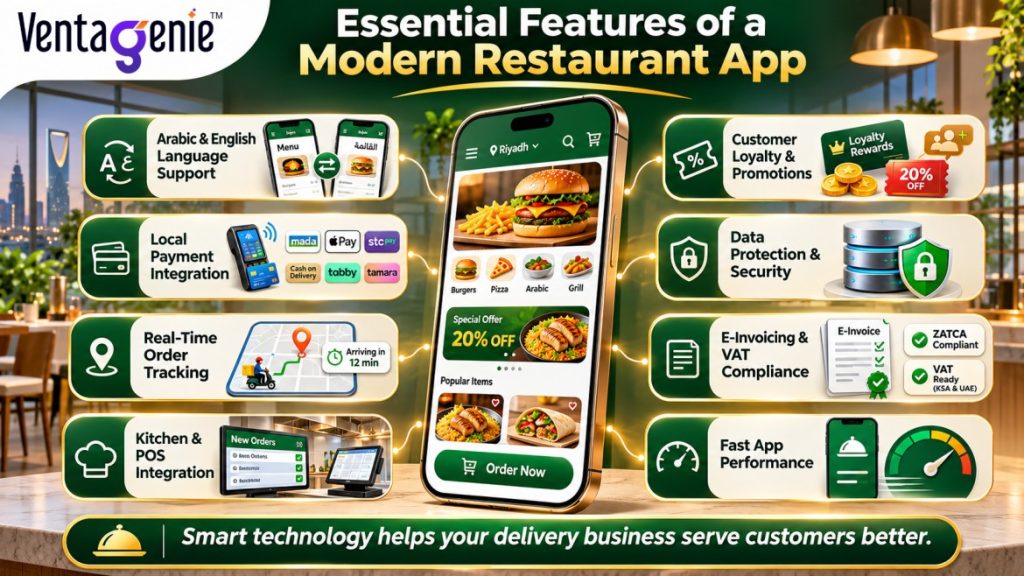
Not every app works well in the Gulf. Local expectations are specific:
Arabic and English with full RTL support
Many customers prefer Arabic, and a poor translation hurts trust.
Local payment methods
Mada, Apple Pay, STC Pay and credit cards in Saudi Arabia, plus cash on delivery. Many customers also like buy-now-pay-later options such as Tabby and Tamara.
ZATCA-compliant e-invoicing (Saudi Arabia)
Your system should generate invoices that follow ZATCA requirements, and VAT-ready reporting for both KSA and UAE.
Live order tracking and driver management
Customers expect real-time maps and accurate ETAs
Loyalty, coupons and referral programs
This is how you pull customers away from aggregator habits.
Kitchen and POS integration
Orders should flow straight to your kitchen display or POS with no re-typing.
Data protection
Customer data should be handled in line with Saudi PDPL and UAE data protection rules.
Fast performance on any phone
Ramadan evenings and weekend peaks are exactly when a slow app loses sales.
Own App vs Aggregator: Honest Comparison
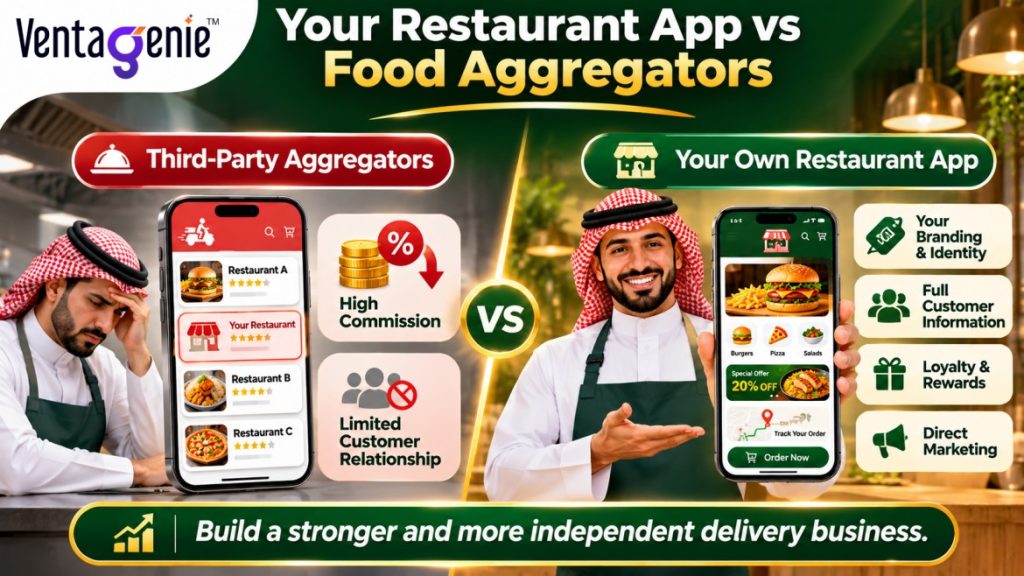
Factor | Aggregators (HungerStation, Jahez, Talabat, etc.) | Your own app |
Commission per order | High, often 15–30%+ | None, only payment gateway fees |
Customer data | Owned by the platform | Owned by you |
Brand experience | Your logo in someone else’s list | Fully branded |
Discovery of new customers | Strong, built-in audience | Needs your own marketing |
Marketing control | Paid placement, limited | Full control, push, SMS, WhatsApp |
Upfront cost | Low | One-time build or subscription |
Long-term profit | Shrinks with growth | Improves with growth |
Our honest advice: do not leave aggregators overnight. They are useful for discovering new customers. The smart strategy is to use them as an acquisition channel, then move repeat customers to your own app.
The 5-Step Plan to Move Customers from Aggregators to Your App
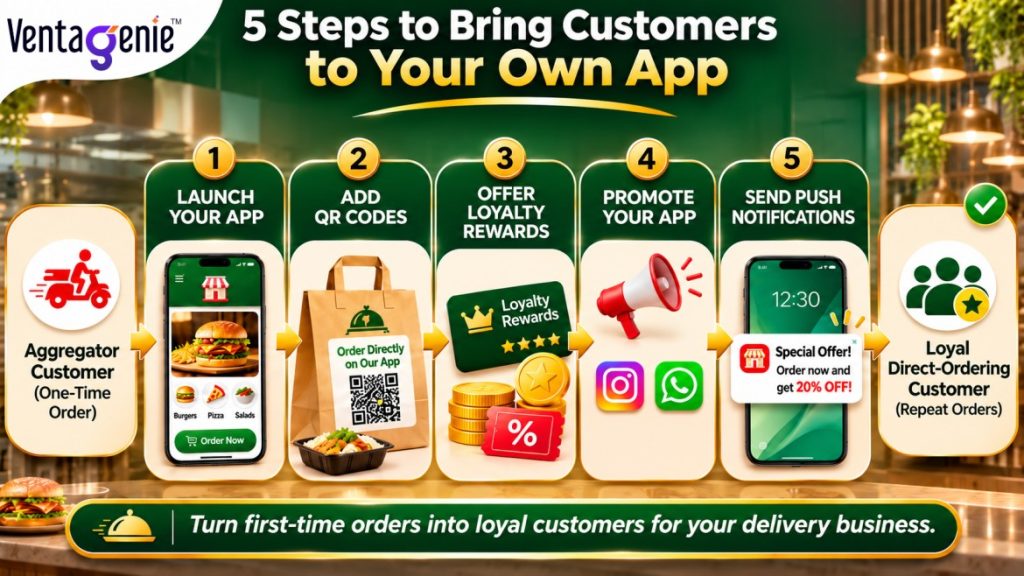
1. Launch your app and website ordering
A branded app plus a mobile-friendly ordering page, both connected to the same menu and kitchen flow.
2. Add a flyer or QR code to every aggregator order
Something like: “Order directly from us next time and get 15% off or free delivery.” Always check the aggregator’s terms before running promotions.
3. Offer a first-order discount and a loyalty reward
Points, free items or a stamp-card style program work very well in Saudi and UAE.
4. Promote on Instagram and WhatsApp
These are the channels where Gulf customers spend time. Link them directly to your app.
5. Re-engage with push notifications
Reminders, offers during Ramadan, Saudi National Day, Eid and weekends bring customers back at zero cost.
Build Custom or Use a Ready Solution?
A fully custom build can take many months and a large budget. For most restaurants and restaurant groups, a ready, white-label delivery app solution is faster, cheaper and lower risk because the core features are already tested.
This is where VentaGenie helps. VentaGenie is a delivery app development solution that gives restaurants and food businesses their own branded ordering platform, so you can:
- Launch a customer app under your own brand
- Manage menus, orders and offers from a restaurant dashboard
- Handle delivery with your own drivers or a driver app
- Accept local payments and support Arabic and English
- Keep 100% of your customer data and your sales
Who Should Build Their Own App?
An own app makes the most sense if you:
- Receive more than a few hundred delivery orders a month through aggregators
- Run multiple branches, a cloud kitchen or a franchise
- Already have loyal dine-in customers who would order directly
- Want to build a brand, not just a listing
If you are a very small new restaurant with only a few orders a week, start with aggregators and add your own app as volume grows.
Final Thoughts
Aggregators built the online food delivery habit in Saudi Arabia and the UAE, but you do not have to pay them a large share of every order forever. A branded app lets you keep more profit, own your customers and grow a business that does not depend on someone else’s algorithm.
Ready to stop paying high commissions?
👉 Book a free demo of VentaGenie and see how your restaurant can launch its own delivery app.
Frequently Asked Questions
Commission depends on your contract, city, delivery model and promotions, and it changes over time. Restaurants commonly report paying between 15% and 30% or more per order including extra fees. Always check your current agreement.
You can, but most restaurants keep them for discovery while pushing repeat customers to their own app. This hybrid approach protects revenue while reducing commission over time.
Costs vary widely. A custom app can be expensive and slow, while a white-label solution like VentaGenie is usually faster and more affordable. Request a quote based on your branches and features.
A ready solution can often go live in weeks rather than months, depending on branding, menu setup and integrations.
Yes, if you give them a reason: a first-order discount, loyalty points, exclusive menu items or free delivery. Promote it on every order, receipt, box and social page.
A good Gulf-ready app should support Arabic and English, mada, Apple Pay, STC Pay, cards and cash on delivery. Confirm the exact options with your provider.
Yes. The same model works in Dubai, Abu Dhabi and Sharjah, with UAE payment options and VAT-ready reporting.
Sources
- Argaam: Pricing squeeze hits food delivery apps as GAC monitors anti-competitive practices (Jan 29, 2026)
- Menuviel: Jahez fees and commissions for restaurants
- Menuviel: Most popular food delivery apps in UAE
- Communicate Online: Keeta’s UAE launch sparks a GCC delivery shakeup
- Gulf News: UAE food deliveries to pick up speed as mobile orders spike
- Wistech: Dubai restaurant direct ordering commission example
- IMARC: Saudi Arabia online food delivery platforms market
- Report Cubes: Saudi Arabia online food delivery platforms market

Mr. Aniket D is a seasoned digital marketer with over 10 years of experience in market research, content strategy, and performance marketing.
He specializes in analyzing consumer behavior, identifying emerging market trends, and translating insights into actionable digital strategies.
His work focuses on blending research-driven content with SEO and lead generation to drive measurable business growth.
Known for his data-first mindset, Aniket helps brands make smarter, audience-focused decisions in competitive markets.