How Supermarkets and Pharmacies in the UAE Can Launch Their Own Delivery App
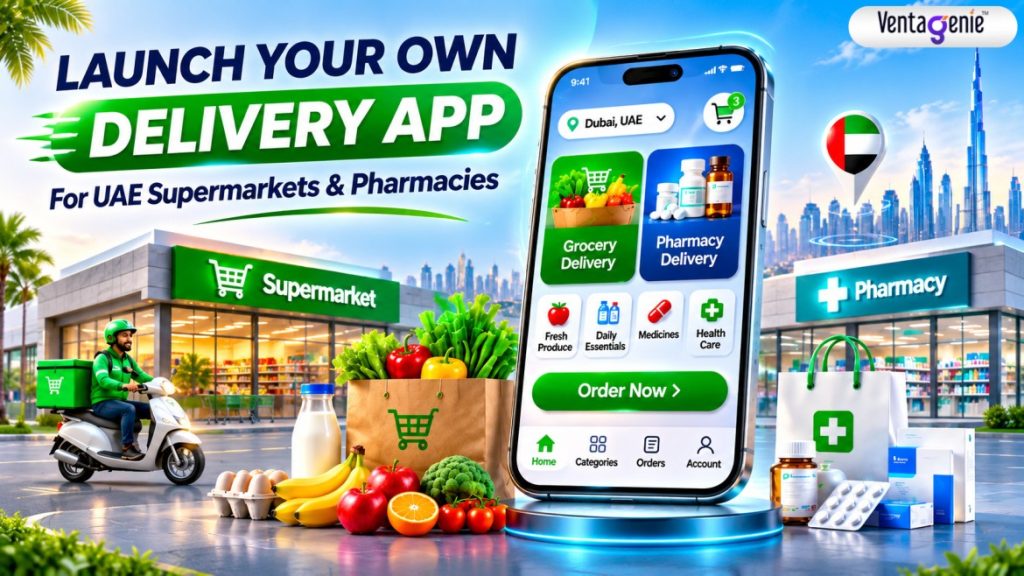
If you run a supermarket in Sharjah or a pharmacy chain in Dubai, you have probably had this conversation with your team: “Customers keep ordering from Talabat, Noon Minutes and Careem Quik. We are paying commission on our own regulars. Why don’t we have our own app?”
It is the right question. The UAE is one of the most delivery-ready markets in the world: high smartphone penetration, dense urban living, customers who expect groceries in under an hour, and a population that is comfortable paying by card or wallet on a phone. Retailers who own their customer relationship, data and margin are pulling ahead of those who rent them from aggregators.
This guide walks you through exactly how supermarkets and pharmacies in the UAE can launch their own delivery app, whether you want to create an app like Talabat, build an app like Instashop or develop an app like Careem Quik: the models, the features that matter, the compliance points you must not skip, realistic cost and timeline thinking, and the mistakes we see businesses make. It is written from the perspective of a team that builds on-demand apps for retailers, so it is practical rather than theoretical.
What the Research Says About Delivery in Dubai and the UAE?
Before you spend a dirham on development, look at what the data says. The figures below come from published market reports, company results and news coverage, linked in the Sources list at the end (figures as of November 2026). Market-size numbers from research vendors are estimates and differ between publishers, so read them as direction rather than gospel.
The market
1. Online grocery is large and growing. One industry report puts the UAE online grocery market at about USD 4.13 billion in 2025, rising to roughly USD 21.97 billion by 2034 (Biobrain). A quick-commerce databook published in April 2026 projects the UAE quick-commerce market reaching USD 1.86 billion by 2029 (GlobeNewswire).
2. The giants are investing more, not less. Talabat has earmarked about USD 120 million for 2026 to scale its talabat mart dark stores and its talabat Pro subscription programme (Zawya).
4. Grocery baskets are bigger. Industry write-ups of Talabat’s model report that talabat mart baskets run about 1.8 times the value of food orders (Miracuves).
5. Dark stores are costly. Careem described its Quik stores as 2,000 to 4,500 square feet stocking around 3,500 products (Gulf News), and one report notes Dubai industrial-district rents rose 14.3% in Q1 2024 (Research and Markets).
Customer behavior
1.Quick commerce is now an expectation. A Redseer survey of 300 UAE consumers, reported by AGBI in March 2026, found 55% had increased quick-commerce use for groceries amid regional security concerns, and Alshaya Group’s online sales rose 35% (AGBI). The sample is small, but the direction matters: shoppers who try home delivery in a stressful period often keep the habit.
2. Shoppers are planning and value-led. Mastercard’s Consumer Shopper Snapshot 2025, based on 1,000+ UAE consumers, points to intentional shopping: planning earlier and spending more carefully (Pattern). Retailers quoted by Khaleej Times describe customers as less impulsive and more value-driven (Khaleej Times).
3. Orders cluster at predictable times. Careem’s 2025 data shows Sunday as the busiest grocery day, peaking between 7pm and 8pm, with essentials such as bananas topping basket lists (Arabian Business).
4. Packaged foods and produce lead. A 2024 survey found these were the most ordered online grocery categories, with Dubai and Abu Dhabi holding the largest share of online grocery shoppers (Statista).
5. Shoppers are open to AI help. DHL’s 2026 e-commerce report found 51% of UAE respondents use AI chat tools while shopping online (Khaleej Times).
What this means for your app ?
- Plan staffing and delivery slots around evening and weekend peaks, especially Sunday evenings.
- Make reordering effortless. Planned, value-led shoppers love a saved "my usual basket" and clear price visibility.
- Copy the subscription lesson. A free-delivery membership or refill plan can lift repeat orders, as Talabat Pro does.
- Use your existing stores as fulfilment points. With dark-store rents rising, a supermarket or pharmacy chain that already owns shelves, stock and staff can start leaner than a new entrant.
- Put a smart assistant in search or support, so customers can find items or ask about substitutions in Arabic or English.
Why Your Own Delivery App Beats Living on Aggregators Alone?
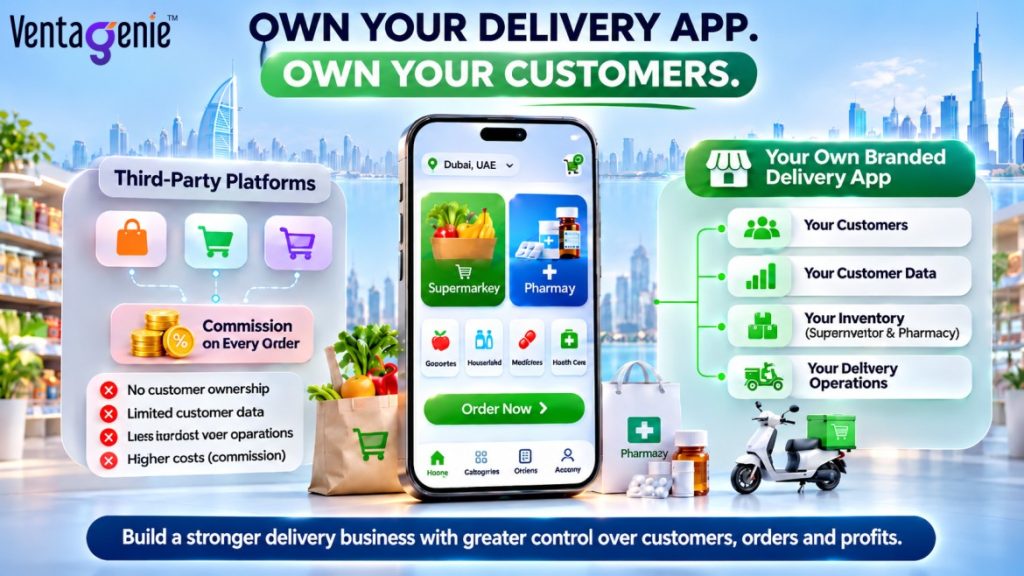
Aggregator platforms are useful for discovery. Nobody is saying you should leave them. But relying on them as your only digital channel creates three problems.
1. Commission eats your margin.
Grocery and pharmacy margins are already thin. Aggregator commissions, plus promotional contributions and delivery subsidies, can turn a profitable basket into a break-even one. On your own app, you pay for technology and riders, not a percentage of every order.
2. You do not own the customer.
On a marketplace, the customer belongs to the platform. You rarely get full contact details, purchase history or the ability to market to them directly. On your own app, every order builds a first-party database you can use for reorder reminders, loyalty offers and seasonal campaigns such as Ramadan, back-to-school or flu season.
3. You cannot control the experience.
Substitutions, packaging, delivery windows, product ranges and brand presentation are all dictated by the platform. With your own app, the experience is yours, and so is the reputation.
The smartest UAE retailers use a hybrid approach: aggregators for reach, their own app for retention and profit. Over time, the goal is to move repeat customers from the marketplace to your channel.
The Three Delivery App Models for UAE Retailers
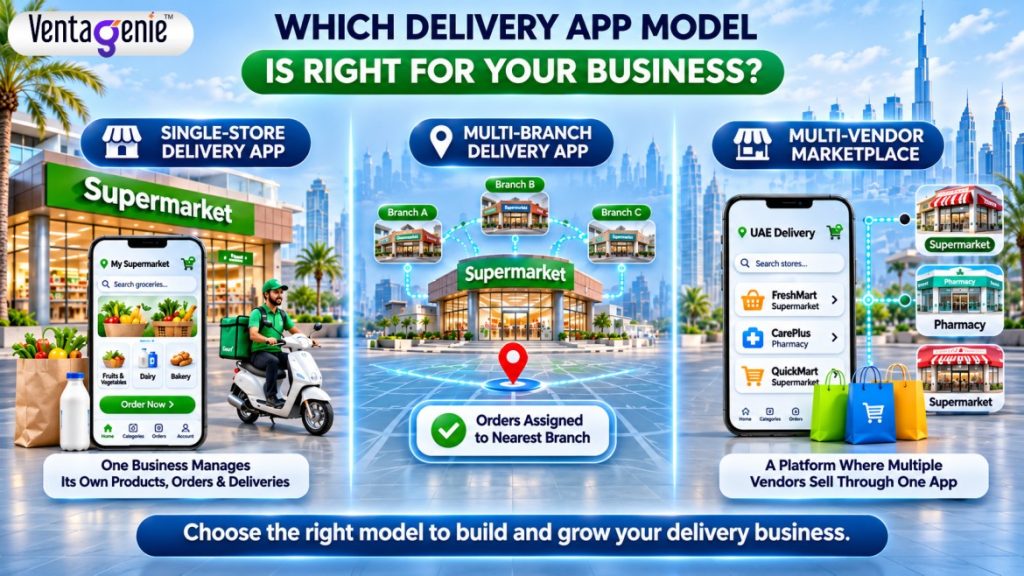
Before you think about features, decide which model fits your business.
Model 1: Single-store or single-brand app
Best for: one supermarket brand or pharmacy chain with its own inventory and delivery fleet.
Customers browse your catalogue, place an order, and your store or dark store fulfils it. This is the fastest model to launch and the easiest to control. Most supermarkets and pharmacy chains should start here.
Model 2: Multi-branch app with smart routing
Best for: chains with several stores across Dubai, Abu Dhabi, Sharjah or other emirates.
The app detects the customer’s location, assigns the order to the nearest branch with stock, and shows accurate delivery times. This needs inventory sync per branch and a strong dispatch engine.
Model 3: Your own marketplace
Best for: groups, malls or franchise networks that want to host multiple vendors.
This is closer to what people mean when they say they want to create an app like Talabat or build an app like Instashop. It adds vendor onboarding, commission management and multi-vendor payouts. It is powerful, but more complex and more expensive. Unless you already have several vendors committed, start with Model 1 or 2 and expand.
Which Model Do Talabat, Noon Minutes, Careem Quik and Instashop Actually Use?
This is the question we hear most from retailers: is Talabat a single-store or multi-store model, and what does Noon run on? Each giant picked a different operating model, and that choice drives inventory control, delivery speed, range and customer experience.
Platform | Operating model | How orders are fulfilled | Closest to |
Hybrid: multi-vendor marketplace plus own inventory | Third-party local shops and restaurants, plus its own talabat mart dark stores | Multi-store marketplace and single-operator | |
Multi-retailer marketplace | Nearby partner stores, matched by customer location | Multi-store marketplace | |
Platform-owned quick commerce | Compact mini stores (dark stores) near demand hubs, supported by noon’s logistics | Single-operator, inventory-led | |
Super-app with its own dark stores | Quik stores, with pickers and delivery captains inside the Careem app | Single-operator, inventory-led | |
Retail partnership | Partner supermarkets such as Choithrams, delivered by Deliveroo’s network | Multi-store, partner-led |
A note on accuracy: sources classify these models slightly differently. Careem’s own launch statements describe Quik as run on its own dark stores, while some analyst write-ups describe it as relying on partner stores. Operating models also change as companies grow, so check current announcements before you copy anything.
Single store or multi store: what should you copy?
- If you own one brand with several branches, follow the Noon Minutes and Careem Quik logic: you control the stock, the picking and the experience. Your branches act as your dark stores. This is a single-operator, inventory-led app.
- If you want to onboard other shops, follow the Instashop logic: a multi-store marketplace where each retailer manages its own catalogue and you earn commission. This is the route if you want to create an app like Talabat or build an app like Instashop.
- If you want both, Talabat’s hybrid is the proof it can work, but it took years and heavy investment. Start single-operator, then open the platform to partners once your operations are stable.
The big-player modules, and which ones you need first
Most of what looks like magic in these apps is a handful of modules. Here is what each does and when to build it.
Module | Where you see it | When to build it |
Customer app: search, cart, checkout, live tracking | Every platform | Day one |
Store or picker app with out-of-stock flagging | Instashop (store and personal-shopper picking), talabat mart | Day one |
Dispatch engine and rider app | Every platform | Day one |
Vendor panel: onboarding, catalogue, commission, payouts | Talabat and Instashop marketplaces | Only for multi-store or marketplace models |
Dark-store inventory and warehouse management | talabat mart, Noon Minutes, Careem Quik | Phase 2, unless you run a dedicated dark store |
Subscription programme with free delivery | talabat Pro | Phase 2, once you have repeat customers |
Super-app wallet, payments and loyalty in one login | Careem | Phase 2 |
Sponsored listings and brand advertising | Talabat | Phase 3, needs real traffic first |
Demand forecasting and analytics | Talabat says it is investing in AI and data analytics for predictive models (Hospitality News) | Phase 3 |
The lesson is not to build everything. It is to build the first three rows brilliantly, then add the rest as your order volume pays for them.
What "Create an App Like Talabat" Really Means
We hear these phrases every week: create an app like Talabat, build an app like Noon Minutes, make an app like Careem Quik, develop an app like Instashop. They are a useful shorthand, but copying a giant platform feature for feature is rarely the right move.
Those companies spent years and enormous budgets building logistics networks, machine-learning systems and city-wide rider fleets. What you actually need is the core of the experience, built around your catalogue and your customers:
- Fast, accurate product search
- A smooth cart and checkout
- Reliable delivery tracking
- Clear communication when something is out of stock
- Easy reordering
Get those five right, and you will compete well in your own neighborhoods. You can add advanced layers such as dynamic pricing or AI recommendations once you have order volume to justify them.
A good development partner will ask you what to leave out of version one, not only what to include.
Must-Have Features for a Supermarket Delivery App
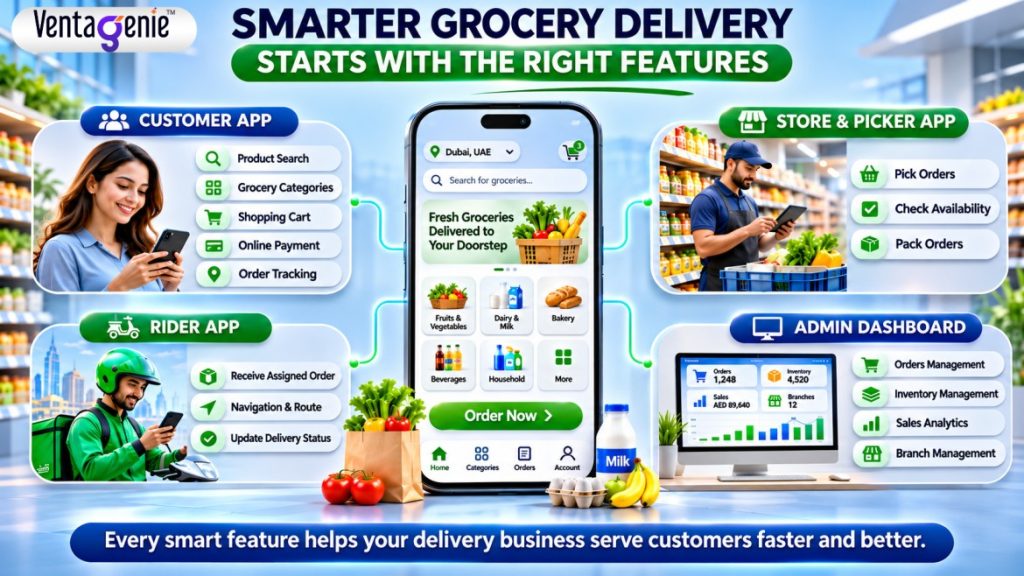
If you want to create an app like Noon Minutes or build an app like Careem Quik for your supermarket, start by respecting that grocery has its own quirks: huge catalogues, perishable goods, variable weights and a high expectation of speed.
Customer app
- Phone, email and social login with OTP verification
- Smart search and categories that handle English and Arabic, with full RTL support
- Barcode scanning and quick reorder from past baskets
- Real-time stock visibility so customers do not order what you do not have
- Substitution preferences: let customers approve alternatives or choose "refund if unavailable"
- Delivery slots and express options (for example, 30 to 60 minutes versus scheduled)
- Multiple payment options: cards, Apple Pay, Google Pay, cash on delivery and wallet
- Live order tracking with rider details and ETA
- Loyalty points, coupons and referral rewards
- Ratings and feedback after each order
Store and picker app
- Order queue with pick lists sorted by aisle
- Weight-based item adjustments (fruit, meat, deli)
- Out-of-stock flagging that updates the customer instantly
- Packing confirmation and handover to the rider
Rider app
- Order assignment and navigation
- Proof of delivery (OTP or photo)
- Cash collection tracking
- Earnings and shift management
Admin dashboard
- Catalogue, pricing and promotion management
- Branch and delivery zone control
- Rider management and dispatch
- Sales, basket-size and retention analytics
- Integration with your POS and ERP
Must-Have Features for a Pharmacy Delivery App
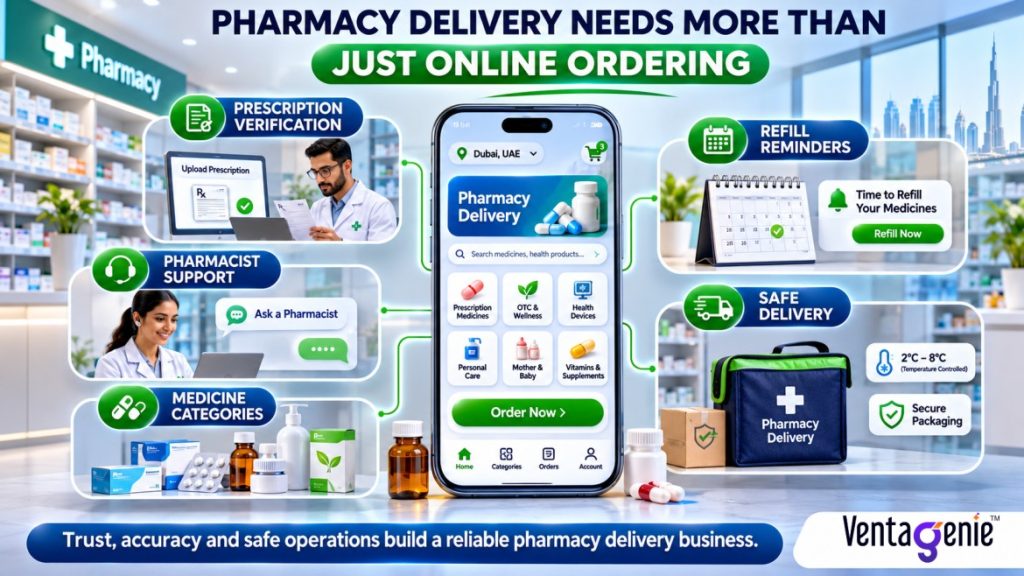
Pharmacy is not groceries with a different logo. Even if you want to build an app like Instashop that carries medicines alongside groceries, the pharmacy side needs its own rules. Trust, accuracy and compliance matter far more.
- Prescription upload and verification. Customers upload a photo of a prescription; your licensed pharmacist reviews it before the order is confirmed.
- Pharmacist chat or call. Many customers want reassurance about dosage, interactions or alternatives. A direct line to a pharmacist builds enormous trust.
- Separate flows for OTC, prescription and controlled items. The app should block or restrict categories that cannot legally be delivered without proper checks.
- Insurance details capture, where your pharmacy processes insurance claims.
- Refill reminders. For chronic conditions such as diabetes or hypertension, automated reminders drive loyalty and better health outcomes.
- Cold-chain handling notes for temperature-sensitive products, with rider guidance and delivery-time limits.
- Order privacy, with discreet packaging and careful notification wording.
- Verified product information and batch or expiry visibility where relevant.
If a feature feels optional in grocery, it is probably mandatory in pharmacy. When customers hand you their health needs, any error costs you more than a refund.
UAE Compliance: What You Cannot Ignore
This is the section many app agencies skip, and it is where businesses get into trouble. The exact rules depend on your emirate, license type and products, so treat the following as a starting checklist and confirm details with the relevant authority or a legal adviser.
- Business licensing. Your trade license activity must cover e-commerce or online sales. In Dubai that typically involves the Department of Economy and Tourism; other emirates have their own economic departments.
- Health regulation for pharmacies. Pharmacies operate under federal and emirate-level health authorities, such as the Ministry of Health and Prevention, the Dubai Health Authority and the Department of Health in Abu Dhabi. These bodies set the rules on online sale and home delivery of medicines, prescription handling, controlled substances and pharmacist supervision. Prescription-only and controlled medicines carry strict requirements. Your app design must follow your regulator’s current guidance, not assumptions.
- Food safety. Supermarkets handling fresh, chilled and frozen food must follow municipality or food authority rules on storage, transport temperature and hygiene, which also affect your packaging and rider equipment.
- Data protection. The UAE’s federal Personal Data Protection Law (PDPL) governs how you collect, store and use customer data. Health-related information is especially sensitive. Your app needs clear consent flows, a privacy policy, secure storage and sensible retention rules. Free-zone entities such as DIFC and ADGM may have their own regimes.
- VAT. Pricing in the app must display VAT correctly and invoices must meet UAE tax invoice requirements. Note that some healthcare and basic items may be treated differently, so confirm with your accountant.
- Payments. Use a licensed UAE payment gateway that supports local cards and wallets, and make sure it is PCI-DSS compliant. Never store raw card data on your own servers.
- Consumer protection. Clear return, refund and substitution policies are expected, and your app should display them before checkout. A reliable development partner will build compliance into the product design from day one. If a vendor shrugs when you ask about it, that is a red flag.
Tip: Please verify the latest compliance requirements with the relevant UAE regulatory authorities before proceeding.
Technology Choices That Matter in the UAE
- Native or cross-platform?
For most retailers, cross-platform frameworks such as Flutter or React Native offer a strong balance of cost, speed and quality, delivering iOS and Android from one codebase. If you need heavy device-level features, native may be worth it.
2. Arabic and English from the start.
Bilingual support is not a nice-to-have in the UAE. It needs proper RTL layouts, Arabic search and correct typography, not just translated labels.
3. Scalable cloud hosting.
Demand spikes around Ramadan, Eid, White Friday and the summer travel season. Host on a scalable cloud platform and consider in-region hosting for data residency and speed.
4. Integrations.
Your app is only as good as its connection to your POS, inventory, ERP, accounting and payment systems. Out-of-sync stock is the number one cause of bad reviews.
5. Maps and routing.
UAE addresses can be informal, using landmarks, villa numbers and community names. Combine map pins with free-text landmark notes and a rider call option.
6. Web admin plus mobile.
Your team will manage most operations from a dashboard. Make sure it is fast and simple for non-technical staff.
Step-by-Step: How to Launch Your Delivery App
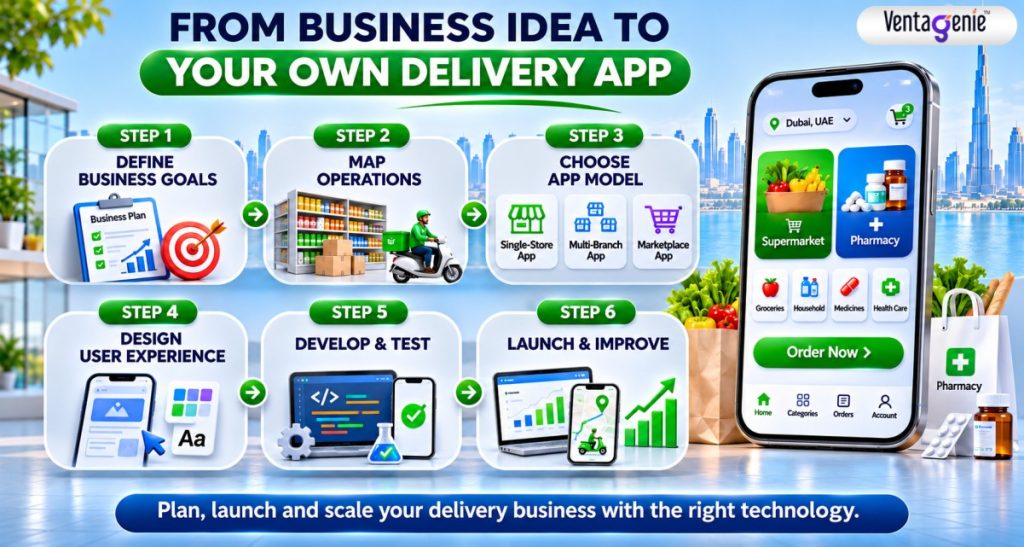
Step 1: Define goals and numbers
Be specific. Is your goal to move 20% of orders off aggregators in a year? To increase basket size? To retain pharmacy customers on refills? Clear goals shape the feature list and keep scope under control.
Step 2: Map your operations
A great app on top of a messy operation just spreads the mess faster. Decide how you will pick, pack and deliver. Will stores fulfil orders, or will you open a small dark store? Will you use your own riders, a third-party fleet, or both?
Step 3: Choose your model and MVP scope
Start with the smallest version that delivers real value, even if your long-term goal is to make an app like Talabat: catalogue, cart, checkout, tracking, admin panel, rider app. Put advanced features on a phase-two list.
Step 4: Design for trust and speed
Good UX in grocery means few taps to reorder. In pharmacy, it means clarity and reassurance. Test prototypes with real customers and store staff before development starts.
Step 5: Build, integrate and test
Development typically runs in sprints with regular demos. Test on real devices, on weak mobile networks and with realistic data volumes. Run a pilot in one area or branch before the full rollout.
Step 6: Launch with a plan
Do not rely on the app stores to bring customers. Use your in-store footfall: QR codes at checkout, receipts, shelf talkers, WhatsApp broadcasts to existing customers, and launch-week offers that reward first orders.
Step 7: Measure and improve
Track repeat-order rate, average order value, delivery time, substitution rate, cancellation reasons and customer support tickets. Improve the weakest metric each month.
How Much Does It Cost and How Long Does It Take?
Honest answer, whether you want a lean grocery app or plan to create an app like Talabat: it depends on scope, and anyone who quotes a fixed price without understanding your operation is guessing.
As a general guide, a focused single-brand delivery app with customer app, rider app and admin panel is a matter of months, not weeks. A multi-branch system with deep ERP integration takes longer. A full multi-vendor marketplace takes longer still.
The main cost drivers are:
- Number of apps (customer, rider, picker, vendor)
- Level of integration with your POS and ERP
- Custom design versus template-based foundations
- Advanced modules like pharmacy verification, loyalty engines or analytics
- Ongoing hosting, support, maps and SMS or payment fees
A smart way to control budget is to begin with a proven foundation and customise it to your brand, rather than reinventing every module. That is how many retailers go live faster and keep early costs predictable. Ask any vendor for a clear breakdown of build cost versus recurring cost so there are no surprises after launch.
Realistic Ways to Make the App Pay for Itself
- Reduce aggregator dependency on repeat customers, saving commission on every order you shift
- Raise average basket size with bundles, “frequently bought together” suggestions and free-delivery thresholds
- Run targeted promotions based on purchase history instead of blanket discounts
- Sell private-label and high-margin products through featured placements
- Offer subscriptions such as free delivery for a monthly fee, or auto-refills for pharmacy
- Monetise brand placement with suppliers who want visibility in your app, where appropriate
The retailers who succeed treat the app as a retention engine, not just another sales channel.
Common Mistakes to Avoid
- Trying to copy a giant platform on day one. Focus on the core experience.
- Ignoring inventory accuracy. Out-of-stock surprises destroy trust faster than slow delivery.
- Underestimating delivery operations. Riders, packaging and dispatch matter as much as software.
- Skipping Arabic. You will lose a large segment of customers.
- Treating pharmacy like grocery. Compliance and pharmacist involvement are non-negotiable.
- No launch marketing. A great app nobody downloads is still a failure.
- Choosing a vendor on price alone. Cheap builds often cost more in rework, security gaps and missed integrations.
How to Choose the Right App Development Partner
When you shortlist agencies, ask these questions:
- Have you built on-demand delivery or e-commerce apps before? Can I speak to a client?
- How do you handle UAE-specific needs like Arabic, VAT, local payment gateways and data protection?
- Who owns the source code and data after launch?
- What does post-launch support look like, and what is the response time?
- Can you show a working demo, not just slides?
- How do you handle scaling when order volume grows?
Transparency is the best signal. A trustworthy partner explains trade-offs, says no to unnecessary features, and puts everything in writing.
Ready to Build Your Own Delivery App?
If you want to create an app like Talabat, build an app like Instashop, or launch your own Careem Quik-style grocery or pharmacy delivery platform, VentaGenie can help you scope it properly, avoid expensive detours and go live with confidence.
Our team works with retailers to turn the idea into a working, branded, bilingual app with customer, rider and admin tools built for the UAE market.
Book a free consultation with VentaGenie and we will review your operation, recommend the right model and give you a clear roadmap, timeline and cost breakdown. No pressure, just straight answers.
Frequently Asked Questions
Yes, you can build an app with the same core experience, such as browsing, ordering, live tracking and online payment, tailored to your own catalogue and customers. You do not need to replicate a full multi-vendor marketplace unless that is your business model.
Pharmacies can offer delivery within the limits set by health authorities such as MOHAP, DHA and DOH. Rules vary by emirate and by medicine category, especially for prescription and controlled drugs. Always confirm current requirements with your regulator before launch.
A focused MVP typically takes a few months, depending on integrations, design and testing. A phased approach, starting with core features and expanding afterwards, gets you to market faster.
Not necessarily. Many retailers start with a mix of in-house riders and third-party delivery partners, then adjust as volume grows. Your app should support both.
Yes. Bilingual Arabic and English support with proper RTL design is essential in the UAE market.
It depends on your goals. A customizable, proven foundation usually launches faster and costs less up front, while a fully custom build offers maximum flexibility. A good partner will recommend what fits your stage of growth.
An app like Talabat is usually a multi-vendor marketplace, with many restaurants and shops listed, plus an inventory-led dark-store arm for groceries. An app like Noon Minutes is a single-operator quick-commerce model where one company owns the stock and fulfils orders from nearby mini stores. For a supermarket or pharmacy chain, the single-operator model is simpler and faster to launch.
Most pharmacy chains start with a single-brand app so that every order passes through their own licensed pharmacists. A marketplace of several pharmacies is possible but adds regulatory and quality-control complexity, so confirm the rules with your health authority first.

Mr. Aniket D is a seasoned digital marketer with over 10 years of experience in market research, content strategy, and performance marketing.
He specializes in analyzing consumer behavior, identifying emerging market trends, and translating insights into actionable digital strategies.
His work focuses on blending research-driven content with SEO and lead generation to drive measurable business growth.
Known for his data-first mindset, Aniket helps brands make smarter, audience-focused decisions in competitive markets.