
How to Calculate the Profitability of Each Delivery Order ?
You checked your app today. Orders are coming in. Riders are out on the road. Payments are landing in your account. Everything looks fine.
But late at night, when it’s quiet, a different question creeps in:
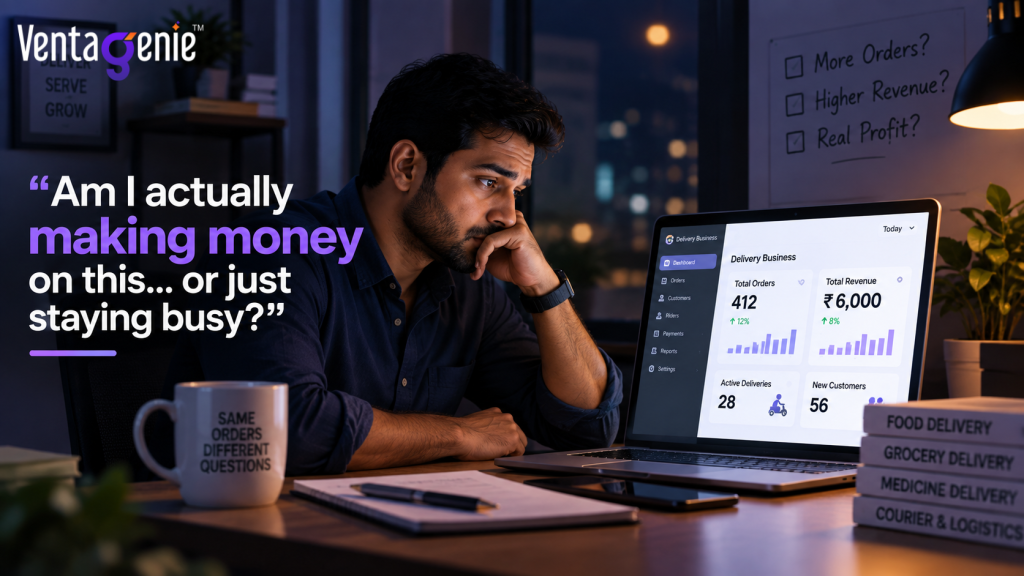
“Am I actually making money on this… or just staying busy?”
If you’ve ever felt that, you’re not alone. Most delivery business owners — whether you’re running food delivery, grocery, medicine, or a courier/logistics service — feel this exact same doubt at some point. And the honest truth is: being busy and being profitable are two completely different things.
Let’s talk about this the way one owner would talk to another. No jargon. No finance-textbook language. Just real talk.
Quick Answer
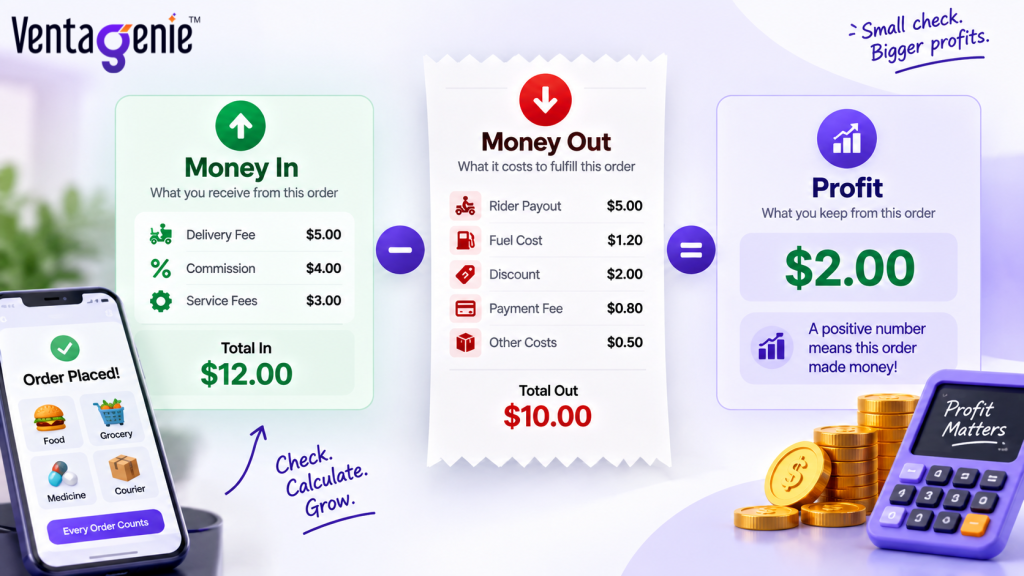
Delivery order profitability is calculated as: Order Revenue (delivery fee + commission + service fees) minus Order Cost (rider payout, payment processing fees, discounts, and operational overhead). A positive result means the order made money; a negative result means it cost the business money, even if the sale itself looked successful.
This single calculation, repeated across every order, tells a delivery business far more than total revenue or order volume ever can.
The Question Nobody Asks Enough
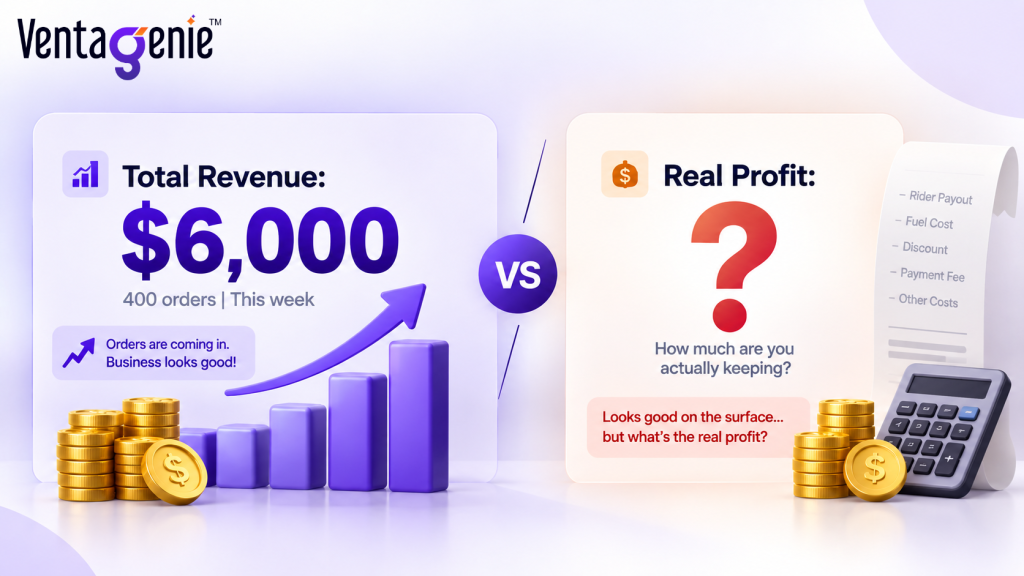
Every owner tracks total sales. “We did 400 orders today.” “Revenue was $6,000 this week.” That feels good to say.
But almost nobody checks: “On THIS one order — did I actually make money, or did I just move money around?”
Because here’s the truth — some of your orders are making you money. And some of them, quietly, every single day, are costing you money. And unless you check order by order, you’ll never know which is which.
Why This Happens To Good Owners?
You’re not bad at business. This isn’t about you doing something wrong. It’s about the nature of delivery itself — the costs are hidden in plain sight:
- The rider payout feels small… but it adds up per order.
- The discount you gave to win a new customer felt worth it… but did you check if it made the order lose money?
- The “just $2 more” delivery fee you were scared to charge… might be the exact amount separating profit from loss.
- Fuel, packaging, payment gateway charges — these nibble away at margins so quietly you don’t notice until you zoom out.
None of these show up loudly. They show up quietly, order after order, until one day you look at your bank balance and wonder where the money went — even though you were “busy” all month.
A Simple Way to Check, Right Now
Take one single order from today. Just one. And ask:
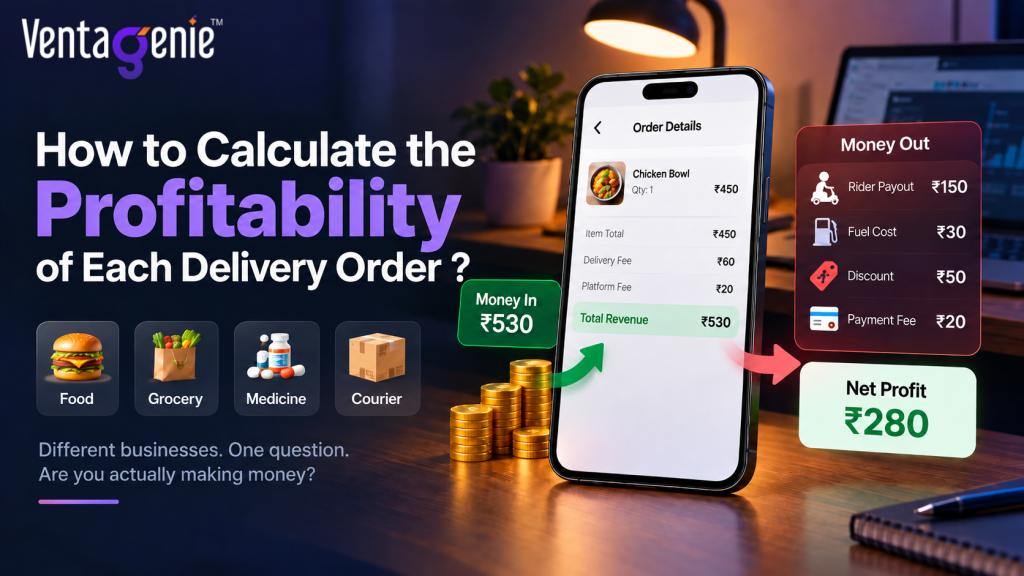
Money that came in (delivery fee + commission you earned) minus Money that went out (rider pay + discount given + payment processing fee + any extra cost) = ?
If that number is positive — good, that order helped your business. If it’s small or negative — that order quietly hurt you, even though it looked like a normal sale.
Now imagine doing that for every order, every day, across food orders, grocery baskets, medicine deliveries, and courier drops. That’s the real picture of your business — not the total sales number, the per-order number.
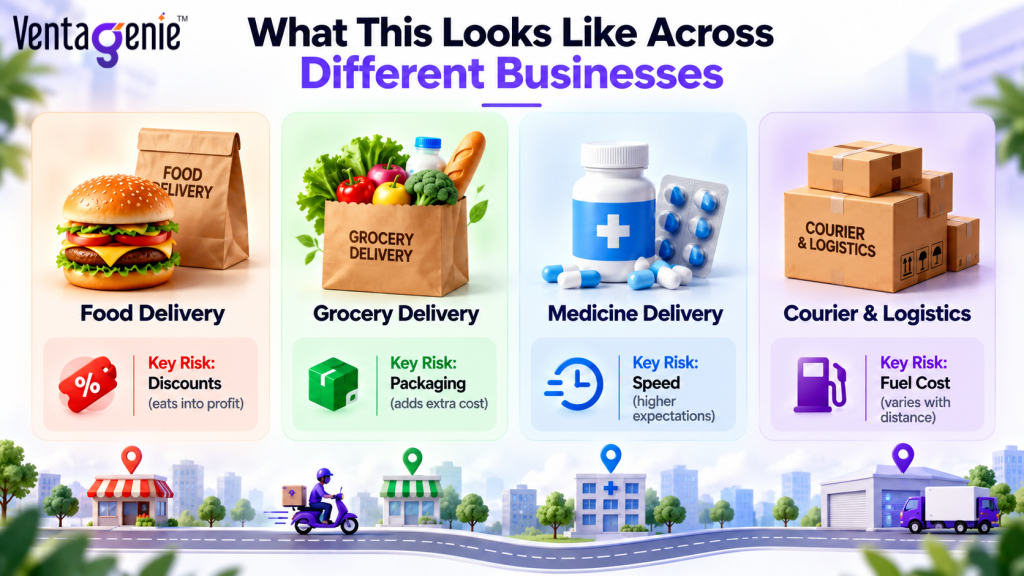
What This Looks Like Across Different Businesses
If you run food delivery
Your biggest risk is usually discounts and short-distance orders where the rider payout eats most of the margin.
If you run grocery delivery
Small basket orders and packaging costs are usually your silent profit-killers.
If you run medicine delivery
Speed matters most to customers, but fast/dedicated riders cost more, so many medicine orders can slip into loss without careful pricing.
If you run logistics or courier
Fuel and distance changes day to day, so what was profitable last month may not be profitable this month if you’re not watching closely.
Different business, same lesson: the danger isn’t in your business model — it’s in not measuring it order by order.
What This Looks Like Across Different Businesses (With Real Numbers)
Food Delivery — Where Discounts Quietly Eat Your Margin
A customer orders food worth $20.
Component | Amount |
Delivery fee (customer pays) | $3.00 |
Restaurant commission (15% of $20) | $3.00 |
Total Revenue | $6.00 |
Rider payout | $4.00 |
Payment processing (2%) | $0.50 |
Discount coupon used | $1.00 |
Total Cost | $5.50 |
Order Profit | $0.50 |
The honest read: You made fifty cents. Not zero, not a loss — but if that discount coupon had been $1.50 instead of $1.00, this order would have lost you money. Food delivery margins are this thin, this often. Your biggest risk: discounts and short-distance orders where the rider payout eats most of the margin.
Grocery Delivery — Where Small Baskets Are the Silent Killer
A customer orders groceries worth $40.
Component | Amount |
Delivery fee | $2.00 |
Store commission (10% of $40) | $4.00 |
Total Revenue | $6.00 |
Rider payout | $3.50 |
Packaging cost (bags, boxes) | $0.50 |
Payment processing | $0.80 |
Total Cost | $4.80 |
Order Profit | $1.20 |
The honest read: This order actually did well — $1.20 profit. But notice: if the basket had been $15 instead of $40, your commission drops to $1.50, and suddenly this same order barely breaks even. Your biggest risk: small basket orders and packaging costs quietly draining what looked like a healthy margin.
Medicine Delivery — Where Speed Costs More Than You Think
A customer orders medicine worth $25.
Component | Amount |
Delivery fee | $3.00 |
Pharmacy commission (8% of $25) | $2.00 |
Total Revenue | $5.00 |
Rider payout (fast/dedicated rider) | $5.00 |
Payment processing | $0.50 |
Special handling (cold-chain, etc.) | $0.50 |
Total Cost | $6.00 |
Order Profit | −$1.00 (a loss) |
The honest read: This order lost you a dollar — and it probably felt completely normal when it happened. Customers expect medicine to arrive fast, and fast costs more. Your biggest risk: speed and dedicated riders costing more than the order can cover, unless pricing accounts for it.
Logistics/Courier — Where Fuel Changes the Math Every Month
A business sends a package across the city.
Component | Amount |
Delivery charge | $8.00 |
Total Revenue | $8.00 |
Driver payout (distance-based) | $5.00 |
Fuel cost | $1.50 |
Payment processing | $0.30 |
Vehicle maintenance (allocated) | $0.70 |
Total Cost | $7.50 |
Order Profit | $0.50 |
The honest read: Fifty cents of profit today — but fuel prices move. If fuel cost rises to $2.50, this same order flips to a loss without you changing anything else. Your biggest risk: fuel and distance shifting month to month while your pricing stays the same.
The Pattern Across All Four
Industry | Typical Order Profit | Silent Risk |
🍔 Food | ~$0.50 | Discounts + short-distance rider cost |
🥦 Grocery | ~$1.20 | Small baskets + packaging cost |
💊 Medicine | −$1.00 (loss) | Speed + special handling |
📦 Logistics | ~$0.50 | Fuel + distance volatility |
Different business, same lesson: the danger isn’t in your business model — it’s in not measuring it order by order.
You Didn't Start This Business to Do Math All Day
Here’s the honest part — you started this business to serve customers, build something of your own, maybe give your family something better. You didn’t start it to sit with spreadsheets every night trying to figure out where your margin disappeared.
Manually calculating profitability per order works for a handful of transactions. It becomes impractical at scale, when hundreds or thousands of daily orders involve constantly shifting rider incentives, discount codes, surge pricing, and payment processing rates.
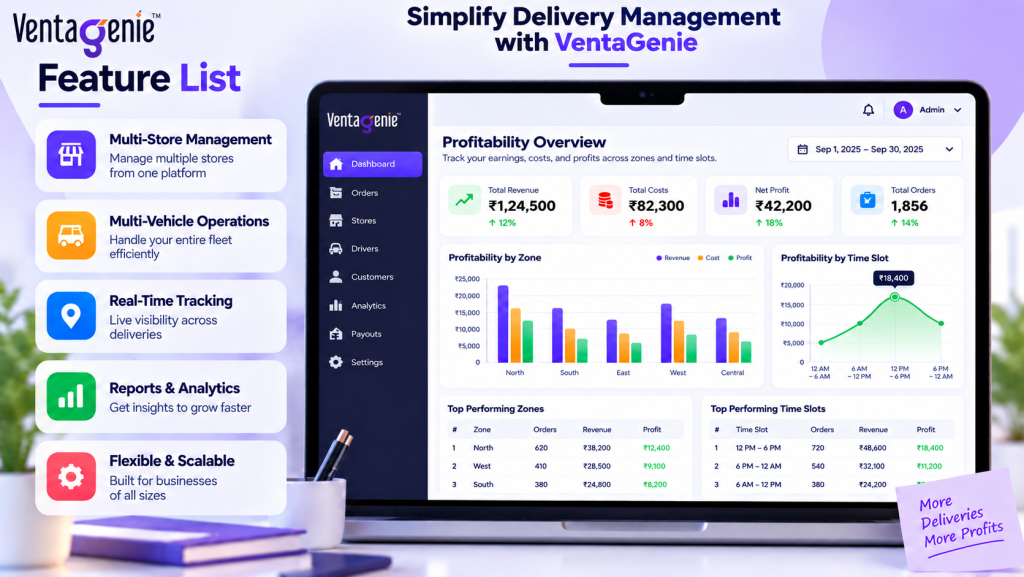
This is the exact problem Ventagenie’s delivery app development solutions are built to solve. Ventagenie has worked with delivery businesses across food, grocery, medicine, and logistics verticals to build platforms where profitability tracking is a core system feature rather than a manual afterthought:
Real-time profitability engine
Automatically calculates revenue and cost for every order as it’s placed and fulfilled.
Segmented analytics dashboards
View profitability by zone, time slot, order type, and vertical.
Configurable pricing and commission rules
Adjust delivery fees, minimum order values, and commission tiers directly from an admin panel.
Multi-vertical architecture
A single platform adaptable across food, grocery, medicine, and logistics business models.
Scalable infrastructure
Built to maintain accuracy whether processing hundreds or hundreds of thousands of orders daily.
One Last Thing, Owner to Owner
You already work hard enough. You don’t need more hustle — you need more clarity. Knowing your real, per-order profit isn’t about becoming a finance expert. It’s about finally being able to answer that late-night question with confidence instead of doubt:
“Yes — I know exactly where my money is going, and I know exactly where it’s coming from.”
That peace of mind is worth building for.
Ready to finally see the real profit behind every delivery order? Talk to Ventagenie — and build a delivery app that works as hard, and as smart, as you do.
Frequently Asked Questions
Revenue is the total money collected from an order (delivery fees, commissions, service fees). Profit is what remains after subtracting all costs — including rider pay, processing fees, discounts, and overhead. An order can generate revenue while still losing money once costs are subtracted.
Medicine delivery typically requires faster turnaround times, dedicated riders, and sometimes special handling (such as temperature-controlled transport), all of which raise the cost side of the equation without necessarily raising commission or delivery fee revenue proportionally.
Ideally, in real time or daily. Costs like fuel prices, rider incentive structures, and discount campaigns change frequently, so profitability should be monitored continuously rather than reviewed only at the end of a month or quarter.
Yes. High order volume reflects demand, not profitability. If the cost to fulfill each order exceeds the revenue it generates, increasing order volume can increase losses rather than reduce them.
Manual tracking (spreadsheets) becomes impractical beyond a small order volume, since costs like rider payouts, discounts, and processing fees change constantly. Most scaling delivery businesses use automated tracking built into their delivery app platform.
Mr. Aniket D is a seasoned digital marketer with over 10 years of experience in market research, content strategy, and performance marketing.
He specializes in analyzing consumer behavior, identifying emerging market trends, and translating insights into actionable digital strategies.
His work focuses on blending research-driven content with SEO and lead generation to drive measurable business growth.
Known for his data-first mindset, Aniket helps brands make smarter, audience-focused decisions in competitive markets.