How Delivery Businesses Make Money: 7 Revenue Models Explained
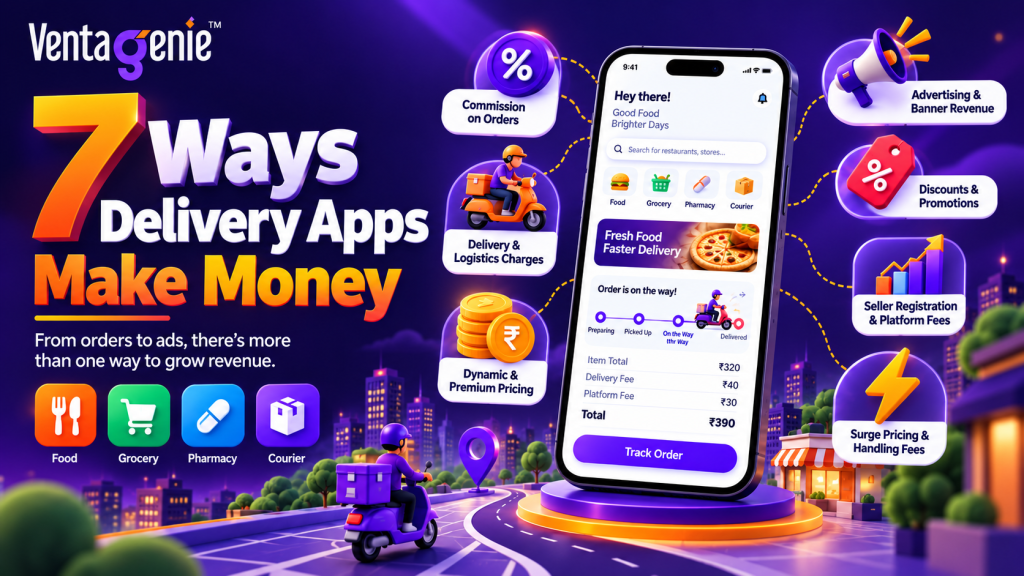
If you’ve ever opened Swiggy, Zomato, DoorDash, or Amazon and wondered “how does this app even make money when delivery is free and discounts are everywhere?” — you’re not alone. It’s one of the first questions every founder asks before they decide to build an app like this.
The truth is, a delivery business rarely earns money from just one place. It stacks several small revenue streams together, and each one adds up. In this blog, we’ll break down the 7 most effective revenue models used by successful delivery businesses today, with real examples of big players who nailed it, and how a platform like Ventagenie helps you set all of this up without writing a single line of code.
Let’s get into it.
What Is a Delivery App Revenue Model?
A delivery app revenue model explains how your platform generates income from customers, sellers, delivery partners, or other businesses using the platform.
For example, imagine you operate a multi-vendor food delivery marketplace.
A customer orders food worth $50.
Your platform could potentially earn through:
- A commission from the restaurant
- A delivery fee from the customer
- A service or convenience fee
- A monthly membership
- Sponsored restaurant listings
- Promotional advertising
This means one order can contribute to more than one revenue stream.
The goal is not simply to charge users more. It is to create a model where customers receive value, sellers get more business, delivery operations remain efficient, and the platform earns sustainable revenue.
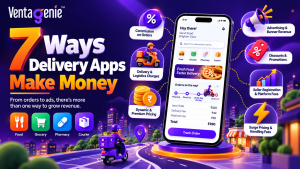
7 Revenue Models for Delivery Businesses
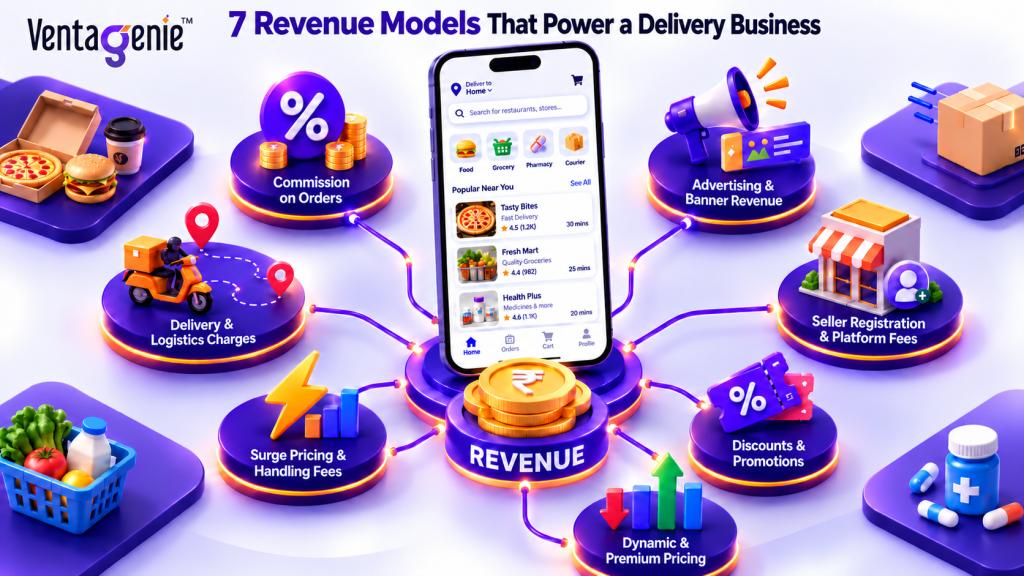
Quick Look: Who Uses What
Revenue Model | Big Players Using It |
Commission on Orders | Zomato, Swiggy, DoorDash, Uber Eats, Amazon, Grubhub |
Delivery & Logistics Charges | Amazon, Instacart, Zepto, Blinkit, Uber Eats, Deliveroo |
Surge Pricing & Handling Fees | Uber, Uber Eats, Ola, Deliveroo |
Advertising & Banner Revenue | Amazon, Zomato, Swiggy, Flipkart |
Seller Registration & Platform Fees | Amazon, Flipkart, Meesho |
Discounts & Promotions | Zomato, Swiggy, Myntra, Amazon |
Dynamic & Premium Pricing | Uber, Airlines, Zepto, Blinkit |
1. Commission on Every Order (The Bread and Butter)
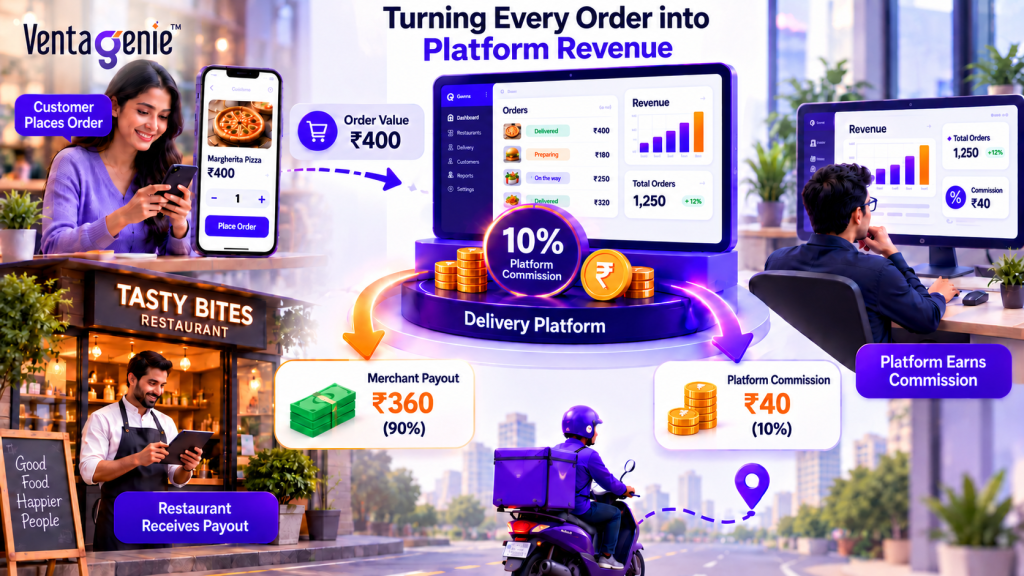
This is the most common way delivery and marketplace apps earn money. Every time a seller (restaurant, store, or vendor) makes a sale through the platform, the company takes a small cut — usually somewhere between 5% and 20%.
How it plays out in real life: Swiggy and Zomato both run on a commission model where restaurants pay a percentage of every order value to stay listed and get orders. DoorDash and Grubhub do the same with restaurants across the US, Uber Eats runs an almost identical model globally, and Amazon charges category-wise commission (called “referral fees”) to every seller on its marketplace.
How Ventagenie handles this:
Admins can configure commission seller-wise — so a new seller might pay 5%, while a high-volume seller pays 10%. On a ₹400 order at 10% commission, the platform earns ₹40 instantly, without touching pricing or inventory.
This model is popular because it scales automatically — the more your sellers sell, the more you earn, with zero extra effort.
2. Delivery & Logistics Charges
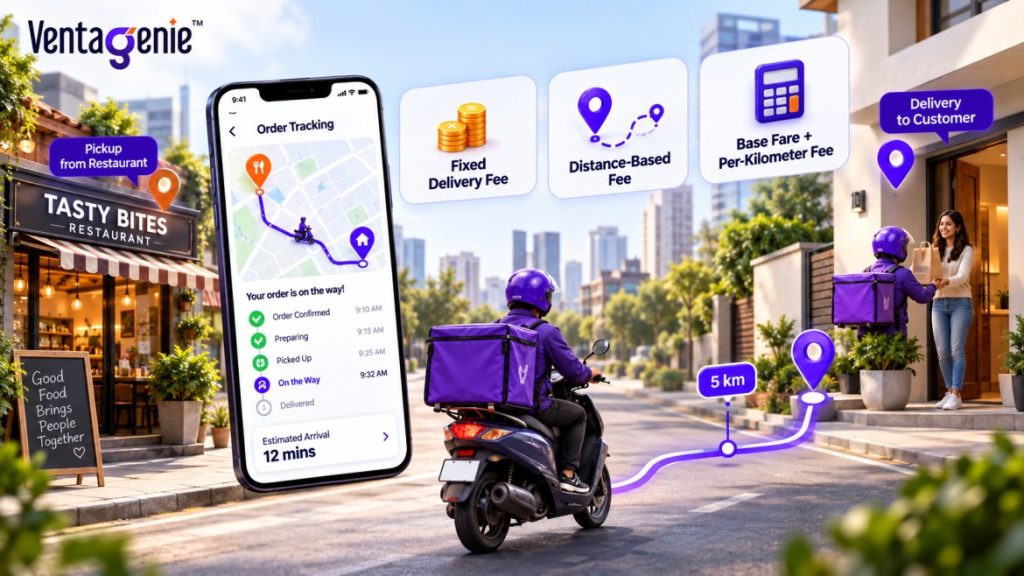
Someone has to pay for the rider, the fuel, and the last-mile hustle — and that’s usually the customer, at least partially. Delivery charges are a direct, dependable revenue stream that most people don’t even think twice about paying.
Real-world examples: Amazon charges delivery fees on orders below a certain value (unless you’re a Prime member). Instacart, DoorDash, and Uber Eats all charge delivery fees that vary by distance and demand. Zepto and Blinkit (India’s quick-commerce giants) built their entire business around fast delivery fees stacked on top of small basket sizes, and Deliveroo in the UK/Europe runs on the same distance-based logic.
How Ventagenie handles this: You can set delivery charges in three flexible ways:
1.Fixed charge — e.g., ₹50 flat, regardless of distance
2.Distance-based — e.g., ₹12/km, so an 8 km delivery earns ₹96
3.Base fare + per km — e.g., ₹40 base + ₹10/km, so a 6 km delivery earns ₹100
You can also configure charges differently by store type — grocery, pharmacy, or bakery — since delivery cost economics differ across categories.
3. Surge Pricing & Handling Charges
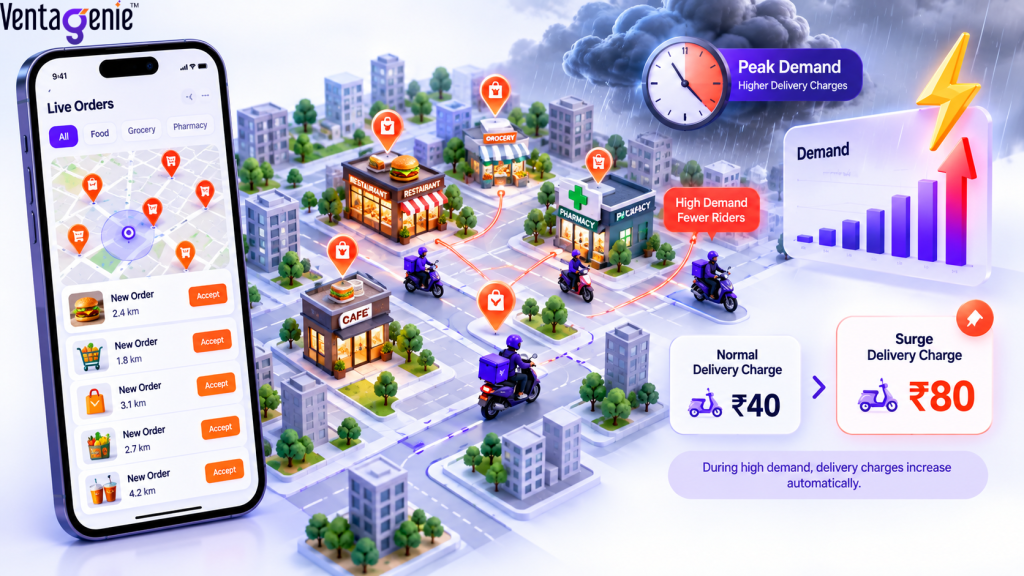
Ever ordered food during a thunderstorm or on New Year’s Eve and noticed the price was a little higher? That’s surge pricing — and it’s one of the smartest ways delivery apps balance supply and demand while boosting revenue during peak hours.
Big player example: Uber and Uber Eats pioneered surge pricing at scale — prices go up automatically when demand outpaces available riders, encouraging more delivery partners to come online while managing customer expectations. Ola runs a similar surge model in India, and Deliveroo and Zepto both add rain/peak-hour surcharges during high-demand windows.
How Ventagenie handles this: Two levers are built in:
1.Handling charge — a small fee (say ₹30) for packing and processing every order
2.Surge charge — an extra fee (say ₹80) applied automatically during rain, festivals, or high-traffic hours
On a ₹1,000 order, that’s an extra ₹110 in pure margin — money that directly offsets your operational costs during the busiest, most expensive hours to run deliveries.
4. Advertising & Banner Revenue
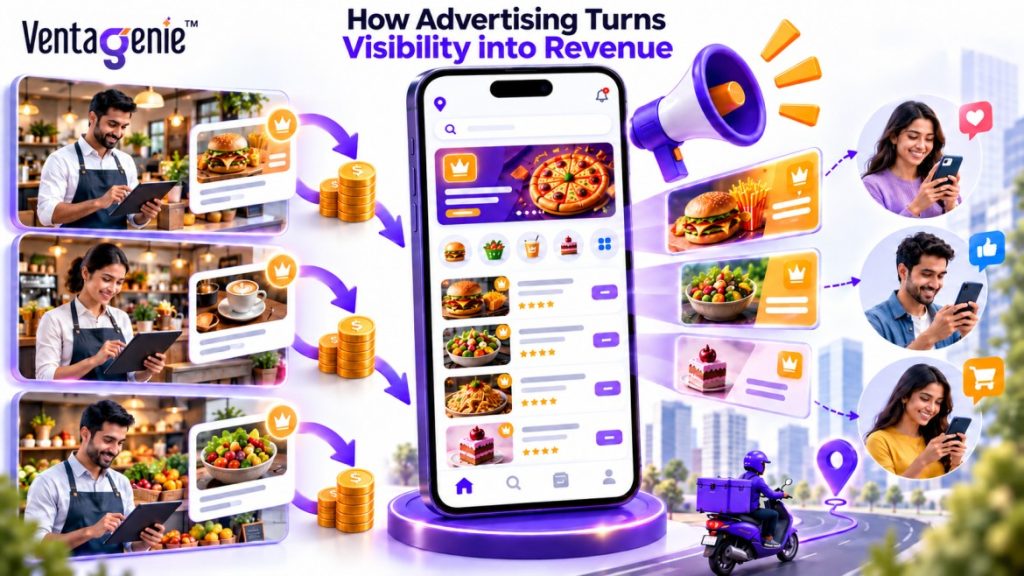
Once a delivery app has enough daily users, it becomes a mini advertising platform. Brands are willing to pay real money just to get seen by your customers first.
Real-world example: Amazon’s advertising business — sponsored product listings — has grown into one of its most profitable divisions, often more profitable than retail itself. Zomato and Swiggy both sell “featured restaurant” placements and homepage banners to brands wanting visibility, and Flipkart runs a nearly identical sponsored-listing model for sellers on its marketplace.
How Ventagenie handles this: The banner management module lets admins run:
1.Promotional banners (“Flat 20% off Electronics”) that drive traffic to specific categories
2.Sponsored brand banners where a brand pays a flat fee (say ₹50,000/month) purely for homepage visibility
3.Festival & flash sale banners that have shown daily sales jump from ₹2,00,000 to ₹5,00,000 during campaigns in real deployments
This is pure, high-margin revenue — you’re not selling a product, you’re selling attention.
5. Seller Registration & Platform Fees
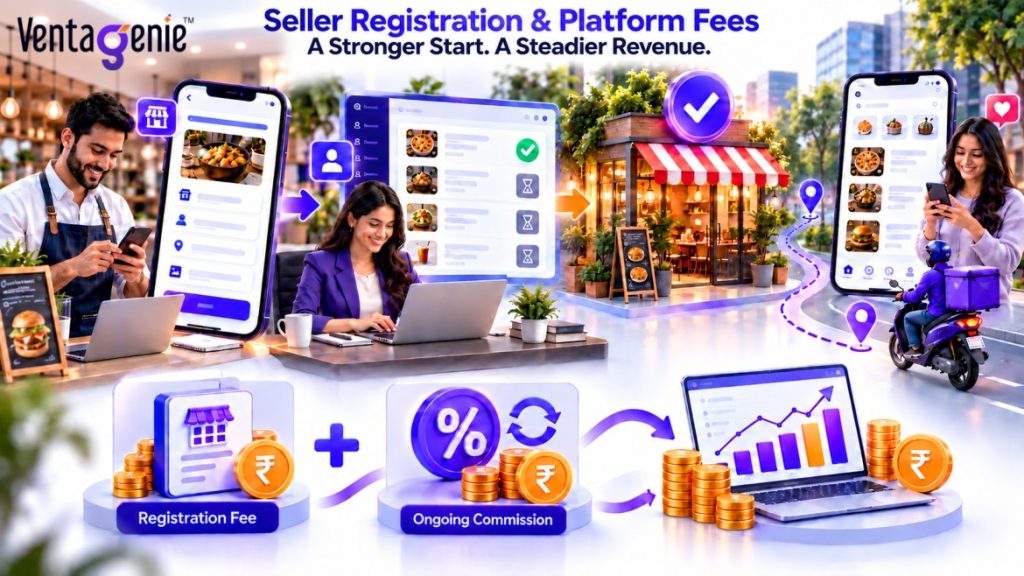
Instead of (or in addition to) commission, many marketplaces charge sellers a one-time or recurring fee just to join the platform. This creates upfront revenue and filters in sellers who are serious about growing on your platform.
Real-world example: Amazon charges a monthly “Professional Selling Plan” fee on top of commission, and Flipkart has similar seller subscription tiers. Meesho took a different route — keeping seller onboarding free but monetizing through ads and value-added services instead — proving there’s more than one way to structure this model depending on your market.
How Ventagenie handles this: A seller pays a one-time registration fee (say ₹5,000) and in return gets a reduced commission rate (say 9% instead of 10%). If that seller does ₹2,00,000 in monthly sales, you earn ₹5,000 upfront plus ₹18,000 in recurring commission — combining a quick win with long-term revenue.
6. Discounts & Promotions That Increase Order Volume
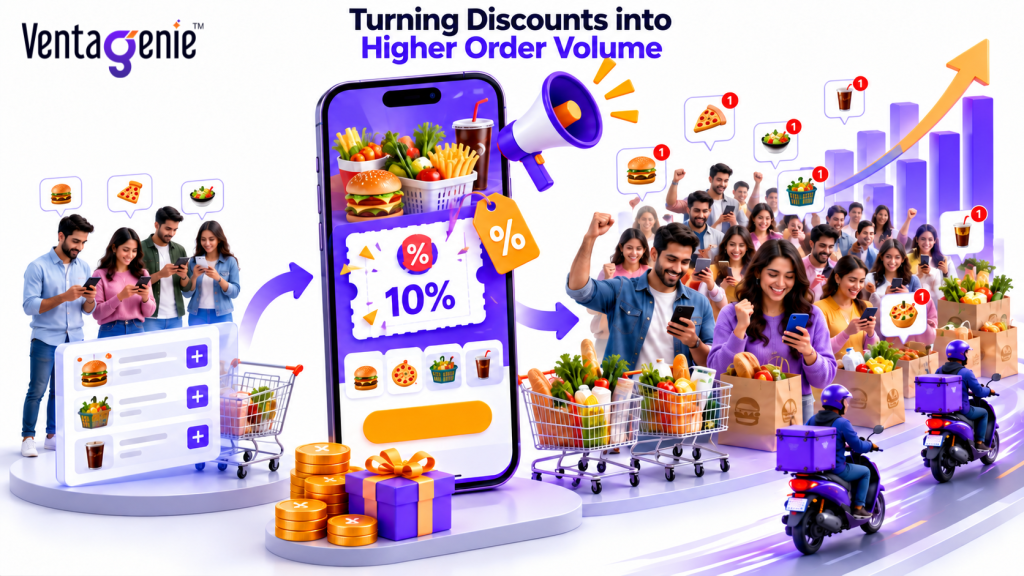
This one sounds counterintuitive — how does giving a discount make you more money? The answer: volume. A well-designed discount doesn’t shrink your revenue, it multiplies your order count enough to more than make up for the lower margin per order.
Real-world example: Zomato and Swiggy run festival campaigns (Diwali, New Year) with steep discounts specifically because order volume during these windows jumps 2-3x, and the platform still earns more in total commission and delivery fees than on a normal day. Amazon’s Great Indian Festival and Myntra’s End of Reason Sale follow the exact same logic — deep discounts, but volume so high that total revenue still climbs.
How Ventagenie handles this: Say a store runs a 10% off campaign: before the offer, it’s 100 orders/day at ₹2,000 average (₹2,00,000/day). During the offer, orders jump to 160/day at a slightly lower ₹1,800 average — but total revenue still climbs to ₹2,88,000/day. Minimum-order-value coupons work the same way: a customer planning to spend ₹4,200 pushes their cart to ₹5,000 just to unlock a ₹500 discount coupon, netting the platform ₹800 more in sales than it “lost” on the discount.
7. Dynamic & Premium Pricing
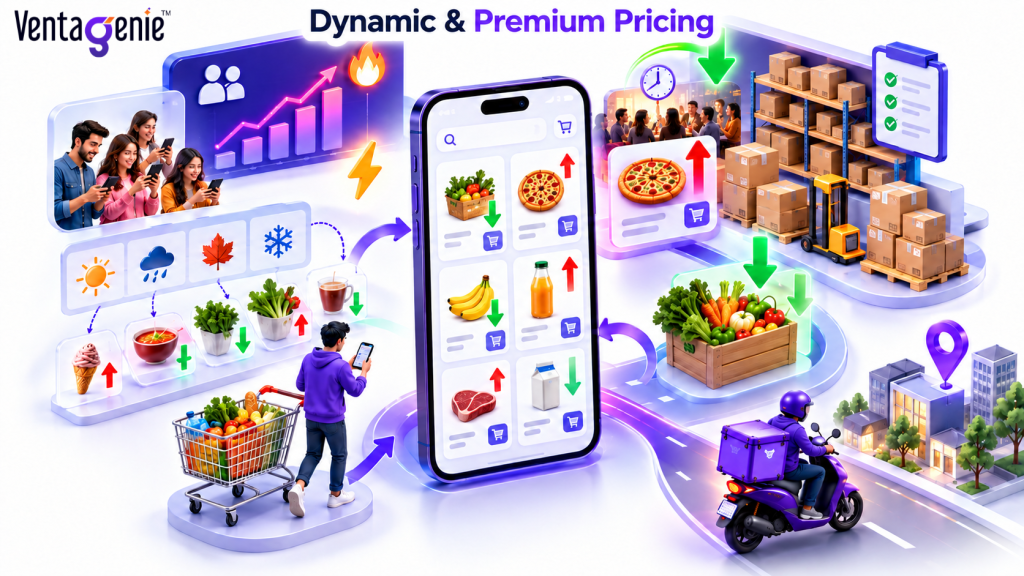
Prices don’t have to stay fixed. Smart delivery businesses adjust prices based on demand, season, and stock levels — sometimes going up during high-demand windows, and down when they need to move volume.
Real-world example: Airlines and Uber have used dynamic pricing for years, but quick-commerce platforms like Zepto and Blinkit now do the same — raising prices slightly on rainy days or festival evenings when demand for delivery spikes, and running clearance-level discounts to move slow inventory.
How Ventagenie handles this: Admins can raise prices on high-demand items (a raincoat going from ₹800 to ₹880 during monsoon, for instance) or drop prices to move volume (a thali dropping from ₹200 to ₹170 that ends up selling 18 units instead of 10, actually pushing total revenue up from ₹2,000 to ₹3,060). Clearance sales at 30% off old stock free up warehouse space and inventory while still generating cash flow instead of dead stock sitting unsold.
Which Revenue Model Is Best for Your Delivery App?
There is no single model that works for every delivery business.
The right model depends on your business type.
Business Type | Recommended Revenue Models |
Food Delivery | Commission + Delivery Fee + Advertising |
Grocery Delivery | Commission + Delivery Fee + Subscription |
Pharmacy Delivery | Delivery Fee + Commission + Subscription |
Courier Delivery | Delivery Fee + B2B Contracts |
Multi-Vendor Marketplace | Commission + Advertising + Service Fee |
Quick Commerce | Delivery Fee + Subscription + Product Margin |
Meal Subscription | Subscription + Delivery Fee |
Local Retail Delivery | Commission + Delivery Fee + B2B |
The strongest businesses often combine multiple models instead of depending on just one.
So, Which Model Should You Pick?
Here’s the thing — you don’t have to pick just one. Every big name you know — Amazon, Swiggy, Zomato, DoorDash, Uber Eats, Instacart, Blinkit, Zepto, Flipkart, and Deliveroo — runs on a combination of these 7 models at the same time. Commission funds the core business, delivery charges cover logistics, surge pricing protects margins during peak hours, advertising becomes a high-profit side business, and promotions keep customer growth compounding.
That’s exactly why Ventagenie’s Revenue Generation Module isn’t built around a single pricing switch — it’s built as a complete toolkit. Whether you want to launch a food delivery app, a grocery/quick-commerce app, a pharmacy delivery app, or a full multi-vendor marketplace, you can mix and match commission structures, delivery charge models, surge pricing, banner ads, registration fees, and promotional campaigns — all configurable from a single admin panel, without touching code.
Ready to Build an App Like Swiggy, DoorDash, or Amazon?
If you’re planning to build an app like these big players, the real differentiator isn’t just the UI — it’s whether your revenue engine is solid from day one. Ventagenie gives you a ready-made, proven revenue framework so you’re not guessing how to monetize after launch — it’s baked in from the start.
Whether you want to build an app like Swiggy, an app like DoorDash, an app like Zomato, or even an app like Amazon or Blinkit, Ventagenie’s delivery app development solution helps you launch faster with a revenue model that’s already tested in the real world.
Want to build your own profitable delivery app?
VentaGenie helps businesses launch branded ordering and delivery platforms for food, grocery, pharmacy, courier, quick commerce, and multi-vendor businesses—with the flexibility to build around the revenue model that fits their business.
Build your delivery app. Choose your revenue model. Own your platform.
Frequently Asked Questions
Delivery apps typically use multiple revenue streams, including commissions on orders, delivery fees, service or handling charges, advertising, seller fees, subscriptions, promotions, and dynamic pricing. Most successful platforms combine several models rather than relying on a single source of income.
There is no single most profitable model for every delivery business. Commission, advertising, subscriptions, delivery fees, and premium pricing can all contribute to revenue. The best combination depends on your business type, customer base, order volume, and operating costs.
The commission rate depends on the category, market, seller agreement, and services provided by the platform. Many marketplace businesses use percentage-based commissions, while others combine commission with subscription or advertising fees. The key is to choose a rate that remains attractive to sellers while supporting your platform’s economics.
Yes. A platform can generate revenue through seller commissions, advertising, subscriptions, service fees, product margins, or other monetization methods. Some businesses may use free delivery as a customer-acquisition strategy while earning from other parts of the transaction.
A multi-vendor delivery app can monetize through seller commissions, delivery charges, sponsored listings, banner advertising, seller registration fees, subscriptions, service charges, and promotional campaigns. Combining multiple revenue streams can reduce dependence on any single source.
Large delivery platforms generally use a combination of merchant commissions, delivery or service fees, advertising, subscriptions, and other marketplace-related revenue streams. Their exact pricing structures vary by market, business category, and customer or merchant agreement.
You need a delivery platform with configurable monetization features such as seller commissions, delivery charges, promotional campaigns, advertising, registration fees, and dynamic pricing. A solution such as VentaGenie can provide these capabilities through an integrated delivery and marketplace platform.
.
Yes. A flexible delivery platform can apply different commission rates, delivery charges, promotions, or pricing rules based on seller, product category, location, order value, or business requirements.
Once a delivery platform has a significant customer base, sellers and brands can pay for additional visibility through sponsored listings, homepage placements, promotional banners, and featured products. This allows the platform to monetize customer traffic beyond transaction fees.
A combination of restaurant commission + delivery fee + advertising is a common approach for food delivery marketplaces. Subscription or membership plans can also be added to encourage repeat orders and customer retention.
Grocery and quick-commerce businesses can combine product margins, delivery fees, subscriptions, promotional placements, and seller or brand advertising. The right combination depends on basket size, delivery distance, inventory model, and customer frequency.
Yes. VentaGenie is designed to support different monetization approaches, including commission structures, delivery charges, surge or handling charges, promotional campaigns, advertising and banner management, seller fees, and pricing configurations. This allows businesses to create a revenue strategy suited to their delivery model.

Mr. Aniket D is a seasoned digital marketer with over 10 years of experience in market research, content strategy, and performance marketing.
He specializes in analyzing consumer behavior, identifying emerging market trends, and translating insights into actionable digital strategies.
His work focuses on blending research-driven content with SEO and lead generation to drive measurable business growth.
Known for his data-first mindset, Aniket helps brands make smarter, audience-focused decisions in competitive markets.