If you are running a delivery business—food, grocery, pharmacy, or courier—you are no longer competing on price or speed. You are competing for customer dependency. The real challenge is not acquiring users, but staying relevant in their daily lives.
Take Michael, a delivery business owner who built a successful food delivery app. Early growth was strong—orders increased, users signed up, and the business scaled quickly. But within a year, growth slowed. Customers became inconsistent, acquisition costs rose, and users started switching between apps. Despite more spending on ads and discounts, retention didn’t improve.
The problem wasn’t execution—it was structure. His platform solved only one need, while customers had many. That limited usage, reduced lifetime value, and forced constant reliance on marketing.
- Myth 1: Customers Prefer Separate Apps
Fact :
Customers prefer convenience. If your platform solves multiple needs efficiently, they will choose one app over many.
This is where the Super App model becomes powerful—especially when focused on core categories like :
- Food
- Grocery
- Pharmacy
- Courier
This blog is a deep, practical guide from an owner’s perspective on how to build and scale a multi-category delivery business into a super app.
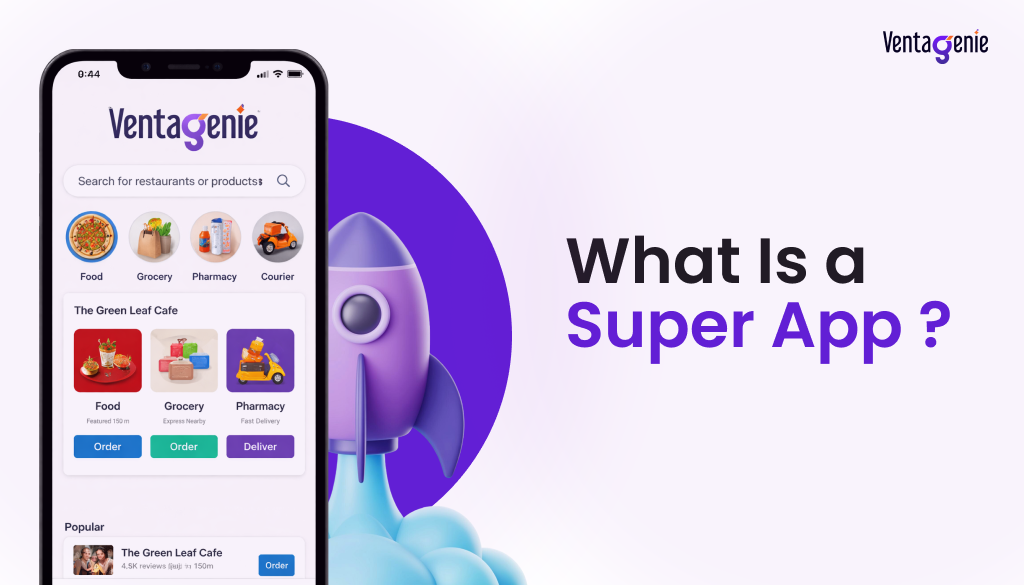
What Is a Super App ?
A Super App is a single platform where your customer can fulfill multiple daily needs without switching apps.
In your case, that means :
- Order food
- Buy groceries
- Order medicines
- Send packages
All inside one app.
But the real meaning is not about features.
It’s about increasing how often customers use your app—and how much they spend inside it.
- Myth 2 : A Super App Means Adding More Features
Fact :
A super app solution is not about adding services randomly. It’s about building a connected ecosystem where food, grocery, pharmacy, and courier work together to increase usage and revenue.
Key Challenges That Limit Delivery Business Growth
Let’s go deeper into what actually stops delivery businesses from scaling.
At a surface level, things may look fine—orders are coming, users are downloading the app, operations are running. But internally, most businesses are hitting invisible limits that slow down growth over time.
1. Growth Is Restricted by Usage Frequency
Every delivery category has a natural usage limit.
- Food drives frequent but time-bound orders
- Grocery drives higher value but lower frequency
- Pharmacy is need-based
- Courier is occasional
This creates a structural issue:
Your total growth is directly tied to how often your service is needed.
Even if you acquire more users, you cannot force them to order beyond their natural need. This caps :
- Order volume
- Revenue per user
- Overall scalability
2. Customer Acquisition Becomes a Continuous Cost
In most delivery businesses, growth is heavily dependent on :
- Paid marketing
- Discounts
- Promotional campaigns
Initially, this works. But over time :
- Cost per acquisition increases
- Quality of users decreases
- Retention becomes unstable
This creates a dependency:
You don’t control growth—your marketing spend does.
Instead of building a self-sustaining system, the business keeps feeding the same loop.
3. Lack of Customer Ownership
Customers today are platform-independent.
They :
- Use multiple apps
- Compare before ordering
- Switch based on price or convenience
This happens because:
Your platform is not essential—it is optional.
When you serve only one category, you become one of many choices, not the default platform.
This weakens :
- Brand power
- Retention
- Predictability of demand
4. Revenue Per User Remains Low
A single-category model limits how much a user can spend.
For example :
- A food user may order once or twice a day
- A grocery user may order weekly
But beyond that:
There is no additional revenue layer.
This restricts :
- Average revenue per user (ARPU)
- Customer lifetime value (LTV)
So even with growth, profitability remains under pressure.
5. Demand Is Time-Sensitive and Unbalanced
Delivery businesses often operate in peaks and gaps.
- Food → high demand during lunch/dinner
- Other hours → low activity
This leads to :
- Uneven revenue flow
- Operational inefficiency
- Planning challenges
You are busy at certain times and underutilized at others.
6. Logistics Efficiency Remains Low
Because demand is inconsistent :
- Drivers are overloaded at peak time
- Idle during non-peak hours
This results in :
- Poor fleet utilization
- Higher delivery cost per order
- Reduced margins
Even if order volume increases, efficiency does not improve proportionally.
7. Expansion without Integration Creates Complexity
Many businesses try to grow by adding services.
But they do it like this :
- Separate systems
- Separate vendor management
- No unified workflow
This creates :
- Operational confusion
- Data silos
- Slow decision-making
Instead of simplifying growth, expansion makes the business harder to manage.
8. No Cross-Category Monetization
Even when multiple services exist, they often operate in isolation.
This means :
- A food customer is not converted into a grocery customer
- A grocery user is not exposed to pharmacy services
So :
Each service grows separately, instead of strengthening each other.
This leads to lost opportunities in:
- Cross-selling
- Upselling
- Engagement
9. Over-Reliance on Discount-Driven Behavior
When growth depends on offers :
- Customers become price-sensitive
- Loyalty becomes transactional
- Profit margins shrink
You attract users who are looking for deals, not value.
This makes long-term sustainability difficult.
10. Business Feels Active but Lacks Real Growth
This is the most critical point.
From outside :
- Orders are happening
- Team is working
- App is running
But internally :
- Profit margins are thin
- Growth is unstable
- Retention is weak
The business is operationally active but strategically stuck.
Growth is no longer about getting more users.
It’s about getting more value from each user.
How a Super App Development Solution Solves This?
A proper super app development solution is not about adding more features.
It’s about building a connected system where multiple services work together to increase usage, improve efficiency, and grow revenue from the same customer.
Let’s break this down clearly.
1. Increases Daily Usage by Covering Multiple Needs
Instead of depending on one service, you combine :
- Food → daily usage
- Grocery → weekly usage
- Pharmacy → urgent needs
- Courier → utility usage
Now the same customer has multiple reasons to open your app.
More needs covered = more app opens = more orders
This is the core advantage of a super app solution—it removes the limitation of single-service usage.
2. Turns One-Time Users into Repeat Customers
In a single-service app :
- User comes → completes one task → leaves
In a multi-category delivery app development solution :
- User comes for food
- Stays for grocery
- Returns for pharmacy
This creates :
- Higher repeat rate
- Better retention
- Stronger customer relationship
You are no longer chasing users—you are keeping them inside your system.
3. Increases Revenue Per Customer (Without Extra Marketing)
Instead of spending more to get new users:
You earn more from existing users.
Example:
- One user → food order
- Same user → grocery order
- Same user → medicine order
Same customer = multiple revenue streams
This is how you scale profit, not just orders.
4. Reduces Dependency on Ads and Discounts
When your app becomes useful for multiple needs :
- Users return naturally
- You don’t need heavy offers
- Marketing cost reduces
Growth shifts from:
Paid growth → Organic usage
A strong super app development solution builds this internal growth system.
5. Improves Delivery Efficiency
With multiple services running together:
- Orders come throughout the day
- Not limited to peak hours
This helps :
- Better route planning
- Higher driver utilization
- Lower delivery cost
A multi-vertical app development solution ensures your logistics system runs continuously, not in bursts.
6. Creates a Unified and Easy-to-Manage System
Instead of :
- Separate apps
- Separate systems
- Separate operations
You get :
- One platform
- One dashboard
- One control system
This makes it easier to :
- Manage orders
- Track performance
- Scale operations
7. Enables Smart Cross-Selling
A well-built system connects services.
Example :
- After food → suggest grocery
- During grocery → show pharmacy
This leads to :
- More orders per user
- Higher engagement
- Better user experience
This is where a create app like super app approach becomes powerful.
8. Builds Strong Customer Dependency
When your app solves multiple problems :
- Customers rely on it
- They stop switching apps
- You become their default choice
You move from “one option” → to “main platform”
This is the real business advantage.
9. Supports Long-Term Scalability
A proper super app solution is built with :
- Scalable architecture
- Modular services
- Future expansion capability
So you can :
- Add new categories
- Expand to new markets
- Grow without breaking the system
10. Creates a Complete Business Ecosystem
At the end, you are not just running a delivery app.
You are building :
- A platform
- A user network
- A connected service system
Where :
- Users stay longer
- Spend more
- Return frequently
A super app development solution solves the core problem of delivery businesses:
Low usage, low retention, and limited revenue.
By combining services into one system, you:
- Increase usage frequency
- Improve customer lifetime value
- Reduce marketing dependency
- Build a scalable business
This is not feature expansion.
This is business transformation.
- Myth 3: Technology Is the Biggest Challenge
Fact:
Technology is important, but the real challenge is strategy and execution. A well-planned super app solution solves both.
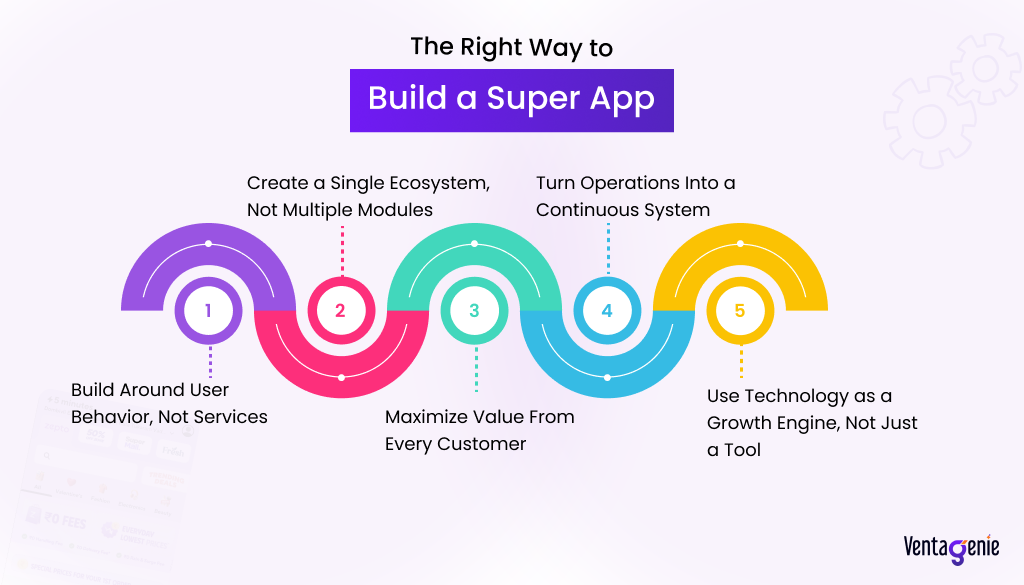
The Right Way to Build a Super App (A Strategic Solution)
The biggest mistake most businesses make is thinking they can build a super app by simply adding more services.
That approach fails.
Because a true super app solution is not built by stacking features—it is built by designing a connected business system where every service strengthens the other.
1. Build Around User Behavior, Not Services
Most businesses think in categories :
- Food
- Grocery
- Pharmacy
- Courier
But customers don’t think like that.
They think in daily needs.
A strong super app development solution is built around :
- Daily usage (food)
- Weekly planning (grocery)
- Urgent needs (pharmacy)
- Utility tasks (courier)
The goal is simple : make your app part of the customer’s routine.
When you align your platform with real-life behavior, usage becomes natural—not forced.
2. Create a Single Ecosystem, Not Multiple Modules
Many businesses launch multiple services, but they operate like separate apps.
That is not a super app.
A real multi-vertical app development solution creates :
- One user identity
- One wallet
- One data system
- One operational flow
Everything is connected.
This allows :
- Seamless movement between services
- Better tracking of customer behavior
- Stronger control over the entire system
You are not running services. You are running an ecosystem.
3. Maximize Value From Every Customer
Traditional growth focuses on:
- More downloads
- More installs
- More new users
But smart businesses focus on:
More revenue from the same user
A proper multi category delivery app development solution ensures :
- One customer uses multiple services
- One session leads to multiple actions
- One platform captures maximum spend
This is how you increase :
- Customer lifetime value (LTV)
- Average order value (AOV)
- Overall profitability
4. Turn Operations Into a Continuous System
In single-category apps, operations are inconsistent :
- High load at peak hours
- Low activity during off-hours
This creates inefficiency.
A strong super app solution balances demand across services :
- Food drives peak traffic
- Grocery fills mid-level demand
- Courier utilizes idle capacity
Now your operations become :
- Continuous
- Predictable
- Efficient
You stop reacting to demand—you start controlling it.
5. Use Technology as a Growth Engine, Not Just a Tool
Most apps are built to function.
Super apps are built to scale.
A proper super app development solution includes :
- Scalable backend architecture
- Real-time data processing
- Smart recommendation systems
- Integrated logistics management
This allows you to :
- Add new services easily
- Expand without system failure
- Maintain performance under growth
Technology should accelerate your business, not limit it.
6. Build Cross-Service Intelligence
The real power of a create app like super app strategy comes from data.
When multiple services are connected:
You can :
- Predict user needs
- Suggest relevant services
- Increase conversion without extra marketing
Example:
- Food user → grocery suggestion
- Grocery user → pharmacy reminder
This creates :
- Higher engagement
- More transactions
- Better user experience
7. Build a Platform That Customers Depend On
The ultimate goal is not usage—it is dependency.
When your platform handles :
- Food
- Grocery
- Pharmacy
- Courier
You become :
- A daily-use app
- A trusted service
- A default choice
At this point :
Customers stop searching for alternatives.
The best way to build a super app is not to think like a developer.
It is to think like a system builder.
A powerful super app development solution :
- Connects services
- Maximizes user value
- Optimizes operations
- Reduces growth cost
- Creates long-term scalability
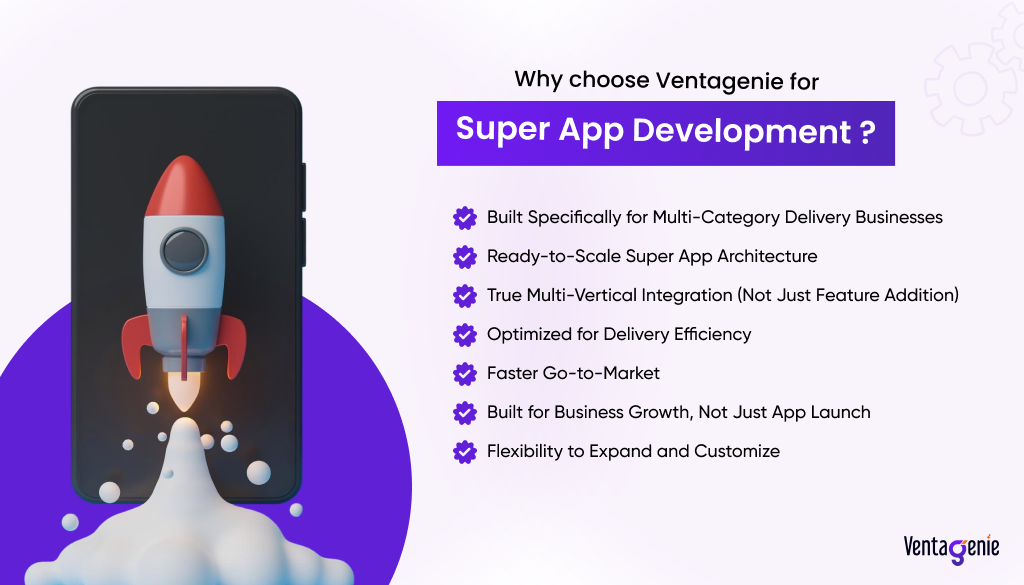
Why Ventagenie Is Positioned Perfectly for Super App Development ?
Most businesses fail at building a super app not because of strategy—but because of execution.
They either :
- Start with the wrong architecture
- Use disconnected systems
- Or rely on solutions that are not built for scale
This is exactly where Ventagenie creates a strong advantage.
1. Built Specifically for Multi-Category Delivery Businesses
Ventagenie is not a generic app development platform.
It is designed specifically for :
- Food delivery
- Grocery delivery
- Pharmacy delivery
- Courier services
This means you are not starting from scratch.
Instead, you are using a multi category delivery app development solution that already understands :
- Order flow
- Vendor management
- Delivery operations
- Customer behavior
You save time, cost, and avoid critical mistakes.
2. Ready-to-Scale Super App Architecture
Most platforms work fine at a small level—but break when you scale.
Ventagenie is built with a strong super app development solution architecture, which includes :
- Scalable backend systems
- High-performance order handling
- Multi-service integration capability
- Real-time data and tracking
This allows you to :
- Start small
- Expand fast
- Scale without rebuilding
You are building for growth from day one.
3. True Multi-Vertical Integration (Not Just Feature Addition)
Many solutions claim to support multiple services—but they operate separately.
Ventagenie provides a real multi-vertical app development solution, where :
- All services run inside one ecosystem
- One user can access everything
- One system manages all operations
This ensures :
- Smooth user experience
- Better cross-selling
- Higher engagement
This is what actually makes a platform a super app.
4. Optimized for Delivery Efficiency
Delivery is the backbone of your business.
Ventagenie focuses heavily on :
- Smart order allocation
- Route optimization
- Driver management
- Real-time tracking
This improves :
- Delivery speed
- Fleet utilization
- Cost efficiency
You don’t just get more orders—you handle them better.
5. Faster Go-to-Market
Building a super app from scratch takes :
- Time
- Capital
- Technical expertise
With Ventagenie, you can :
- Launch faster
- Test your market quickly
- Start generating revenue early
This gives you a strong competitive edge.
6. Built for Business Growth, Not Just App Launch
Ventagenie is not just about creating an app.
It helps you :
- Build a scalable system
- Increase customer retention
- Maximize revenue per user
- Reduce dependency on paid marketing
It aligns perfectly with the goal of a super app solution:
More usage. More value. More growth.
7. Flexibility to Expand and Customize
As your business grows, your needs change.
Ventagenie allows you to :
- Add new services
- Expand to new locations
- Customize features based on market demand
- Reduce dependency on paid marketing
This makes it easier to create app like super app without limitations.
To successfully build a super app, you need more than an idea.
You need :
- The right technology
- The right structure
- The right execution partner
Ventagenie brings all three together through a powerful super app development solution designed specifically for delivery businesses.
If your goal is to scale beyond a single service and build a long-term platform, Ventagenie is not just a tool—it is your growth foundation.
Final Conclusion:
Single-service delivery businesses will always face limits—low usage, high marketing costs, and weak customer retention.
A strong super app solution changes this by combining food, grocery, pharmacy, and courier into one platform, increasing usage, revenue, and customer dependency.
With the right super app development solution and a scalable multi category delivery app development solution, you don’t just grow—you build a system that sustains growth.
The future is not single apps. It’s platforms customers use every day.
Frequently Asked Questions
A super app is a single platform where users can access multiple services like food delivery, grocery, pharmacy, and courier without switching between apps. A well-built super app solution increases user convenience and business growth.
Because single-service apps have limited growth. A super app development solution helps increase:
- User engagement
- Revenue per customer
- Retention
It allows businesses to grow using existing users instead of constantly acquiring new ones.
The most effective combination is:
- Food delivery (daily usage)
- Grocery delivery (weekly usage)
- Pharmacy delivery (urgent needs)
- Courier services (utility use)
This creates a complete multi category delivery app development solution.
A regular app focuses on one service.
A super app solution connects multiple services into one system, increasing usage frequency and overall revenue.
No. A strong super app development solution allows you to start with one category and expand gradually while keeping the system scalable.
It increases revenue by:
- Encouraging repeat usage
- Enabling cross-selling between services
- Increasing customer lifetime value
One user generates multiple revenue streams.
Key challenges include:
- Managing multiple services
- Maintaining app performance
- Ensuring smooth user experience
- Optimizing logistics
A proper multi-vertical app development solution is required to handle these efficiently.
It depends on the approach. With a ready super app development solution, businesses can launch faster and expand over time instead of building everything from scratch.
Yes. With the right multi category delivery app development solution, even growing businesses can successfully build a super app without massive investment.
Ventagenie provides a complete super app solution designed for delivery businesses. It helps you :
- Launch faster
- Manage multiple services
- Scale efficiently
- Increase revenue and retention