The USA On-Demand Delivery Boom 2026: Who Is Actually Winning, and Where the Next Opportunity Lies
The Question Nobody Asks
Everyone talks about how big delivery is. Almost nobody asks the question that matters to a business owner:
“Out of all this money, who keeps the profit and the customer?”
Right now, in most cases, it is not the restaurant, the grocery store, or the local shop. It is the platform in the middle. That gap is the biggest opportunity in on-demand delivery in 2026, and this blog shows you how to see it, measure it, and build for it.
Why Every Market Number You Read Is Different
If you search for the size of US food delivery, you will find very different numbers. That is not a mistake.
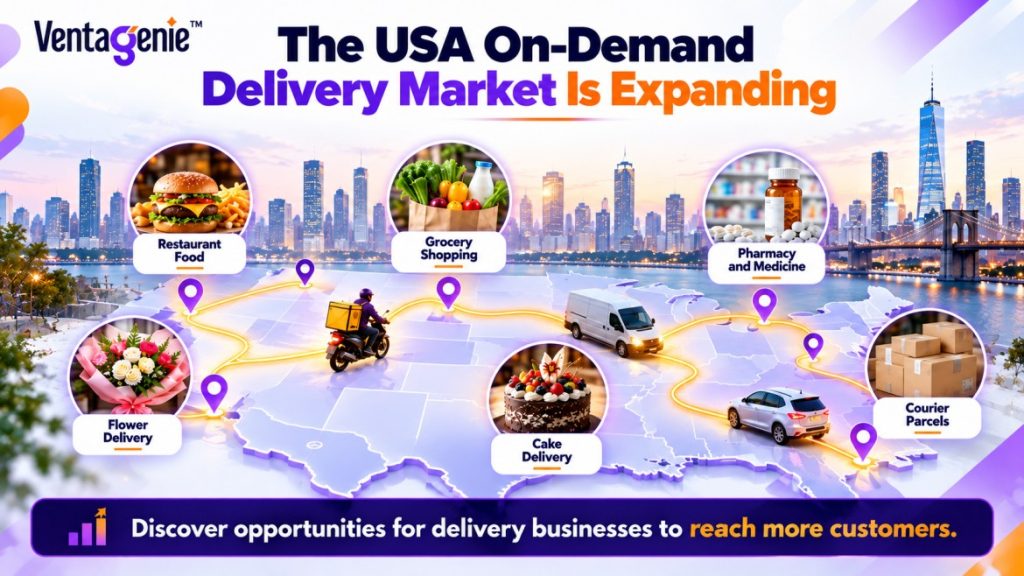
One 2026 roundup shows the US figure ranging from about $27.6 billion to $34.9 billion, purely because one firm counts only platform-based restaurant delivery, while the other also includes grocery platforms and meal kits. IMARC puts the market at about $38 billion in 2026, heading toward $75 billion by 2034. Statista, which counts groceries and meals together, projects US revenue of about $473 billion in 2026, with grocery delivery alone at roughly $364 billion. Food Delivery Statistics in US 2026 | Market Size, Apps & Facts | +3
What to take from this:
- The direction is clear: growth of roughly 7% to 11% a year, depending on the source.
- The biggest number belongs to groceries and daily essentials, not restaurant meals alone.
- Don't chase the "market size" headline. Chase your slice: one city, one category, one type of customer.
The Loyalty Paradox: The Most Important Statistic in This Blog
Here is a fact most delivery blogs skip. According to DoorDash’s 2026 merchant report, 79% of delivery orders come from restaurants the customer has ordered from before, and 73% of consumers stick with the same app. DoorDash
Read that again. Delivery customers are habit-driven. Once someone forms a routine, they repeat it.
That creates two very different situations:
- For a new business, the first order is the hardest thing to win.
- For an established business, every repeat order is a gift, but only if the customer is yours.
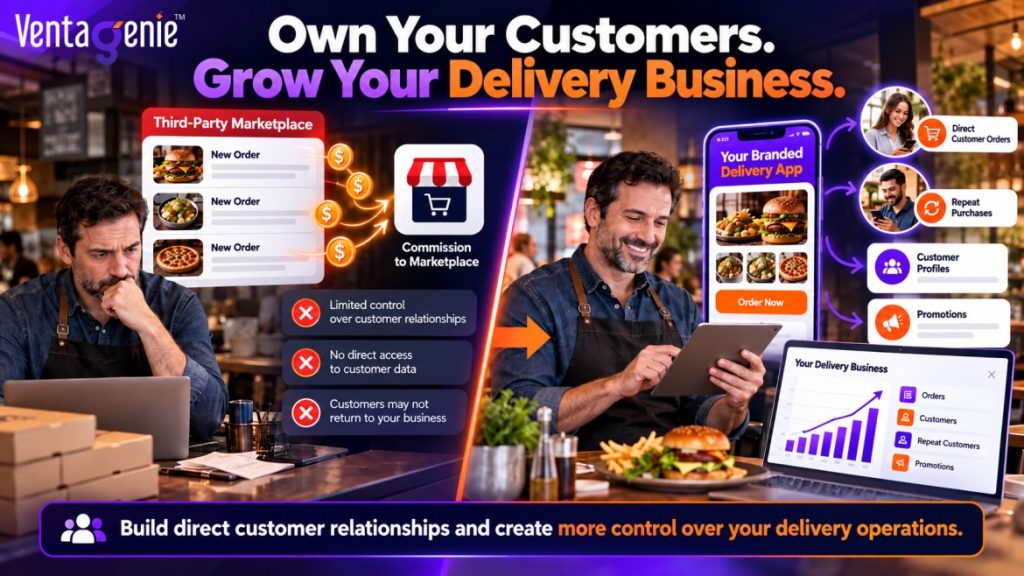
If your customers order through a big platform, the habit belongs to the platform, not to you. If they order through your own app, the habit belongs to your brand.
This is why the smartest restaurants, retailers, and local brands in 2026 are not asking, “How do we get more orders on the big apps?” They are asking, “How do we move our regulars to our own channel?”
The Commission Math (With a Real Example)
Let’s make this concrete. These are illustrative numbers, not a promise. Your own costs will vary.
Say a local restaurant sells 1,000 delivery orders a month at an average of $30.
On a third-party platform (assume 25% commission) | On your own app | |
Monthly order value | $30,000 | $30,000 |
Platform commission | −$7,500 | $0 |
Payment processing (approx. 3%) | included in commission | −$900 |
Delivery cost (own drivers or a courier network) | often bundled | −$4,000 to −$6,000 (varies widely) |
Rough net effect | Simple, but expensive | Higher margin, more control, but you run operations |
Your own app is not free money. You take on delivery operations. But you also gain three things no commission-based platform gives you:
- Your customer data: names, order history, what they love, when they order.
- Your pricing and promotions: run offers without paying someone to show you to your own customers.
- Your brand: the customer sees your logo, not a competitor’s suggestions on the next screen.
A smart approach is a hybrid model: use big platforms to discover new customers, and use your own app to keep them.
Five Shifts Changing Delivery in 2026
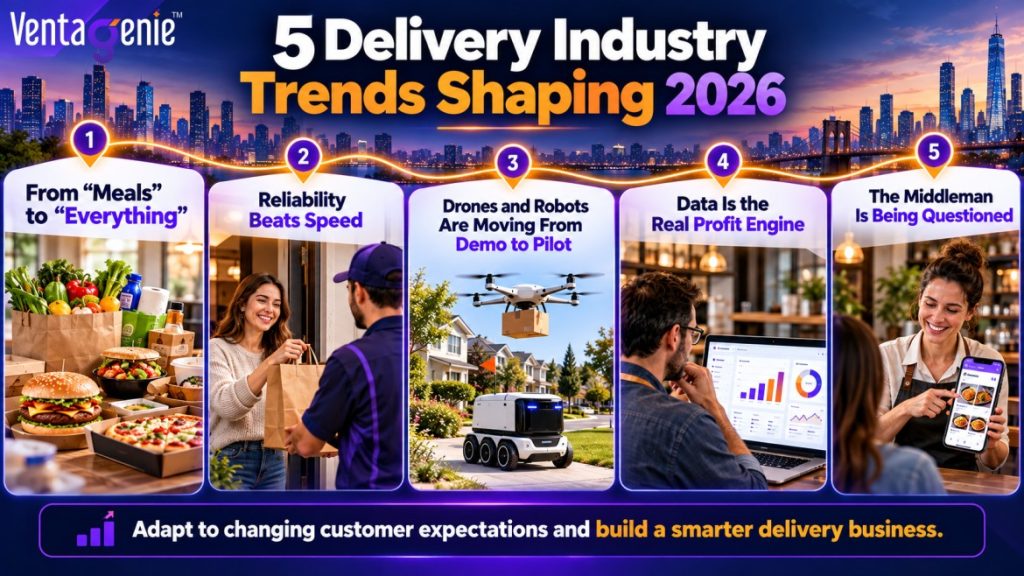
Shift 1: From "Meals" to "Everything"
The category is bigger than dinner. Grocery orders are heavy: they contain roughly 2.3 times more items than restaurant orders, which means bigger baskets and more reasons to order every week. Around 64% of active users order at least once every seven days. Market Reports WorldMarket Reports World
Shift 2: Reliability Beats Speed
Everyone talks about 15-minute delivery, but the data points somewhere more practical. In one industry analysis, order accuracy influences about 58% of repeat usage, and delivery time reliability affects about 61% of customer retention. Market Reports World
The lesson: a correct order on time beats a fast wrong order. Customers forgive a 40-minute wait that was promised. They don’t forgive a missing item.
Shift 3: Drones and Robots Are Moving From Demo to Pilot
In April 2026, DoorDash expanded a partnership with Wing to offer drone-based food delivery in the Atlanta area. Walmart and Uber are piloting drones and autonomous vans to lower delivery costs and reach lower-density suburbs. One forecast expects autonomous delivery to cut last-mile costs by 35% to 50% over time. United States Online Food Delivery Market | Forecast 2034 +2
Shift 4: Data Is the Real Profit Engine
The giants are learning that delivery is a data business. Instacart has integrated restaurant delivery through Uber Eats, and analysts point to retail media (advertising inside shopping apps) as a very lucrative adjacency with gross margins of 70% to 90%. Even small operators can use the same idea: promote your own high-margin products, bundles, and subscriptions inside your own app. Mordor Intelligence
Shift 5: The Middleman Is Being Questioned
Platform-to-consumer delivery still dominates, holding over 71% of revenue share in 2024. But commissions, fees, and price-matching frustrations are pushing merchants to look for alternatives. That gap is your opening. Grand View Research
The Opportunity Map: Five Gaps Big Platforms Can't Fill Well
Big platforms are built for scale. Scale means they treat everyone the same. Your advantage is being specific.
Gap 1: The Specialist Gap
Halal, vegan, organic, Indian, Korean, Caribbean, pet food, baby products, medical supplies. A specialist app that knows its customer beats a generic app that lists everything.
Gap 2: The Suburban and Small-City Gap
Delivery is thickest in dense metros. Lower-density areas are harder to serve profitably for the giants, which is why even they are experimenting with drones and autonomous vans to reach them. A local operator who knows the area, its roads, and its people can serve it better and more cheaply.
Gap 3: The Trust Gap
Some products need care: medicines, elderly essentials, baby items, fresh produce, gifts. People pay more for reliable, careful, personal service.
Gap 4: The B2B Gap
Offices, clinics, salons, schools, and event planners need regular deliveries: catering, supplies, and parcels. These are contract-style customers with predictable repeat demand.
Gap 5: The Multi-Service Gap
Customers hate having ten apps. A single local app for food, groceries, parcels, and errands can become a daily habit for a neighborhood.
Opportunity Scorecard
Opportunity | Competition | Repeat Orders | Startup Difficulty | Best For |
Restaurant’s own branded app | Medium | High | Low | Restaurants, chains, cloud kitchens |
Niche grocery (organic, ethnic, etc.) | Low–Medium | Very High | Medium | Specialty retailers, entrepreneurs |
Small-city multi-service app | Low | High | Medium | Local entrepreneurs |
B2B delivery and courier | Low | Very High | Medium | Logistics and courier businesses |
Pharmacy and wellness delivery | Medium | High | Higher (regulations) | Licensed pharmacies |
Broad “everything” app in a top metro | Very High | Medium | Very High | Well-funded companies only |
*This is a general guide based on market structure, not a guarantee. Always study your own local market before deciding.
Five Mistakes That Sink Delivery Startups
- Launching in too many places at once. Win one neighborhood first.
- Ignoring the driver experience. Unhappy drivers mean late orders and bad reviews. A simple, fair driver app is not optional.
- Copying the giants’ discounts. You can’t outspend them. Outserve them.
- Treating the app as the whole business. The app is the tool. Operations, support, and quality are the business.
- Choosing technology that can’t grow. Rebuilding after six months wastes money and momentum.
What Your Delivery Platform Actually Needs
A delivery business runs on four connected parts:
- Customer app: search, ordering, live tracking, multiple payments, reorder in one tap.
- Driver app: job alerts, smart navigation, earnings visibility.
- Merchant panel: menu and stock management, order handling, sales reports.
- Admin dashboard: commissions, promotions, zones, analytics, and payouts.
Add the features that create habit: saved favorites, reorder buttons, subscriptions and membership plans, loyalty points, scheduled deliveries, and push notifications. Remember the loyalty statistic: habit is the goal.
Your First 90 Days
Days 1–15: Choose your lane. One city or area, one customer type, one category. Write one sentence: “We deliver ___ to ___ faster and better than anyone else.”
Days 16–45: Build and prepare. Set up your app, onboard 10 to 30 merchants or your own inventory, and recruit and train your first drivers.
Days 46–75: Soft launch. Serve a small area. Call your first 50 customers personally. Ask what went wrong. This feedback is worth more than any market report.
Days 76–90: Fix and repeat. Improve accuracy and timing first, then add promotions, referral rewards, and membership offers.
The Bottom Line
The delivery market is big, but “big” is not your advantage. Specific is.
The winners of the next few years will not be the ones who copy the giants. They will be the ones who own a niche, own their customer relationship, and use technology that lets them grow without rebuilding.
The customers are already ordering. The habit is already formed. The only open question is: whose app will they open?
Ready to Build Your Delivery Platform with VentaGenie?
At VentaGenie, we build delivery app solutions for people who want ownership, not dependency: customer app, driver app, merchant panel, and admin dashboard, all designed to grow with you.
Talk to us if you are:
- A restaurant or retailer who wants to stop paying heavy commissions
- An entrepreneur planning a niche or local delivery business
- A logistics or courier company ready to go digital
- Someone with an idea who isn’t sure where to start
Tell us your city, your niche, and your goal. We’ll show you the fastest, smartest way to launch.
Frequently Asked Questions
The USA on-demand delivery market varies in size depending on whether reports include restaurant delivery, groceries, meal kits, and other services. Your blog highlights estimates ranging from approximately $27.6 billion to $38 billion for narrower food delivery definitions, while broader estimates include grocery delivery and other categories.
A branded delivery app gives businesses greater control over customer relationships, order history, pricing, promotions, and brand identity. It can also help reduce marketplace commission expenses, although businesses must manage delivery operations and associated costs.
Grocery delivery, restaurant-branded apps, small-city multi-service platforms, B2B delivery and courier services, and pharmacy and wellness delivery. The best opportunity depends on local demand, competition, operating costs, and applicable regulations.
A delivery platform typically needs four core components: a customer app, a driver app, a merchant panel, and an admin dashboard. Useful features include real-time order tracking, payment options, inventory management, order dispatch, sales analytics, scheduled deliveries, loyalty programs, and push notifications.