The Future of Multi Category Marketplace Apps: Trends Shaping Multi-Vendor Platforms in 2026
The future of marketplace apps is no longer limited to a single service like food or grocery delivery. Modern consumers prefer one app that does it all — food, grocery, pharmacy, courier, retail, and even logistics — in one seamless experience.
Multi-category and multi-delivery marketplace apps are evolving into super platforms that combine multiple services, vendors, and delivery models under one unified ecosystem. Instead of managing separate apps for different needs, customers now expect a single platform that offers speed, convenience, and personalization.
Why This Model Is Growing Fast
Today’s users want:
- One login for multiple services
- Faster deliveries with real-time tracking
- Secure, unified payment systems
- Flexible delivery options (instant, scheduled, bulk)
- Easy returns and support
At the same time, businesses want:
- Multi-vendor management
- Centralized dashboards
- Automated dispatch & settlements
- Scalable infrastructure
- Data-driven growth insights
Multi-delivery marketplace platforms solve both sides efficiently.
Real-World Examples
Take DoorDash. What started as a simple food delivery marketplace has evolved into a multi-service platform offering grocery, retail, pharmacy, and same-day delivery. By integrating advanced logistics algorithms, real-time tracking, and merchant tools, it transformed from a delivery app into a full-scale commerce ecosystem.
Similarly,
- Amazon leverages marketplace technology combined with advanced last-mile logistics, AI-driven recommendations, and fulfillment networks to create one of the most powerful delivery infrastructures globally.
- Grab started as a ride-hailing service but expanded into food delivery, grocery, courier, digital payments, and financial services — all within one ecosystem.
- Rappi offers food, grocery, pharmacy, cash delivery, and logistics services in a single marketplace app.
- Uber evolved from ride-sharing into food delivery, freight, grocery, and multi-service logistics operations.
These companies demonstrate a clear shift:
- The future belongs to platforms that combine multiple services.
- The more categories you manage in one ecosystem, the higher the customer retention.
This is the power of marketplace platforms.
From retail and food delivery to healthcare, logistics, B2B procurement, and hyperlocal commerce, marketplace models are redefining how value is exchanged. Inspired by platform giants like Amazon, Alibaba Group, Doordash and Uber, the next generation of marketplaces is becoming more intelligent, automated, modular, and capital-efficient.
For startups, enterprises, and investors alike, 2026 represents a structural turning point.
The global digital economy is increasingly platform-driven. Over the past decade, marketplace apps have evolved from simple listing platforms into sophisticated ecosystems. Businesses today are actively looking to create marketplace apps, build delivery apps, and partner with a reliable marketplace app development company to launch scalable digital platforms. But this transformation did not happen overnight.
In this Blog, we explore the future of marketplace apps in 2026, key trends shaping multi-vendor platforms, AI integration, multi-vertical expansion, and why delivery infrastructure is critical for scalable growth
.Let’s explore how marketplace apps are becoming the backbone of the modern digital economy.
What Is a Marketplace App?
A marketplace app is a digital platform that connects multiple sellers (vendors) with multiple buyers in one unified system.
Unlike a single-brand eCommerce website that sells its own products, a marketplace app allows different independent sellers to list their products or services, manage inventory, receive orders, and interact with customers — all under one platform.
In simple terms:
A marketplace app is a digital marketplace where many businesses sell, and customers choose from multiple options in one place.
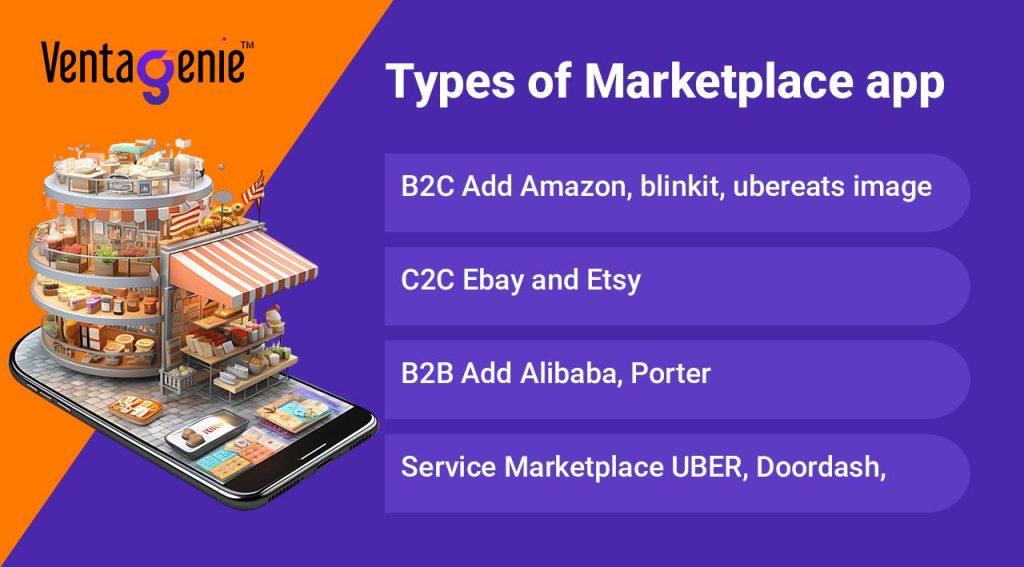
Types of Marketplace Apps
Marketplace platforms can operate in different models:
- B2C (Business to Consumer)
Businesses sell products or services directly to end customers through the platform.
Examples:
- Amazon
- Blinkit (grocery delivery from stores to consumers)
- Uber Eats
In this model, registered businesses or vendors list their offerings, and customers purchase directly through the app.
2. C2C (Consumer to Consumer)
Individuals sell products or services directly to other individuals.
Examples:
- eBay
- Etsy
The platform acts as an intermediary, facilitating payments, trust, and dispute resolution.
3. B2B (Business to Business)
Businesses trade goods or services with other businesses.
Examples:
- Alibaba Group
- Porter (connects businesses with logistics providers)
These platforms usually support bulk orders, negotiated pricing, and long-term supply relationships.
4. Service Marketplaces
Service providers connect directly with customers through the platform.
Examples:
In this model, the platform connects drivers, delivery partners, or service professionals with end users while managing bookings, payments, and tracking.
Myth #1: Marketplace Apps Are Only for Big Companies
Fact: While global giants like Amazon and Alibaba Group dominate headlines, modern technology has lowered the barrier to entry.
Today:
👉 Startups can launch niche marketplaces.
👉 Regional businesses can build hyperlocal platforms.
👉 Vertical-specific platforms can outperform large generic ones.
With the right technology infrastructure, even small companies can compete in focused markets.
Facts and Figures About Marketplace Apps (2026)
Marketplace App Market Size, Growth & Industry Statistics
Here are up-to-date statistics that illustrate the scale, growth, and trends in marketplace apps — with reliable research sources mentioned clearly.
1. Marketplace Transaction Volume Is Massive
According to Statista, global e-commerce sales surpassed $6 trillion in 2024, with online marketplaces accounting for the majority share of transactions.
As per Digital Commerce 360, marketplaces contribute over 60% of global online sales, making them the dominant eCommerce model worldwide.
Research from eMarketer (Insider Intelligence) indicates that marketplaces are projected to drive more than 50% of total eCommerce growth through 2030.
2. Marketplace Revenue Market Size
According to Grand View Research, the global digital marketplace market was valued at approximately $580 billion in 2024 and is projected to exceed $1 trillion by 2030, growing at a CAGR of around 10%.
Boston Consulting Group (BCG) reports that platform-based business models continue to outperform traditional digital retail due to scalable revenue streams and network effects.
Myth #2: Marketplace Revenue Comes Only from Commissions
Fact: Modern marketplace platforms earn from multiple streams:
Today:
👉 Transaction commissions
👉 Subscription fees
👉 Advertising revenue
👉 Logistics margins
👉 Financial services (embedded finance)
👉 Vendor tools
Revenue diversification increases platform valuation and reduces dependency on a single model.
3. Massive User Base and Growth
As per Statista, the global number of online shoppers is expected to reach 2.8–2.9 billion by 2026.
According to DataReportal Global Digital Reports, billions of consumers worldwide actively use digital commerce platforms, indicating that nearly one in three people globally participates in online marketplace activity.
4. Mobile Dominates Marketplace Usage
According to Statista Mobile Commerce Report, mobile devices account for approximately 60–70% of global eCommerce traffic.
Research from Data.ai (formerly App Annie) shows that consumers spend several billion hours annually using shopping apps, with mobile commerce continuing to outpace desktop growth.
This confirms that marketplace apps are now fundamentally mobile-first ecosystems.
5. Regional Growth and Market Shifts
According to Statista Regional E-commerce Data, Asia-Pacific leads global marketplace sales, representing the largest regional share of online transactions.
McKinsey & Company reports that Latin America is among the fastest-growing digital commerce markets, with strong expansion in delivery and hyperlocal marketplace models.
Emerging markets are benefiting from:
- Rapid smartphone adoption
- Expanding middle-class populations
- Increasing digital payment penetration
6. Mobile Engagement & Consumer Time Spent
According to Data.ai, global users spend tens of billions of hours annually inside shopping and marketplace apps.
The World Economic Forum highlights that AI-powered personalization and mobile optimization significantly increase session duration and conversion rates within platform ecosystems.
7. Marketplace Platforms Remain Fragmented and Opportunity-Rich
According to CB Insights, marketplace startups remain one of the most funded categories in venture capital due to strong scalability and asset-light structures.
Major global players include:
Amazon, Alibaba Group, Doordash and Uber
However, research from Boston Consulting Group (BCG) indicates that niche and vertical marketplaces continue to outperform in specialized segments such as hyperlocal delivery, B2B procurement, and service-based platforms.
- Key Takeaways
✔ Marketplace apps are central to global digital commerce, as confirmed by Statista and Digital Commerce 360.
✔ Mobile usage is the primary growth driver, according to Statista and Data.ai.
✔ User participation continues to expand globally, supported by DataReportal insights.
✔ Asia-Pacific and emerging markets lead growth trends, based on Statista and McKinsey research.
✔ Revenue models are diversifying, as reported by BCG and CB Insights, strengthening long-term platform sustainability.
Myth #3: Marketplace Success Is Only About More Vendors
Fact: More vendors do not automatically mean more success.
What truly matters:
👉 Vendor quality
👉 Efficient onboarding
👉 Smart search algorithms
👉 Inventory optimization
👉 Data-driven recommendations
Platforms that prioritize vendor enablement and data intelligence scale more sustainably.
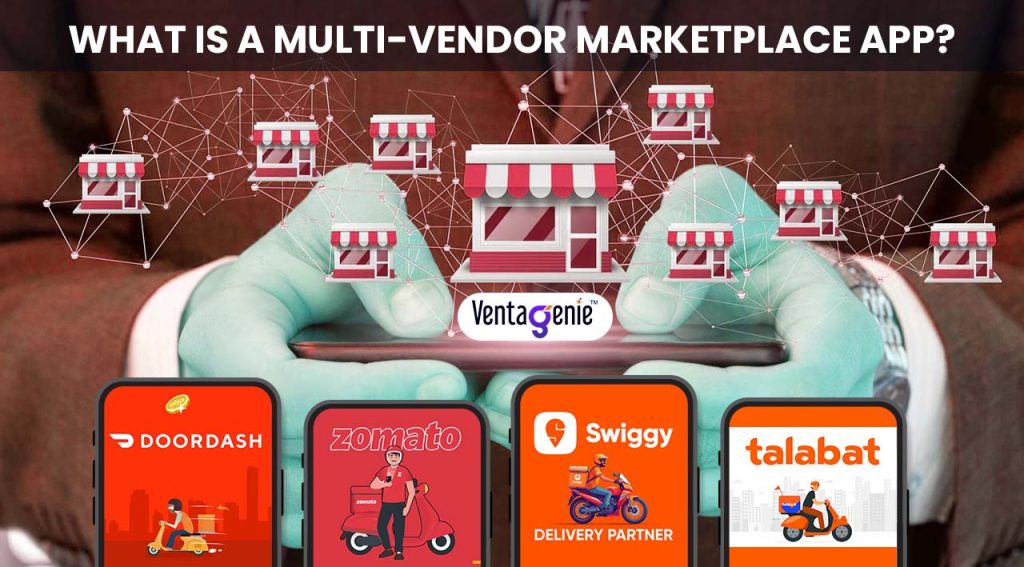
What Is a Multi-Vendor Marketplace App?
A multi-vendor marketplace app is a digital platform where multiple independent sellers (vendors) list, manage, and sell their products or services within a single ecosystem.
Instead of one company selling its own inventory, the platform acts as an intermediary infrastructure layer — connecting buyers and multiple sellers, managing transactions, payments, logistics, ratings, and customer support.
Core Characteristics
- Multiple vendors operate under one platform
- Centralized payment processing
- Commission-based or subscription-based revenue model
- Unified customer experience (search, checkout, tracking)
- Vendor dashboards for inventory, orders, analytics
How It Works ?
Customer → Marketplace App → Vendor
Platform earns commission on each transaction
The marketplace does not necessarily own inventory — it orchestrates supply and demand.
Big Multi-Vendor Marketplace Examples
-
DoorDash
Connects thousands of restaurants with customers through a commission-based marketplace model. Restaurants act as vendors, while DoorDash manages logistics and payments. -
Zomato
A restaurant marketplace platform where multiple food vendors list menus and manage orders through a centralized app. -
Swiggy
Operates a multi-vendor food delivery ecosystem with integrated logistics and real-time tracking. -
Talabat
A regional multi-vendor marketplace connecting restaurants, grocery stores, and customers across the Middle East.
Many startups and enterprises now partner with a professional multi-vendor marketplace app development company to build feature-rich platforms with vendor dashboards, commission systems, and payment gateway integration.
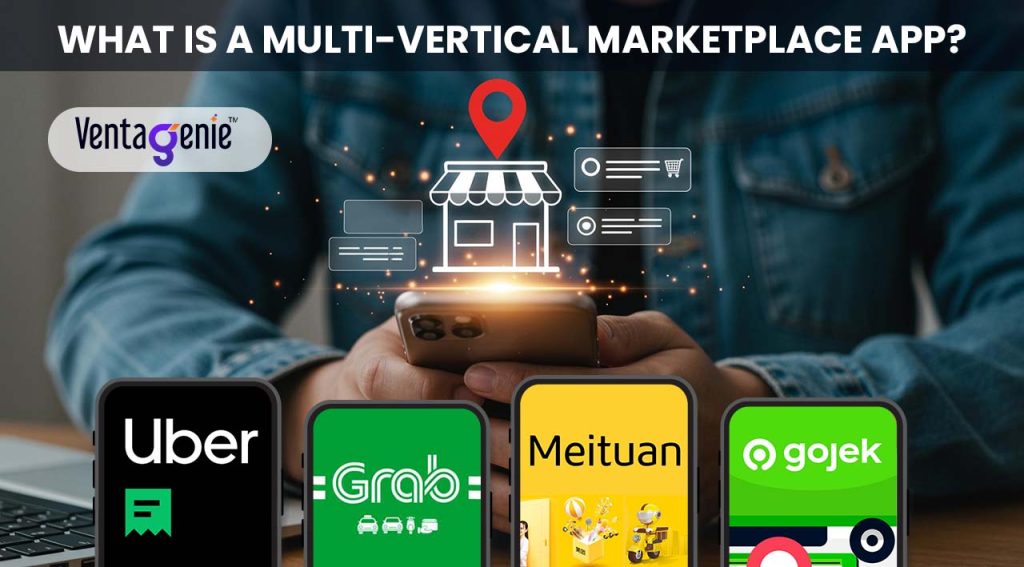
What Is a Multi-Vertical Marketplace App?
A multi-vertical marketplace app goes one step further.
Instead of operating in only one category (like electronics or fashion), it integrates multiple service or product categories (verticals) within a single platform.
This creates a broader ecosystem where users can access different types of services without leaving the app.
Example of Verticals Inside One App
- Grocery delivery
- Food delivery
- Ride-hailing
- Pharmacy
- Home services
- Payments
This model increases user lifetime value and app engagement.
Big Multi-Vertical Platform Examples
-
Uber Started
with rides, expanded into food delivery, freight, and logistics. -
Grab
Offers ride-hailing, food delivery, digital payments, and financial services. -
Meituan
Combines food delivery, travel bookings, local services, and more. -
Gojek
Integrated transport, food, payments, logistics, and on-demand services.
Myth #4: Multi-Vertical Apps Are Always Better
Fact:
Multi-vertical platforms can generate higher lifetime value — but expansion requires strong infrastructure.
Many successful platforms:
👉 Start in one niche.
👉 Achieve market dominance.
👉 Then expand into adjacent verticals.
Scaling too early without operational stability increases complexity and risk.
Strategy matters more than ambition.
Companies aiming to build super apps often look for a trusted multi-vertical app development solution that allows them to expand from a single service into grocery, food delivery, logistics, and on-demand services within one ecosystem.
Multi-Vendor vs Multi-Vertical
A multi-vertical marketplace app goes one step further.
Instead of operating in only one category (like electronics or fashion), it integrates multiple service or product categories (verticals) within a single platform.
This creates a broader ecosystem where users can access different types of services without leaving the app.
Example of Verticals Inside One App
- Grocery delivery
- Food delivery
- Ride-hailing
- Pharmacy
- Home services
- Payments
This model increases user lifetime value and app engagement.
Big Multi-Vertical Platform Examples
-
Uber Started
with rides, expanded into food delivery, freight, and logistics. -
Grab
Offers ride-hailing, food delivery, digital payments, and financial services. -
Meituan
Combines food delivery, travel bookings, local services, and more. -
Gojek
Integrated transport, food, payments, logistics, and on-demand services.
Feature | Multi-Vendor | Multi-Vertical |
Multiple Sellers | ✔ | ✔ |
Multiple Categories | Sometimes | Always |
Focus | One industry | Many industries |
Complexity | Medium | High |
Revenue Potential | High | Very High |
A platform can be both multi-vendor and multi-vertical — meaning:
Multiple vendors + Multiple industries inside one ecosystem.
That is the direction most large platforms are moving toward in 2026.
The Future of Marketplace Apps
Marketplace apps are changing very fast. In 2026 and beyond, they will not just be apps where people buy and sell products. They will become smart digital ecosystems that manage payments, delivery, services, and even financing — all in one place.
Here is what the future looks like in simple terms:
1. Smarter Apps with AI
In the future, marketplace apps will think and act more intelligently.
Artificial Intelligence (AI) will help platforms:
- Suggest products based on what customers search and buy
- Automatically show the best price
- Predict which products will sell more
- Help sellers know what to stock
- Detect fake orders or fraud instantly
- Provide instant AI chat support
For example, companies like Amazon already use AI for recommendations and pricing. But in 2026, this will not be limited to big tech companies. Even mid-size and startup marketplaces will use AI tools.
AI will reduce manual work and help platforms make smarter decisions automatically.
Modern businesses want to build AI-powered marketplace apps that improve personalization, automate operations, and increase conversion rates.
Myth #5: Only Large Platforms Can Use AI
Fact:
AI is becoming democratized.
Cloud-based tools and API integrations allow:
👉 Mid-sized marketplaces
👉 Vertical platforms
👉 Hyperlocal delivery apps
To integrate:
👉 Smart recommendations
👉 Dynamic pricing
👉 Fraud detection
👉 Predictive demand forecasting
AI is no longer a luxury — it is becoming operational standard.
2. Multi-Vertical or Multi-Category Apps Are in Higher Demand
Multi-vertical and multi-category marketplace apps are becoming more popular because customer behavior is changing. People now prefer convenience over everything else.
In 2026 and Beyond, customers don’t want to download 10 different apps for 10 different needs.
They want:
- Grocery
- Food delivery
- Ride booking
- Home services
- Pharmacy
- Shopping
- Payments
All inside one single platform.
This is why multi-vertical marketplace apps are growing faster.
Platforms like Amazon started as a book marketplace but now offer almost every product category.
Super apps like Grab and Gojek combine transport, food delivery, grocery, and payments in one ecosystem.
Customers prefer these platforms because:
1. Convenience
Everything is available in one place. No need to switch apps.
2. Faster Checkout
Saved addresses, saved cards, one wallet — simple payments.
3. Better Trust
If users already trust a platform for one service, they are more likely to try another service inside the same app.
4. Loyalty & Rewards
Multi-category apps can give combined rewards across services, increasing engagement.
In 2026 and Beyond , more marketplaces will expand into multiple categories to increase customer lifetime value.
3. Faster Delivery Everywhere
Speed has become a major expectation.
Customers now expect:
- Same-day delivery
- 30-minute grocery delivery
- Real-time tracking
- Accurate delivery time estimates
Marketplace apps will invest more in:
- Smart route optimization
- Local warehouse networks
- Micro-fulfillment centers
- Strong logistics partnerships
Delivery will no longer be just a service — it will be a competitive advantage.
The faster the delivery, the higher the customer satisfaction.
This is why demand for hyperlocal delivery app development solution and on-demand delivery app solutions is growing rapidly in 2026.ol
4. Built-In Payments and Financing (Embedded Finance)
Marketplace apps will move beyond simple payment processing.
They will offer:
- Buy Now, Pay Later (BNPL)
- Digital wallets
- Vendor working capital loans
- Installment payments
- Small business financing
Platforms like Shopify already provide financial tools to sellers.
In the future, marketplaces will act like mini financial ecosystems. They will earn revenue from financial services — not just commissions.
Embedded finance will become one of the biggest profit drivers.
5. Rapid Growth in Emerging Markets
Marketplace growth is not only happening in the US or Europe.
Countries in:
- Asia
- Africa
- Latin America
Are experiencing fast digital growth.
More people are getting:
- Affordable smartphones
- Faster internet
- Access to digital payments
This creates massive opportunities for marketplace apps to expand in these regions.
Emerging markets will drive the next wave of platform growth.
6. Rise of Niche Marketplaces
Not all future marketplaces will be huge general platforms.
Many will focus on specific industries like:
- Healthcare services
- Construction materials
- B2B supply chains
- Used vehicles
- Freelancer services
For example, Upwork focuses only on freelance services.
Niche marketplaces succeed because:
- They build deeper trust
- They solve specific problems
- They offer industry-focused features
Specialization can sometimes be more profitable than generalization.
7. Better Tools for Sellers
Future marketplace apps will focus strongly on vendor success.
They will provide sellers with:
- Advanced analytics dashboards
- Inventory forecasting tools
- Automated marketing features
- Sales performance reports
- Demand prediction
The goal will not just be to list products — but to help vendors grow their business.
When sellers succeed, the marketplace grows.
8. Data Will Be the Real Power
Data is becoming the most valuable asset for marketplace apps.
Platforms will use data to:
- Understand buying behavior
- Improve product recommendations
- Optimize pricing
- Predict future demand
- Reduce fraud
- Improve delivery efficiency
The more users a marketplace has, the more data it collects.
The more data it collects, the smarter it becomes.
Data will drive long-term competitive advantage.
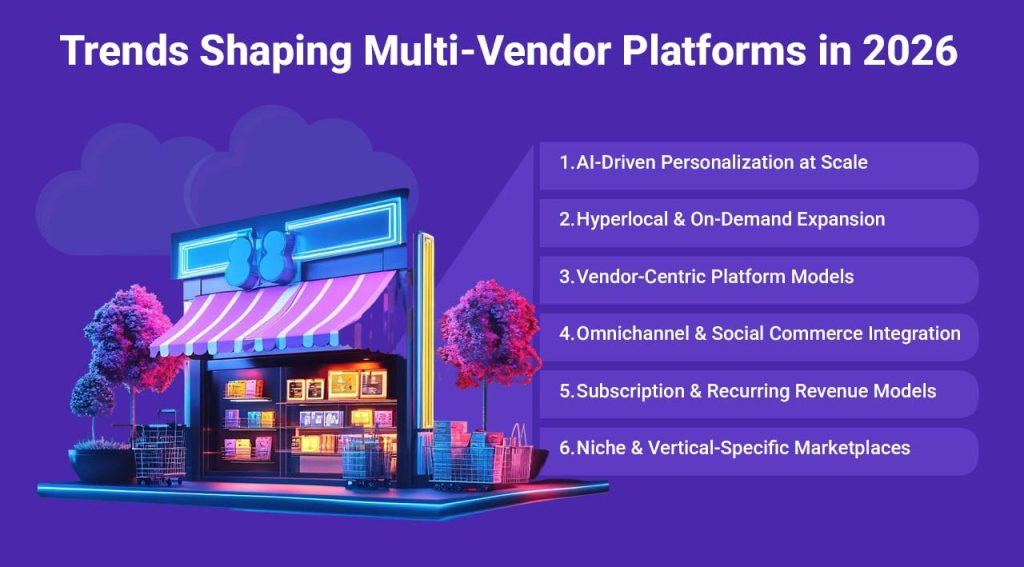
Trends Shaping Multi-Vendor Platforms in 2026
Multi-vendor platforms are evolving quickly. In 2026, they are no longer simple product listing websites. They are full digital ecosystems connecting buyers, sellers, logistics partners, and financial services in one integrated system.
Below are the key trends shaping multi-vendor platforms this year — explained in simple language but with strategic depth.
1. AI-Driven Personalization at Scale
Personalization is no longer optional.
Multi-vendor platforms now use AI to:
- Recommend products based on browsing behavior
- Show dynamic pricing
- Predict demand for vendors
- Automate customer segmentation
- Reduce cart abandonment
Platforms like Amazon have already proven that better recommendations increase revenue significantly.
In 2026, even mid-sized marketplaces are integrating AI engines to improve conversion rates and customer retention.
2. Hyperlocal & On-Demand Expansion
Speed is becoming a competitive advantage.
Customers now expect:
- Same-day delivery
- 30-minute grocery fulfillment
- Real-time tracking
Multi-vendor platforms are investing in:
- Local warehouse networks
- Micro-fulfillment centers
- Route optimization software
The faster the service, the stronger the competitive position.
3. Vendor-Centric Platform Models
In 2026, successful platforms focus not just on customers — but on sellers.
Modern multi-vendor systems provide:
- Advanced analytics dashboards
- Inventory forecasting
- Automated marketing campaigns
- Sales performance reports
- Dynamic pricing tools
When vendors grow, platform revenue grows.
Vendor enablement is becoming a strategic priority.
4. Omnichannel & Social Commerce Integration
Customers discover products on social media first.
Platforms are integrating with:
- TikTok
- YouTube
When vendors grow, platform revenue grows.
Vendor enablement is becoming a strategic priority.
- Direct social selling
- Influencer storefronts
- Live commerce integration
- In-app checkout from social traffic
Commerce is becoming content-driven.
5. Subscription & Recurring Revenue Models
One-time purchases are being replaced by predictable revenue models.
Multi-vendor platforms now support:
- Subscription boxes
- Auto-renew services
- Membership benefits
- Loyalty programs
Recurring revenue increases business stability and platform valuation.
6. Niche & Vertical-Specific Marketplaces
Not every marketplace is trying to be the next global giant.
Specialized platforms focused on:
- Healthcare
- B2B procurement
- Construction
- Freelance services (like Upwork)
Are gaining strong market share.
Vertical specialization builds trust and reduces competition.
7. Security, Compliance & Trust Infrastructure
As platforms grow, regulation increases.
Multi-vendor platforms are investing in:
- KYC verification
- Fraud detection systems
- Secure payment gateways
- Transparent vendor ratings
Trust is becoming a growth driver.
Without security and compliance, scalability becomes risky.
Why Ventagenie Delivery App Development Solution Is Built for the Future
The marketplace economy in 2026 is defined by speed, intelligence, scalability, and integration. Delivery is no longer an add-on feature — it is core infrastructure.
For any multi-vendor platform — whether it is food delivery, grocery, pharmacy, hyperlocal commerce, or multi-category retail — delivery capability determines customer satisfaction, retention, and long-term profitability.
Ventagenie’s delivery app development solutions are designed for this new reality.
1. Multi-Vertical & Multi-Category Architecture
Modern users want everything in one platform.
Ventagenie supports delivery ecosystems across:
- Food delivery
- Grocery & quick commerce
- Pharmacy delivery
- Retail & eCommerce
- Courier & logistics
- Hyperlocal services
Inspired by scalable ecosystem models like Grab and Gojek, Ventagenie’s architecture allows businesses to:
- Launch in one vertical
- Expand into multiple categories
- Operate all services under one admin system
This ensures long-term flexibility and growth without rebuilding the platform.
2. AI-Ready Delivery Intelligence
Delivery businesses today generate massive operational data:
- Order frequency
- Peak demand hours
- Delivery time variations
- Route inefficiencies
- Customer behavior patterns
Ventagenie’s system is designed to integrate AI-powered modules for:
- Smart order allocation
- Predictive demand analysis
- Route optimization
- Fraud detection
- Performance forecasting
Like global leaders such as Amazon and Uber, modern platforms must operate with data intelligence — not guesswork.
Ventagenie is built with a future-ready tech stack to support this intelligence layer.
3. Hyperlocal & Quick Commerce Optimization
The future of delivery is speed.
Customers now expect:
- Same-day delivery
- 30-minute grocery fulfillment
- Real-time tracking
- Accurate ETA updates
Ventagenie includes:
- Real-time GPS tracking
- Smart driver assignment
- Zone-based delivery configuration
- Micro-fulfillment support
- Automated dispatch systems
This infrastructure enables businesses to compete in fast-growing quick commerce markets.
4. Scalable Cloud Infrastructure
Delivery apps experience unpredictable traffic spikes:
- Weekend peaks
- Festival demand
- Seasonal sales
- Flash promotions
Ventagenie is built on scalable cloud infrastructure that ensures:
- High performance
- Zero downtime
- Secure data storage
- Seamless transaction processing
Whether you manage 100 orders per day or 100,000, the system scales with demand.
5. Built-In Payment & Wallet Integration
Future delivery platforms are evolving into financial ecosystems.
Ventagenie supports:
- Multiple payment gateways
- Digital wallet integration
- Cash-on-delivery configuration
- Vendor payout automation
- Commission management
As embedded finance grows globally, platforms that integrate financial tools internally increase profitability and vendor loyalty.
6. Vendor & Partner-Centric Dashboard
Marketplace success depends on vendor empowerment.
Ventagenie provides:
- Real-time order tracking
- Sales analytics
- Inventory management tools
- Performance reports
- Commission transparency
When vendors clearly see their growth metrics, trust increases.
This improves retention and reduces churn.
7. Delivery Agent Management System
Efficient delivery requires structured workforce management.
Ventagenie includes:
- Driver onboarding system
- KYC verification modules
- Performance tracking
- Incentive management
- Rating & feedback systems
This ensures operational control and workforce scalability.
8. Multi-Region & Global Expansion Support
The next wave of delivery growth is happening in emerging markets across:
- Asia
- Africa
- Latin America
Ventagenie enables international scalability with:
- Multi-language interfaces
- Multi-currency support
- Country-based tax configuration
- Region-specific commission settings
Technology removes geographic barriers.
Ventagenie is built to support cross-border marketplace growth.
9. Security & Compliance by Design
With increasing regulations in digital commerce, compliance is critical.
Ventagenie incorporates:
- Asia
- Africa
- Latin America
Ventagenie enables international scalability with:
- Secure authentication systems
- Data encryption protocols
- Fraud detection mechanisms
- Admin-level compliance monitoring
Security is not an afterthought — it is integrated at the core.
10. Modular & Customizable Framework
Every marketplace has unique requirements.
Ventagenie offers:
- Customizable UI/UX
- Flexible commission models
- API-based integrations
- Modular feature activation
- White-label solutions
Startups, mid-sized businesses, and enterprise platforms can adapt the system according to their growth stage.
No forced limitations. No rigid structure.
Businesses looking to create marketplace apps, build delivery apps, or partner with a reliable marketplace app development company must focus on scalability, AI integration, and multi-vertical expansion from day one.
Conclusion: Multi Category Marketplace Platforms Are Becoming Digital Infrastructure
Marketplace apps are no longer just online stores.
They are:
- Technology ecosystems
- Financial gateways
- Logistics networks
- Data intelligence engines
In 2026 and Beyond , the marketplace model is evolving from a transactional platform into a complete digital infrastructure layer for industries.
The companies that will lead this transformation will:
- Leverage AI for intelligent automation
- Integrate multi-vertical services strategically
- Invest in delivery optimization
- Empower vendors with real analytics
- Use data as a competitive advantage
- Expand into emerging markets thoughtfully
The shift is structural, not temporary.
Multi-vendor platforms are becoming the operating systems of commerce.
For founders, enterprises, and investors, the opportunity is not simply to build an app — but to build scalable marketplace infrastructure.
With future-ready architecture, delivery intelligence, financial integration, and global scalability, solutions like Ventagenie are positioned to power the next generation of marketplace ecosystems.
The next decade will reward platforms that combine:
👉 Technology
👉 Speed
👉 Trust
👉 Scalability
The marketplace future is already unfolding. The real question is:
From idea validation to UI/UX design, backend architecture, API integration, and post-launch support, Ventagenie delivers complete custom marketplace app development Solution tailored to your business goals.
Are you building for today — or for 2026 and beyond?
Ready to Dominate the Marketplace Industry?
Don’t just build an app. Build a scalable, AI-ready, multi-vertical ecosystem that grows with your business.
The future belongs to platforms that move fast, scale smart, and deliver better.
👉 Launch your Multi Category Marketplace with Ventagenie today.
Frequently Asked Questions
An eCommerce website sells products from one brand or company.
A marketplace app connects multiple independent sellers with buyers and manages transactions, payments, logistics, and vendor dashboards within one platform.
Yes. Marketplace apps remain highly profitable due to:
- Scalable commission-based revenue
- Asset-light business models
- Recurring income streams
- Embedded financial services
- Advertising monetization
Research from firms like Boston Consulting Group (BCG) and Statista shows strong long-term growth projections for platform-based models.
Customers prefer convenience. Instead of downloading multiple apps, they want:
- Grocery
- Food delivery
- Ride booking
- Payments
- Services
All in one ecosystem. Platforms like Grab demonstrate how multi-service integration increases engagement and retention.
AI is becoming essential.
It helps with:
- Personalized recommendations
- Fraud detection
- Dynamic pricing
- Demand forecasting
- Vendor performance analysis
Without AI, platforms risk inefficiency and lower conversion rates.
Delivery is critical, especially in:
- Hyperlocal commerce
- Grocery
- Food
- On-demand services
Fast and reliable delivery increases customer trust and repeat orders. Platforms must treat logistics as core infrastructure.
Yes — if they focus on:
- Niche markets
- Strong vendor relationships
- Smart technology
- Efficient delivery
- Clear value proposition
Specialized marketplaces often outperform general platforms in targeted industries.
- Regulatory compliance
- Vendor retention
- Delivery optimization
- Data security
- Technology scalability
- Customer acquisition costs
Platforms that invest early in strong technical infrastructure reduce these risks.
A future-ready marketplace has:
- AI integration
- Multi-vertical expansion capability
- Embedded finance
- Real-time analytics
- Mobile-first architecture
- Secure and scalable cloud infrastructure
Technology maturity defines long-term competitiveness.