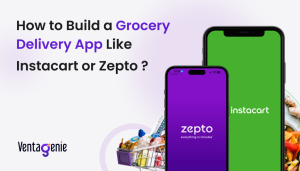
How to Build a Grocery Delivery App Like Instacart or Zepto?
Imagine this for a moment :
A customer opens an app, searches for milk, vegetables, and snacks, completes checkout in under a minute—and receives the order before they’ve finished making tea.
This experience has become normal. Platforms like Instacart, Zepto, Getir, Gopuff, Blinkit, and Amazon Fresh have changed how the world shops for groceries. They didn’t just move grocery stores online—they rebuilt the entire grocery-buying experience around speed, convenience, and reliability.
Today, customers don’t ask if groceries can be delivered. They ask how fast, how fresh, and how easy.
If you’re a business owner or entrepreneur considering a grocery delivery app development, this guide will walk you through every important concept, decision, and system involved, step by step.
Quick Summary : What You’ll Learn in This Guide
In this guide, you’ll learn :
- Which grocery business model fits your market—so you can build a grocery app like Instacart or tailor it to your region.
- Core grocery delivery app features you must include (and features you can safely avoid).
- How leaders like Zepto & Instacart structure their operations, app design, and delivery systems.
- How to choose the right on-demand grocery app development company to partner with for scalability and efficiency.
- Step-by-step roadmap for designing, developing, and launching your app successfully.
This summary ensures you know exactly what to focus on, so you can take practical action while planning your grocery delivery business.
What Exactly Is a Grocery Delivery App ?
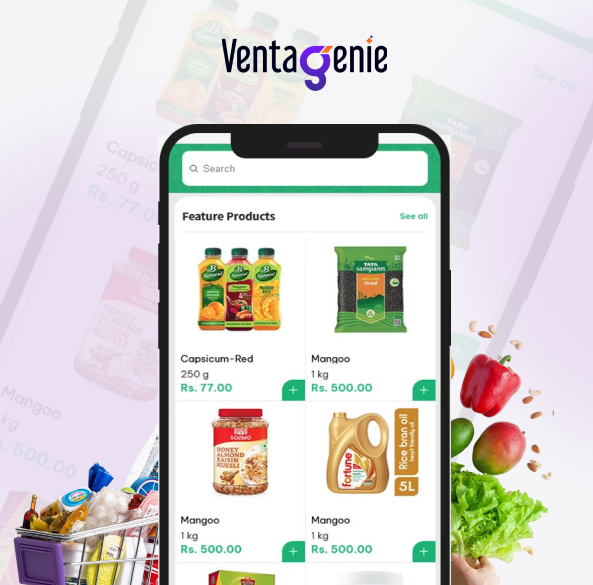
A grocery delivery app is a digital platform that allows customers to purchase grocery and household essentials online and receive them at their preferred location within a scheduled or on-demand time window. From a technical perspective, it is a complex system that manages inventory, order routing, fulfillment, delivery logistics, communication, and customer support.
From the user’s perspective, it’s simple :
- Browse products
- Add to cart
- Pay
- Receive groceries
From the business side, building a grocery delivery app like Instacart requires integrating operational workflows seamlessly with user experience.
Question to consider : Are you building just an app—or a full operational system that runs smoothly every day ?
Step-by-Step Process to Build a Grocery Delivery App
Step 1: Understand What You’re Really Building (Before Writing a Single Line of Code)
Before you think about screens, features, or technology, you must answer one foundational question :
What real problem will your grocery delivery app solve better than existing options ?
This step decides everything that follows—your business model, features, delivery strategy, and even your long-term profitability. Many grocery apps fail not because of poor technology, but because they try to solve too many problems at once without solving any of them well.
A strong grocery delivery app focuses on one primary pain point and builds the entire experience around it.
Identify the Real Pain Behind Grocery Shopping
Start by observing how your customers shop today. Not how you think they shop—but how they actually behave.
Ask questions like :
- Are customers short on time and avoiding store visits?
- Do they struggle to find consistent stock, especially for daily essentials ?
- Are they frustrated with long checkout lines or crowded stores?
- Do they want instant delivery—or are they planning weekly purchases ?
- Are local stores losing loyal customers to large online platforms?
Each answer points to a different app strategy.
For example :
- Time-poor urban professionals value speed and simplicity.
- Families value availability, bulk ordering, and reliability
- Health-conscious users value freshness and transparency
- Price-sensitive users value choice and comparison
Trying to serve all of them equally leads to a diluted product.
Learn From Instacart : Choice and Convenience at Scale
Instacart did not focus on speed first.
It focused on choice, flexibility, and ease of use.
The core problems Instacart solved were :
- Customers didn’t want to visit multiple stores
- They wanted access to familiar local retailers
- They wanted someone else to do the picking and packing
Learn From Zepto : Speed Solves Urgency
Zepto approached the problem very differently.
Zepto focused on :
- Emergency purchases
- Last-minute needs
- Ultra-fast delivery in dense urban areas
This required :
- Limited inventory
- Dark stores
- Tight delivery zones
- Extreme operational discipline
Zepto didn’t try to offer endless choice.
It focused on speed, reliability, and urgency.
Before moving to Step 2, write down your answer to this statement:
“Our grocery delivery app exists to solve ______ better than anyone else.”
That sentence will guide every decision you make—from design to delivery to scaling.
Once this problem is clearly defined, choosing the right business model and features becomes far simpler.
Step 2 : Choose the Right Business Model (This Decides Everything)
Once you are clear about the problem you want to solve, the next and most critical decision is choosing the right business model. This step determines how your grocery delivery app will operate, scale, and sustain itself over time.
Many grocery apps fail not because demand is low—but because the business model does not match the problem they are trying to solve.
Simply put:
Your business model is the engine of your grocery delivery app.
If the engine is wrong, no amount of features or marketing will fix it.
Models to consider :
Marketplace / Aggregator Model (Instacart-Style)
In this model, your app connects customers with multiple grocery stores.
How it works :
- Stores list their products
- Customers choose where to shop
- Orders are picked by store staff or shoppers
- Delivery is coordinated by the platform
Best suited for :
- Local grocery stores
- Regions with strong retail presence
- Businesses that want to scale quickly
- Ask yourself
Do I want to build a platform—or run grocery operations myself ?
Quick Commerce / Dark Store Model (Zepto-Style)
This model is built around speed.
How it works :
- Inventory is stored in micro-warehouses
- Orders are picked internally
- Delivery happens within minutes
- Product range is limited but fast-moving
Best suited for :
- Dense urban areas
- High-frequency purchase behavior
- Urgency-driven demand
Reality check :
Speed attracts users—but it also increases pressure on margins.
Single-Store Branded App Model
Here, one grocery store builds its own app to serve its customers directly.
How it works :
- One brand, one store
- Direct customer relationships
- No third-party commissions
Best suited for :
- Independent grocery owners
- Specialty stores
- Loyal customer bases
- Ask yourself
Would customers choose your app over a marketplace they already trust ?
Grocery Chain & Multi-Location Model
Designed for grocery businesses with multiple outlets.
How it works :
- One app connects all store locations
- Orders are routed to the nearest store
- Inventory is managed centrally
Best suited for :
- Regional or national grocery chains
- Businesses planning expansion
Hybrid Model (Most Practical for Long-Term Growth)
Many successful grocery delivery apps don’t rely on one model alone.
They combine :
- Marketplace + owned inventory
- Scheduled delivery + quick commerce
- Single-store + local partnerships
Why hybrid works :
- Flexibility across markets
- Reduced operational risk
- Better scalability
Important insight :
Instacart and Zepto themselves continue to evolve their models.
Match the Model to the Problem You Defined in Step 1
This is where Step 1 and Step 2 connect.
- If your problem is choice and convenience, a marketplace model fits.
- If your problem is speed and urgency, quick commerce fits.
- If your problem is brand loyalty, a single-store app fits.
- If your problem is scale and consistency, a chain model fits.
Misalignment here leads to failure later.
Choosing the right business model is not about copying Instacart or Zepto.
It’s about aligning your capabilities with customer expectations.
Once your business model is locked, everything else—features, technology, and partnerships—becomes far easier to define.
Step 3 : Design the App around Real User Behavior (Not Assumptions)
Once your problem and business model are clear, the next mistake many grocery app builders make is designing the app based on assumptions, not actual behavior.
Customers don’t behave the way strategy decks predict.
They behave the way habits, time pressure, and convenience allow.
The most successful grocery delivery apps—like Instacart and Zepto—are designed not for ideal users, but for real people making rushed, repetitive decisions.
1. Why Assumption-Driven Design Fails
Most grocery apps are designed based on how teams expect users to behave, not how they actually shop. Customers don’t want to explore or compare—they want to finish quickly. When an app demands too much thinking, users drop off instantly.
2. Understand How People Actually Shop for Groceries
Real grocery shopping is repetitive, rushed, and task-oriented. Users reorder the same essentials, add forgotten items, and check out fast—often while multitasking. Your app must support speed, not exploration.
3. Design for Repeat Orders First, Discovery Second
The majority of grocery orders come from repeat behavior. Apps that surface recently bought items, smart reorders, and favorites reduce friction and increase retention. If reordering isn’t fast, users won’t return.
4. Search Matters More Than Categories
Grocery shoppers prefer searching over browsing. A fast, forgiving search with smart suggestions matters more than perfectly organized categories. If users can’t find items instantly, they abandon the order.
5. Design for One-Handed, Mobile-First Use
Most grocery orders are placed on mobile devices during short time windows. Large buttons, minimal input, and thumb-friendly layouts are essential. If it’s hard to use with one hand, it’s poorly designed.
6. Handle Out-of-Stock Situations Gracefully
Stock issues are inevitable, but poor communication is not. Real-time availability, clear substitutions, and quick approvals protect trust. Customers accept changes—surprises break loyalty.
7. Simplify Checkout Ruthlessly
Checkout should be fast, predictable, and friction-free. Remove unnecessary steps and repeated inputs. If checkout feels harder than shopping, users will quit before payment.
Great grocery apps are not built for perfect behavior.
They are built for human behavior.
When you design around how people actually shop—not how you wish they would—you build an app that becomes a habit, not just a tool.
Step 4 : Build the Right Core Features (What Actually Matters)
When building a grocery delivery app, the biggest mistake businesses make is adding too many features too early. Big players like Instacart, Zepto, Getir, and Amazon Fresh didn’t win because they had more features—they won because they built the right core features and executed them flawlessly.
A grocery app is not a lifestyle app.
It is a utility.
If your app doesn’t make grocery shopping faster, simpler, and more reliable than offline shopping, users won’t come back—no matter how beautiful it looks.
So, what actually matters?
Let’s break it down.
- Fast & Frictionless User Onboarding
- Intelligent Product Search (The Heart of the App)
- Clean Product Listings with Real Availability
- Smart Cart & Repeat Ordering
- Simple, Transparent Checkout
- Real-Time Order Tracking & Communication
- Smart Handling of Out-of-Stock Scenarios
- Reliable Delivery Partner Experience
- Customer Support That’s Easy to Reach
- Admin Dashboard for Control & Visibility
What Big Players Get Right (And Why It Works)
- Instacart: Choice, personalization, and smart reordering
- Zepto: Speed, limited SKUs, and frictionless flows
- Amazon Fresh: Reliability, scale, and seamless checkout
- Getir & Gorillas: Inventory control and rapid fulfillment
Different strategies—but the same core features executed well.
- Key Takeaway
A successful grocery delivery app is not built by copying competitors feature-by-feature.
It’s built by understanding how people actually buy groceries and removing every possible obstacle in that journey.
Build less.
Build smarter.
Build what actually matters.
Step 5 : Inventory Accuracy Is Not Optional
In grocery delivery, nothing damages trust faster than inaccurate inventory.
A customer may forgive a late delivery.
They may even forgive a missing item once.
But they will not forgive repeatedly ordering items that aren’t available.
Inventory accuracy is not a backend detail—it is a core customer experience feature.
Why Inventory Accuracy Decides Success or Failure
Unlike fashion or electronics, groceries are :
When an app shows items that aren’t actually available, it creates :
This is why grocery leaders obsess over inventory systems.
Instacart invests heavily in real-time inventory sync with stores.
Zepto, Getir, and Gorillas reduce complexity by owning and controlling inventory.
Different approaches—same priority: accuracy first.
- Key Takeaway
Inventory accuracy is not an enhancement.
It is the foundation of trust in grocery delivery.
If customers can’t rely on what they see, they won’t order—no matter how fast or cheap you are.
Build inventory systems as seriously as you build features.
Because in grocery delivery, accuracy comes before scale.
Step 6 : Delivery Experience Is Your Brand
In grocery delivery, your app is only half the product.
The delivery experience is the brand customers remember.
Users don’t judge your platform by your code, features, or dashboards.
They judge it by who shows up at their door, when they arrive, and how the order is handled.
A smooth delivery builds trust.
A bad delivery erases weeks of good marketing.
Why Delivery Defines Customer Perception
Grocery delivery is personal.
It involves essentials—food, household items, daily needs.
When delivery goes wrong, customers fee :
That emotion gets attached to your brand, not the delivery partner.
Instacart understood this early by standardizing delivery workflows.
Zepto built its reputation around predictable, fast last-mile execution.
Different markets, same truth: delivery is the moment of truth.
- Key Takeaway
Your delivery experience is not an operational detail.
It is your most visible brand promise.
A great app attracts users.
A great delivery keeps them.
In grocery delivery, trust arrives at the doorstep.
Step 7 : Use Data the Way Leaders Do
In grocery delivery, data is not just for reports.
It is the decision engine behind every successful platform.
Leaders don’t use data to observe what happened.
They use it to shape what happens next.
Instacart, Amazon Fresh, Zepto, and Getir don’t guess—they measure, learn, and adjust continuously.
They track :
Your grocery delivery app should use data to :
- Key Takeaway
Data is not a backend function.
It is a competitive weapon.
The best grocery delivery apps don’t feel “data-driven” to users.
They feel effortless.
That effortlessness is powered by data working quietly in the background.
Step 8 : Start Small, Then Scale Smart
One of the biggest misconceptions in grocery delivery is that success comes from launching big.
In reality, leaders win by starting small, learning fast, and scaling with intention.
Instacart didn’t dominate overnight.
Zepto didn’t launch everywhere at once.
They scaled only after the fundamentals worked.
Why Starting Small Is a Strategic Advantage :
Instacart didn’t start everywhere.
Zepto didn’t start with hundreds of categories.
- Key Takeaway
Scaling doesn’t create success.
Strong fundamentals do.
Start small.
Get it right.
Then scale what already works.
That’s how grocery delivery leaders grow sustainably.
Step 9 : Plan for Trust, Not Just Transactions
Anyone can build an app that processes orders.
Very few build platforms that earn long-term trust.
In grocery delivery, trust is not emotional—it’s practical.
Customers trust you when you consistently deliver essentials without friction, surprises, or excuses.
That trust is what turns first-time users into daily customers.
Groceries are personal. People care about :
Your app should reinforce trust through :
- Key Takeaway
A grocery delivery app that focuses only on transactions will always struggle with retention.
An app that plans for trust builds habit, loyalty, and long-term growth.
In grocery delivery, trust is not a feature.
It’s the foundation.
Step 10 : Choosing the Right Grocery Delivery App Development Partner
By now, one thing should be clear:
building a grocery delivery app is not just a technical project—it’s an operational, behavioral, and strategic challenge.
The difference between apps that survive and apps that scale often comes down to who builds them.
Choosing the right grocery delivery app development partner can save you years of trial, error, and costly mistakes.
Why the Development Partner Matters More Than the Technology
Many businesses focus on tech stacks and features.
Leaders focus on experience and execution.
A strong development partner :
A weak partner delivers an app that works—but doesn’t grow.
What to Look for in a Grocery App Development Partner
Before selecting a partner, ask these critical questions :
If the answer to most of these is unclear, keep looking.
Where Ventagenie Fits In
For businesses looking to build a future-ready grocery delivery app, Ventagenie approaches development with a product-first and operations-aware mindset.
Rather than offering one-size-fits-all solutions, Ventagenie focuses on :
The goal is not just to launch an app—but to build a Grocery Delivery platform that can adapt, scale, and compete globally.
Technology alone doesn’t win the grocery delivery market.
Execution does.
And execution starts with choosing a partner who understands what actually matters.
Build with clarity.
Scale with confidence.
And choose partners who think beyond launch day.
Final Thoughts : Build a System, Not Just an App
Building a grocery delivery app like Instacart or Zepto is not about copying features.
It’s about understanding why their systems work.
A successful grocery delivery app is built on :
When these come together, the app becomes more than software—it becomes a growth engine for your grocery business.
Build a Grocery Delivery Platform, Not Just an App
Instacart, Zepto, and BigBasket didn’t win because of features—they won because their systems worked at scale.
If you’re ready to build a future-ready grocery delivery platform, partner with a team that understands technology, operations, and growth.
👉 Ventagenie helps businesses build grocery delivery apps designed for long-term success.
Let’s build something that lasts.
Frequently Asked Questions
Yes—but only if the business model is right. Profitability today depends on repeat orders, inventory accuracy, delivery efficiency, and customer retention, not just app downloads. Apps that focus on one clear problem (speed, bulk shopping, or local availability) perform far better than generic platforms.
It depends on your market and capabilities.
- Instacart-style apps work best where multiple grocery stores already exist and customers want choice.
- Zepto-style apps work in dense urban areas where speed matters more than variety.
The key is not copying features, but adapting the model to your region.
The most critical grocery delivery app features are:
- Fast product search and reordering
- Real-time inventory accuracy
- Simple checkout
- Reliable delivery tracking
- Easy substitutions and refunds
Advanced features matter only after these basics work perfectly.
A well-planned MVP can be built in a few months, depending on:
- Business model complexity
- Number of user roles (customer, store, delivery)
- Inventory and delivery logic
Rushing development without clarity usually leads to costly rebuilds later.
Yes—by not competing directly. Local stores win by :
- Offering fresher products
- Faster neighborhood delivery
- Personal customer relationships
- Better substitutions
A branded grocery app helps retain customers instead of losing them to marketplaces.
Not necessarily. Many grocery apps start with:
- Third-party delivery partners
- Store staff handling deliveries
- Hybrid models
You can build delivery capability gradually as order volume grows.
The top reasons are:
- Poor inventory accuracy
- Weak delivery execution
- Too many features, not enough focus
- Copying competitors without understanding user behavior
- Choosing the wrong business model
Technology rarely fails—planning does.
Absolutely. Grocery delivery is built on trust.
If customers repeatedly see out-of-stock items after ordering, they stop using the app. This is why successful platforms invest heavily in real-time inventory syncing and stock validation.
Look for a partner who:
- Understands grocery operations, not just eCommerce
- Has experience with inventory-driven systems
- Designs for scalability and repeat orders
- Offers long-term support, not just app delivery
A strong partner helps you avoid mistakes before they happen.
Yes—if done correctly.
On-demand grocery app development works well for:
- Local stores
- Regional chains
Specialty grocery brands
The key is starting with a focused MVP and scaling gradually.
Trying to build everything at once.
The best approach is:
- Solve one customer problem
- Build core features
- Launch
- Learn
- Improve
Complexity should come later—not on day one.