A Real Hyperlocal Success Story: How Grapso – Meals & More Built a Multi-Delivery Super App with VentaGenie
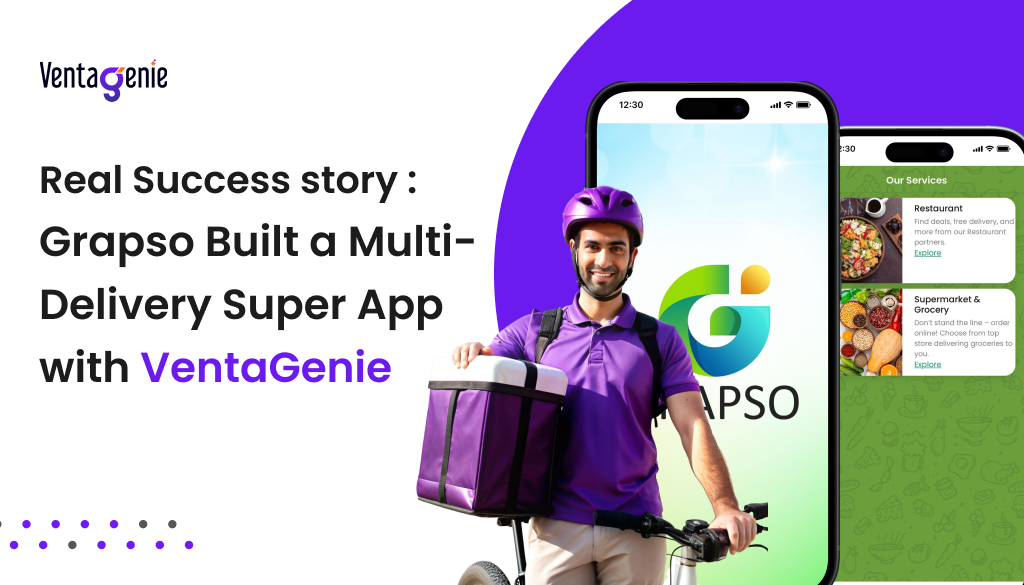
As the hyperlocal delivery industry continues to expand rapidly, customer expectations are evolving just as fast. Today’s users no longer want multiple apps for food, groceries, and essentials—they expect everything in one place.
This shift has given rise to the multi-delivery app model, where businesses offer multiple services through a single platform.
However, building such a system is not simple. Managing multiple delivery categories, vendors, logistics, and user experience requires strong technological infrastructure.
This is where scalable platforms like VentaGenie play a crucial role.
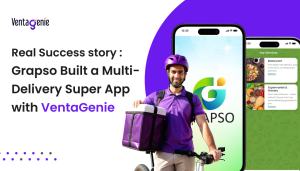
A powerful example of this transformation is Grapso – Meals & More, a fast-growing hyperlocal delivery startup in India that successfully evolved from a food delivery app into a full-scale multi-category delivery platform.
This blog explores Grapso’s journey, the challenges they faced, the strategies implemented, and the measurable outcomes achieved.
Why Multi-Delivery Apps Are the Future of Hyperlocal Businesses ?
The hyperlocal market has shifted from single-service platforms to integrated ecosystems.
Consumers now prefer convenience over fragmentation. Instead of switching between apps, they want a unified experience where they can order meals, groceries, and daily essentials effortlessly.
For businesses, this creates an opportunity to increase customer retention, boost order frequency, and maximize revenue.
However, without the right technology, managing multiple delivery verticals can become operationally complex.
This is why many companies are now investing in multi-delivery platforms powered by scalable backend systems.
About Grapso – Meals & More
Founded in 2024, Grapso – Meals & More started as a food delivery service with a simple mission: deliver hot meals quickly and reliably.
The platform gained early traction, but the team soon recognized a larger opportunity—to build a delivery super app that could handle multiple categories in one place.
Their vision was to create an all-in-one platform where users could order :
- Restaurant food
- Groceries
- Daily essentials
- And more
This ambitious vision required a complete transformation of their existing system.
Challenges Faced by Businesses Like Grapso – Meals & More Before Building a Multi-Delivery Platform
As businesses grow from a single-service model into multi-category platforms, they often encounter challenges that go far beyond basic app development.
These are not just technical issues—they directly impact revenue, customer experience, and scalability.
The journey of Grapso – Meals & More reflects the same challenges many startups and delivery businesses face when trying to build a multi-delivery app.
If you are planning to launch or scale a delivery platform, you will likely face similar roadblocks.
1. Lack of a Scalable Architecture for Multi-Category Expansion
Most delivery startups begin with a single-service app, typically focused on food. However, when they try to expand into groceries, essentials, or other categories, their existing system cannot support multiple workflows.
This creates major limitations :
- Difficulty adding new services
- System instability as complexity increases
- Need for multiple apps or disconnected systems
Without a modular backend, scaling becomes expensive and inefficient.
2. Inefficient Vendor and Zone Management
As the business grows, managing multiple vendors across different locations becomes increasingly complex.
Many businesses struggle with :
- Manual vendor assignment
- Poor location-based delivery planning
- Underutilized or overloaded vendors
This leads to delayed deliveries, operational inefficiencies, and poor customer experience.
3. No clear Operational Structure for Vendors and Delivery Teams
Without role-based systems, vendors and delivery partners often operate without clear workflows.
Common issues include :
- Miscommunication between vendors and delivery agents
- Lack of real-time coordination
- Delays due to manual intervention
This not only slows down operations but also affects service quality.
4. Poor Delivery Optimization and Lack of Real-Time Updates
Many early-stage delivery apps lack intelligent routing systems.
As a result :
- Delivery routes are inefficient
- Orders take longer to reach customers
- Customers remain uninformed about order status
This increases customer frustration and leads to higher support queries.
5. Weak Brand Identity Due to Generic App Solutions
Businesses using ready-made or poorly customized apps often struggle to establish a strong brand presence.
Challenges include :
- Generic UI/UX that looks similar to competitors
- Lack of brand recognition
- Reduced customer trust
In a competitive market, branding plays a crucial role in retention.
6. Fragmented User Experience Across Services
One of the biggest issues in multi-delivery platforms is inconsistency in user experience.
Customers may face :
- Different interfaces for different services
- Complicated navigation
- Longer checkout processes
This friction reduces engagement and impacts repeat usage.
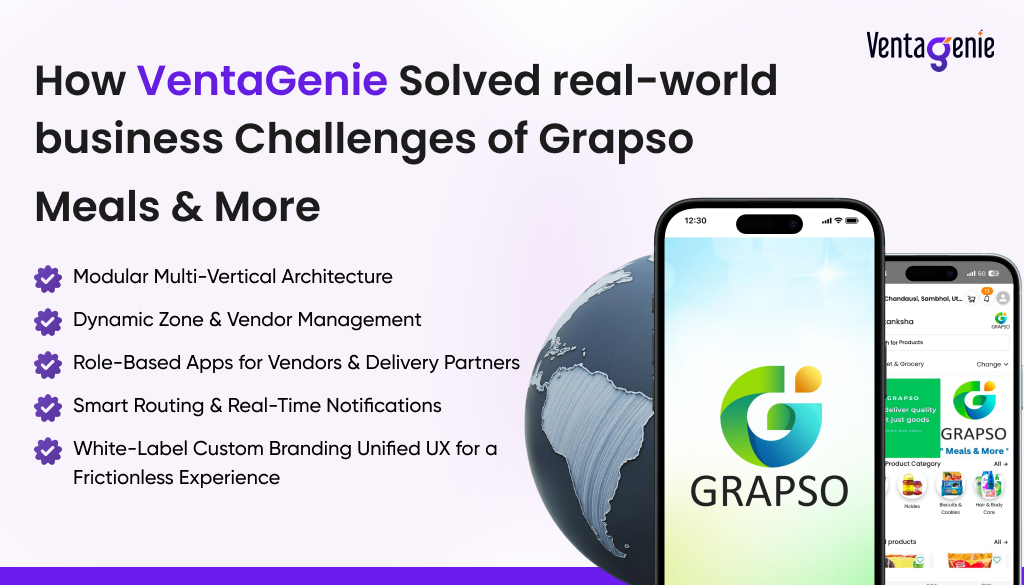
How VentaGenie Solved These Challenges of Grapso – Meals & More ?
To overcome these real-world business challenges, Grapso – Meals & More partnered with VentaGenie, implementing a scalable and intelligent system designed specifically for multi-delivery businesses.
1. Modular Multi-Vertical Architecture
Instead of forcing all services into a single rigid system, VentaGenie built a modular backend that supports multiple delivery categories.
Each category operates independently with its own logic, while still being part of one unified system.
Result :
Businesses can launch food, grocery, and essential delivery in one app—without building separate platforms or facing scalability issues.
2. Dynamic Zone & Vendor Management
VentaGenie introduced an intelligent system that organizes vendors based on location, category, and delivery capacity.
Orders are automatically assigned using smart logic, ensuring optimal efficiency.
Result :
Faster deliveries, better vendor utilization, and reduced operational bottlenecks.
3. Role-Based Apps for Vendors & Delivery Partners
Dedicated apps were developed for vendors and delivery agents, each with customized dashboards and workflows.
This ensures clear responsibilities and seamless coordination.
Result :
Real-time operations, reduced confusion, and improved accountability across the system.
4. Smart Routing & Real-Time Notifications
Advanced routing algorithms optimize delivery paths in real time, while customers receive live updates at every stage.
Result :
On-time deliveries, fewer failed orders, and up to 40% reduction in support queries.
5. White-Label Custom Branding
The platform was fully customized to match Grapso’s brand identity, creating a unique and professional user experience.
Result :
Stronger brand recognition, higher user trust, and better market positioning.
6. Unified UX for a Frictionless Experience
VentaGenie ensured that all services were integrated into one seamless interface.
Users can browse, order, and track everything in a consistent flow.
Result :
Higher engagement, increased order frequency, and improved customer retention.
Why This Matters for Your Business ?
If you are planning to build a multi-delivery app, these challenges are not optional—they are inevitable.
The difference between failure and success lies in how early you address them.
The experience of Grapso – Meals & More shows that with the right technology partner like VentaGenie, businesses can :
- Scale faster without technical limitations
- Deliver a seamless user experience
- Automate complex operations
- Build a strong and recognizable brand
Lessons for Businesses Building Multi-Delivery Apps
The journey of Grapso – Meals & More offers valuable insights.
A unified platform simplifies operations and improves user experience. Businesses should invest in scalable technology that can handle multiple delivery categories efficiently.
Automation is essential for reducing errors and improving speed.
Most importantly, choosing the right technology partner can make or break the success of the platform.
Conclusion : From Food App to Delivery Super App
The transformation of Grapso – Meals & More demonstrates how the right strategy and technology can drive business growth.
By partnering with VentaGenie, the company successfully built a scalable, efficient, and user-friendly multi-delivery platform.
The results speak clearly :
- Expansion into multiple delivery categories
- 25% increase in daily orders
- Improved customer experience
- Reduced dependency on aggregators
For businesses looking to build a multi-category delivery app, this case study highlights an important takeaway:
The right technology foundation can transform a simple idea into a scalable, high-growth platform.
Ready to Build Your Multi-Delivery App ?
If you are planning to launch or scale your delivery business, now is the time to invest in the right technology. With VentaGenie, you can build a fully customized multi-delivery platform that supports multiple categories under one system.
Frequently Asked Questions
A multi-delivery app is a single platform that allows users to order multiple types of products—such as food, groceries, medicines, and daily essentials—from one application. Instead of using separate apps for each service, customers get everything in one unified experience.
A food delivery app focuses only on restaurant orders, while a multi-delivery app supports multiple categories like groceries, essentials, and more. Businesses using a multi-delivery model can serve more customer needs, increase order frequency, and generate higher revenue.
Businesses should invest in a multi-delivery platform because it:
- Increases customer retention
- Boosts average order value
- Expands revenue streams
- Reduces dependency on third-party platforms
Platforms like VentaGenie make it easier to launch and scale such systems efficiently.
A successful multi-delivery app should include:
- Multi-category product management
- Real-time order tracking
- Smart delivery routing
- Vendor and store management
- Role-based apps for vendors and delivery partners
- Secure payment integration
- Analytics and reporting dashboard
These features ensure smooth operations and scalability.
Vendor management systems allow businesses to organize stores based on location, category, and availability. Orders are automatically assigned to the most suitable vendor using intelligent algorithms, improving efficiency and reducing delivery time.
Yes, startups and local businesses can easily launch a multi-delivery platform tailored to their city or region. With solutions like VentaGenie, you can quickly deploy a scalable app without building everything from scratch.
Development time depends on customization and features. However, using ready frameworks like VentaGenie, businesses can launch a fully functional multi-delivery platform in as little as a few days to a few weeks.
Some common challenges include:
- Managing multiple delivery categories
- Handling vendor and logistics coordination
- Ensuring real-time tracking and updates
- Maintaining a seamless user experience
These challenges can be solved with the right technology and architecture.
A multi-delivery app simplifies the entire journey by offering:
- One app for multiple services
- Faster ordering process
- Real-time delivery updates
- Consistent user interface
This convenience leads to higher engagement and repeat orders.
Yes, if built on a scalable architecture like VentaGenie, a multi-delivery platform can easily expand to new locations, vendors, and product categories without performance issues.
Absolutely. Modern platforms offer white-label solutions where you can customize:
- App design and UI
- Logo and branding
- Features and workflows
This helps businesses build a unique identity in the market.
Real-time tracking uses GPS and geolocation technology to monitor delivery movement. Customers can track their orders live, while businesses can optimize routes and improve delivery efficiency.
The cost depends on factors like features, customization, and scale. Using pre-built solutions significantly reduces development costs compared to building from scratch.
Yes, multi-delivery apps are highly profitable because they :
- Increase order frequency
- Enable cross-selling across categories
- Reduce reliance on third-party commissions
- Improve customer lifetime value