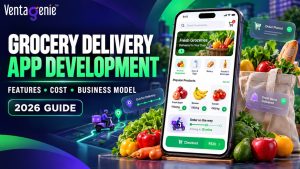
How to Build a Grocery Delivery App: Features, Cost & Business Model
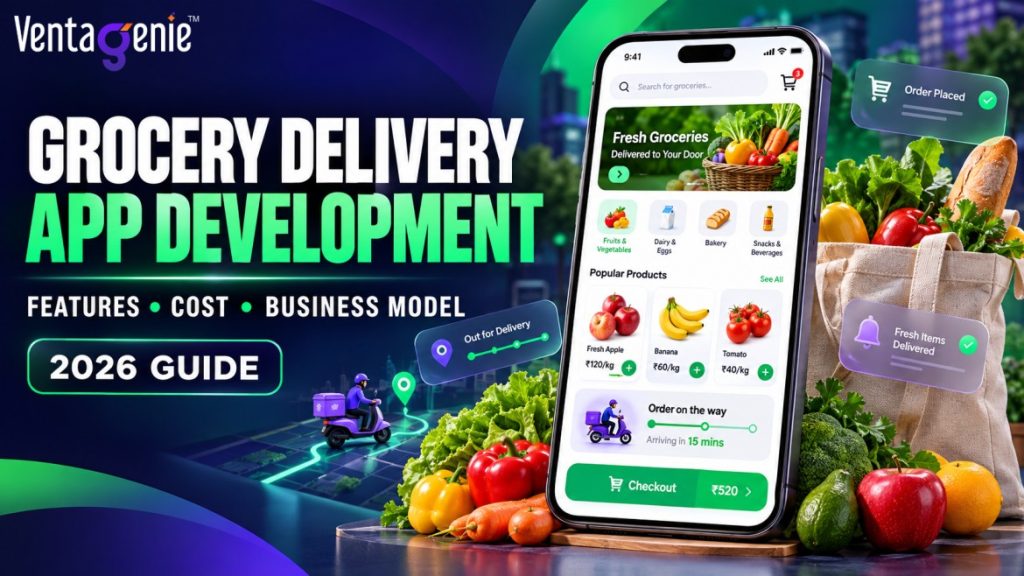
Planning to launch your own grocery delivery app? Build a platform that does more than accept orders — one that helps you manage inventory, streamline deliveries, retain customers, and grow your business.
Whether you want to digitise your supermarket, launch a multi-vendor grocery marketplace, or build an app inspired by Instacart, Blinkit, or Zepto, the right development approach can determine how efficiently you launch and how well your platform scales.
But before investing in grocery delivery app development, you need answers to some critical questions: How much will the app cost? Which features are essential for your business model? How will you manage out-of-stock products, delivery delays, and operating expenses? And how can you build a solution that fits your business without paying for unnecessary complexity?
That is where the right technology partner makes a difference.
VentaGenie helps businesses explore mobile app development solutions tailored to their business requirements, from customer-facing applications to connected operational workflows. The objective is to define the right solution for your business, budget, and growth plans before development begins.
In this guide, discover how to build a grocery delivery app in 2026, choose the right business model, estimate development costs, solve common operational challenges, and identify the features you need to launch with confidence.
Before You Build a Grocery Delivery App, Answer These 5 Questions
Many grocery app projects become expensive because development starts before the business requirements are clear.
Before choosing a grocery delivery app development company, answer these questions.
1. Who will own the inventory?
Will you sell products from your own supermarket, connect independent grocery stores, or manage stock in your own fulfilment centre? Each model requires different inventory and order-management workflows.
2. Who will fulfil the orders?
Will store employees pick products, will dedicated shoppers handle orders, or will delivery partners collect ready-to-dispatch orders? This decision affects the required apps, dashboards, and integrations.
3. How fast do you actually need to deliver?
Scheduled delivery, same-day delivery, and rapid local delivery require different operating capabilities. A shorter delivery promise can increase fulfilment and staffing costs.
4. How will your business earn money?
Your revenue may come from product margins, vendor commissions, delivery fees, subscriptions, or a combination of these models. Your platform should support the commercial rules you actually need.
5. What must be ready at launch?
You may not need advanced AI, automated dispatch, or multi-country functionality in the first release. You do need a reliable way to accept, process, fulfil, and support an order.
These answers establish the foundation for your grocery delivery app development project.
Grocery Delivery App Features That Solve Real Business Problems
A grocery app should be designed around what customers, store operators, delivery partners, and administrators need to accomplish.
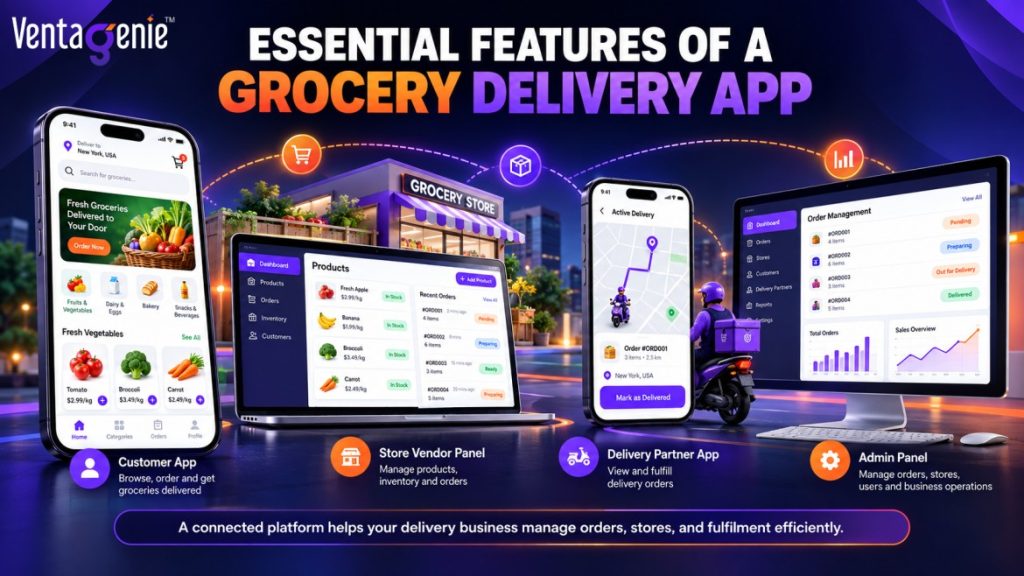
Customer app: Make every order easier to complete
Customers need more than an attractive product catalogue. They need accurate information and a predictable shopping experience.
Essential functionality includes:
- Product categories, search, filters, product variants, and pack sizes.
- Shopping carts, saved addresses, checkout, and payment options.
- Accurate availability information and clear product pricing.
- Delivery slots, order-status updates, and tracking where supported.
- Product substitutions, partial cancellations, and refund workflows.
- Shopping lists, favorites, purchase history, and quick reorder.
- Order notifications and accessible customer support.
The problem to solve: customers should not have to restart their shopping journey because one item is unavailable or an order status is unclear.
Store or vendor panel: Keep products and orders under control
A grocery store needs to manage its catalogue, stock, prices, incoming orders, and fulfilment status without manually coordinating every update.
Useful functionality includes product management, inventory updates, order acceptance, picking status, substitution handling, sales reporting, and low-stock alerts.
For multi-store operations, each vendor may require separate access permissions, store-specific pricing, commission rules, and settlement records.
The problem to solve: prevent discrepancies between what customers see online and what stores can actually fulfil.
Delivery partner app: Coordinate fulfilment
Delivery functionality may include order assignments, pickup information, navigation, delivery-status updates, proof of delivery, and earnings summaries.
Businesses with higher delivery volumes may also need dispatch automation, route optimisation, and order batching.
The problem to solve: reduce unnecessary delays between order readiness, pickup, and delivery.
Admin dashboard: Manage the complete operation
The administration system should provide visibility into customers, stores, products, orders, payments, refunds, delivery zones, promotions, and operational reports.
Role-based access and audit logs help businesses control who can perform sensitive actions.
The problem to solve: give the business a central place to manage exceptions, monitor performance, and make operational decisions.
The 7 Problems Your Grocery Delivery App Must Solve
Adding features is not enough. These are the operational problems to address when planning grocery delivery app development.
Problem 1: Online inventory does not match actual stock
A customer orders ten items, but three are unavailable when the store begins picking the order.
Plan for inventory synchronization, store-level stock tracking, and configurable substitution or refund rules. If stock data cannot be updated in real time, communicate availability limitations rather than promising certainty.
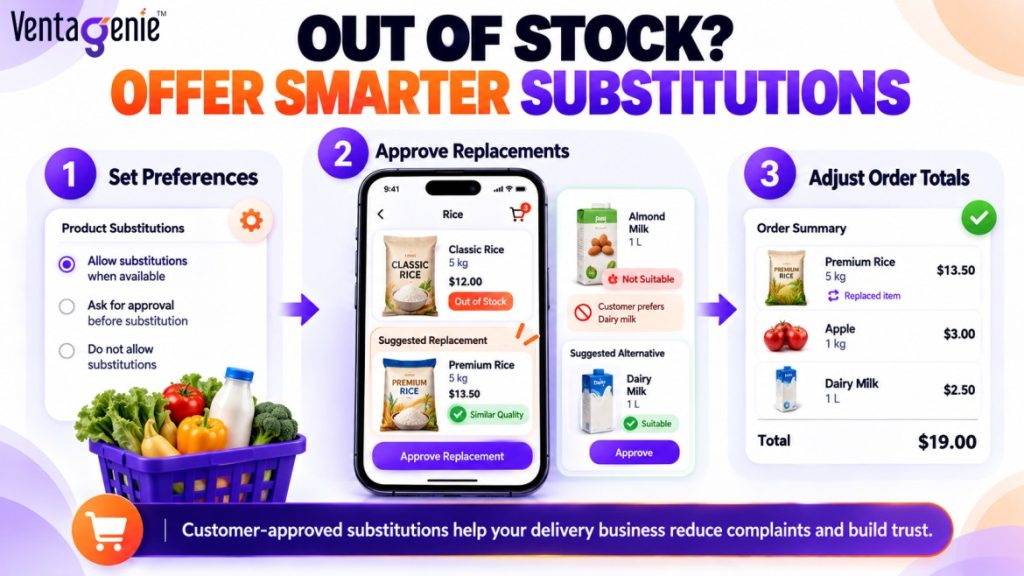
Problem 2: Product substitutions create customer complaints
Grocery products are not always interchangeable. A customer may accept a different brand of rice but reject a substitute for a particular dietary or household requirement.
Allow customers to set substitution preferences, approve replacements where appropriate, and receive accurate order-total adjustments.
Problem 3: Delivery costs consume profit
A large order may justify a delivery expense that makes a small order unprofitable.
Model delivery charges, minimum-order thresholds, fulfilment costs, promotions, and product margins. Use order-level reporting to understand which transactions contribute positively to the business.
Problem 4: Multiple stores create order-management complexity
A multi-vendor grocery marketplace must manage different catalogues, prices, stock levels, store hours, and fulfilment policies.
Define how orders are assigned, how vendor commissions are calculated, how refunds are handled, and who is responsible when a store cannot fulfil an order.
Problem 5: Customers do not return after their first purchase
Discounts may generate first orders without creating long-term loyalty.
Improve repeat purchasing through saved shopping lists, quick reorder, reliable fulfilment, relevant offers, and useful order notifications. Measure repeat-purchase behaviour rather than relying solely on downloads.
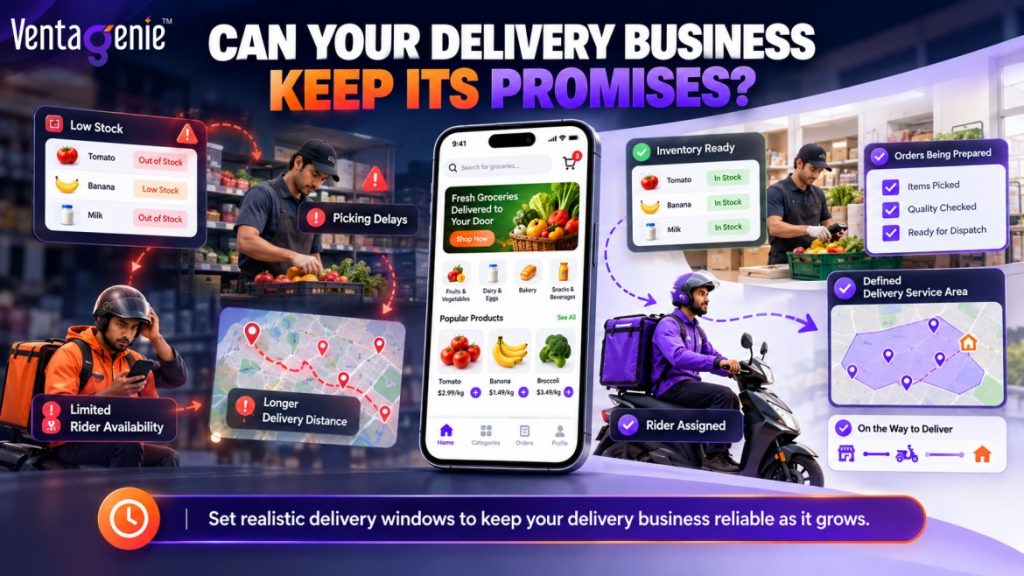
Problem 6: Delivery promises are difficult to maintain
A rapid-delivery promise depends on nearby inventory, picking capacity, dispatch availability, and realistic service boundaries.
Start with delivery windows or a limited service area if that better matches your operational capacity. Expand only when actual performance supports it.
Problem 7: Expanding the business requires expensive redevelopment
Adding vendors, locations, payment methods, or new markets can expose limitations in the original system.
Plan for maintainable integrations, configurable business rules, documented APIs where applicable, security, and clear source-code ownership. Build future flexibility where it matters without paying to implement every possible feature in advance.
How Much Does Grocery Delivery App Development Cost in 2026?
Thinking of launching your own grocery delivery app? You may not need a huge upfront investment to get started. The right development approach can help you launch with essential features first and expand as your customer base and order volume grow.
A basic grocery delivery app may start from $1,000–$3,000, depending on the features, platform requirements, and level of customisation. More advanced solutions involving multiple vendors, delivery partner apps, real-time tracking, inventory integrations, and automated operations require a broader development scope.
What makes grocery app development more expensive?
- Multiple applications: Separate customer, vendor, delivery, and admin interfaces require additional development and testing.
- Inventory integration: Connecting existing point-of-sale systems, warehouses, or supplier databases adds complexity.
- Delivery automation: Live tracking, dispatch, route optimisation, and multi-order fulfilment require additional workflows and integrations.
- Payment and regional requirements: Different payment gateways, currencies, languages, tax rules, and privacy requirements can affect the scope.
- Ongoing operations: Hosting, third-party API usage, maintenance, monitoring, and support should be budgeted separately from initial development.
Before accepting a proposal, ask what is included in the quoted price, which integrations are covered, who owns the source code, and what ongoing support will cost.
Choose the Right Grocery Delivery Business Model
The business model determines how the platform earns revenue, manages products, and fulfils orders.
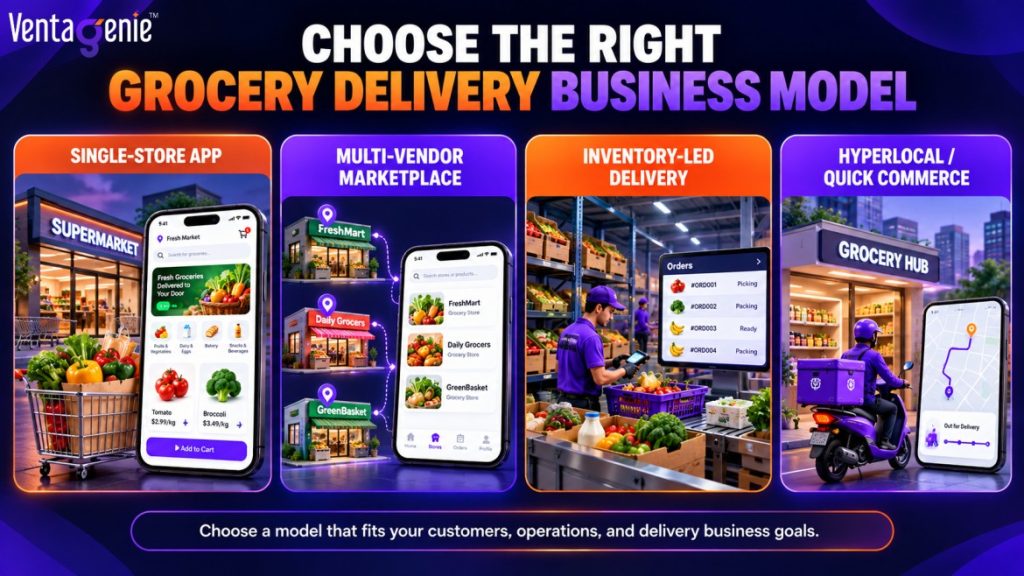
Single-store grocery app
Suitable for supermarkets, independent retailers, and grocery brands selling their own inventory.
Revenue typically comes from product margins, delivery fees, and optional customer memberships.
Multi-vendor grocery marketplace
Connects customers with multiple stores through a shared platform.
Revenue may come from vendor commissions, merchant subscriptions, delivery fees, and sponsored placements. The operator must define vendor responsibilities and settlement rules.
Inventory-led grocery delivery
The operator owns or controls inventory and manages fulfilment through stores or warehouses.
This model provides greater control over product availability and order processing but requires investment in stock, storage, and fulfilment operations.
Hyperlocal or quick-commerce platform
Focuses on a defined service area and short delivery windows.
It requires careful coordination of inventory, picking, delivery capacity, and service coverage. Rapid delivery should be introduced only when the operational model can support it.
Which model should you choose? Start with the simplest model that meets your business objectives and can deliver a dependable customer experience. Expand as demand and operating capacity grow.
How Will Your Grocery Delivery App Make Money?
A sustainable grocery business needs to understand how revenue compares with the cost of fulfilling each order.
Potential revenue streams include:
- Product sales and retail margins.
- Delivery fees.
- Vendor commissions.
- Merchant subscriptions.
- Customer memberships.
- Sponsored product placements.
- Business-to-business grocery ordering.
Not every revenue stream fits every business model. A single-store retailer and a multi-vendor marketplace have different commercial structures.
Calculate contribution margin before launch
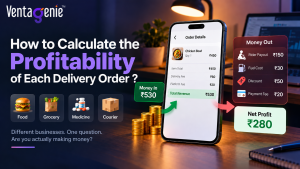
For example, consider a hypothetical order with a $40 basket value.
- Product gross margin at 25%: $10.
- Delivery fee collected: $3.
- Variable fulfilment and transaction costs: $9.
Illustrative contribution before fixed overheads and customer acquisition: $4 per order.
This is an example, not a forecast. Your actual economics depend on product margins, order size, fulfilment costs, discounts, refunds, and delivery arrangements.
A grocery delivery app should help you measure order value, fulfilment performance, repeat purchases, cancellations, and contribution margin—not just total sales.
How to Build a Grocery Delivery App Step by Step
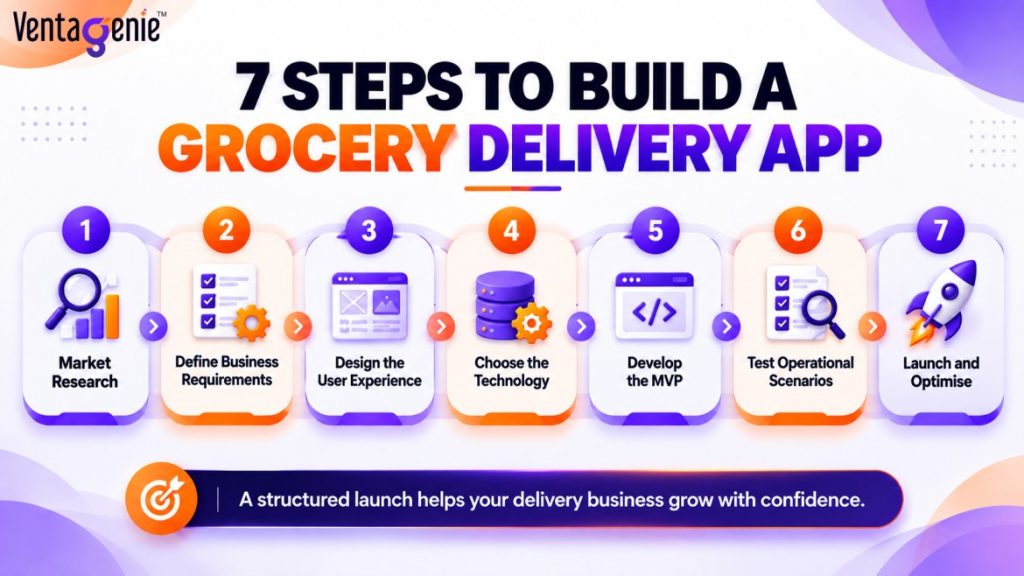
Step 1: Research your target market
Identify your target customers, competitors, product categories, service area, and delivery expectations.
Step 2: Define the business requirements
Document inventory ownership, order fulfilment, payments, substitutions, refunds, delivery rules, and revenue sources.
Step 3: Design the user experience
Map customer, store, delivery, and administrative workflows. Test the checkout and order-management journey before full development.
Step 4: Choose the technology
Select appropriate mobile frameworks, backend technologies, databases, cloud infrastructure, payment integrations, and mapping services according to the project’s requirements.
Step 5: Develop the MVP
Build the minimum complete product needed to accept and fulfil real orders reliably. Do not sacrifice essential order and refund workflows merely to reduce the initial scope.
Step 6: Test operational scenarios
Test stock mismatches, payment failures, duplicate orders, substitutions, cancellations, refunds, delivery delays, and peak-period performance.
Step 7: Launch and optimize
Start with a controlled market or service area. Track customer feedback and operational metrics before investing in additional features or geographical expansion.
A focused MVP may take a few months, while complex marketplace and enterprise projects may take considerably longer. A credible timeline requires a documented scope.
How to Build an App Like Instacart, Blinkit, or Zepto
If you want to build a grocery delivery app inspired by a successful platform, first identify the specific capabilities you want to reproduce.
Your goal | Key development priorities |
Build an app like Instacart | Retailer workflows, substitutions, shopping experience, fulfilment coordination |
Build an app like Blinkit | Local inventory, picking speed, dispatch, service-area controls |
Build an app like Zepto | Quick-commerce workflows, inventory availability, fulfilment and delivery coordination |
Build your own supermarket app | Branded ordering, catalogue, stock, checkout, order management |
Build a multi-vendor/ Seller grocery app | Vendor onboarding, store-specific inventory, commissions, settlements |
These are reference points, not identical technology specifications. Their operating models, scale, and infrastructure differ.
You do not need to replicate an established company’s entire operation to launch a successful grocery delivery business. You need to identify which customer experience you want to provide and build the systems required to deliver it.
Why Consider VentaGenie for Grocery Delivery App Development?
Choosing the right development partner means finding a team that understands the relationship between the mobile experience and the business operation behind it.
VentaGenie offers mobile app development solutions for businesses planning digital products around their own requirements.
For a grocery delivery project, the scope can be planned around:
- Customer-facing grocery ordering applications.
- Single-store or multi-vendor workflows.
- Vendor, delivery, and administration interfaces.
- Payment, inventory, mapping, and third-party integrations.
- A phased roadmap for future features and expansion.
The appropriate solution depends on your requirements, budget, target market, and fulfilment model. These should be evaluated before confirming scope, timeline, and pricing.
Planning to build a grocery delivery app?
Discuss your business model, target market, essential features, and expected delivery operations with VentaGenie to identify a suitable development approach.
Build a grocery delivery app around your business goals with VentaGenie.
Frequently Asked Questions
Grocery delivery app development costs depend on the features, platforms, integrations, and business model. A basic grocery app may start from $1,000–$3,000, provided the project fits a limited starter scope. A multi-vendor marketplace or a platform with advanced delivery management, inventory integrations, and separate vendor and delivery apps requires a more detailed estimate. Always confirm what is included in the quoted price.
Yes, it may be possible to launch a basic grocery app within this budget if you limit the initial scope and use suitable existing components or a starter solution. However, this budget may not cover a fully customized Android and iOS platform with customer, vendor, delivery partner, and admin applications. Confirm the available features, integrations, deployment, and ongoing costs before committing.
Start by identifying the specific business model and customer experience you want to offer. An Instacart-inspired app may priorities retailer coordination and product substitutions, while a Blinkit- or Zepto-inspired model requires careful planning for local inventory, picking, dispatch, and short delivery windows. Define your essential workflows first, then develop and test a minimum viable product (MVP) before expanding.
A basic grocery delivery app typically needs product listings, search, a shopping cart, checkout, payment processing, order updates, and an admin interface. Depending on the business model, you may also need inventory management, vendor dashboards, delivery partner functionality, product substitutions, refunds, and sales reporting. Prioritise features that help customers place orders and enable your business to fulfil them reliably.
A focused MVP may take a few months, while a more complex marketplace or quick-commerce platform can take considerably longer. The timeline depends on the number of applications, custom features, third-party integrations, testing requirements, and readiness of the business workflows. A reliable estimate should follow a clearly defined project scope.
A single-store grocery app allows one retailer or grocery brand to sell its products directly to customers. A multi-vendor marketplace connects multiple stores through one platform and may require vendor onboarding, store-specific catalogues and inventory, commission rules, settlements, and vendor-level order management. The right model depends on who owns the inventory and how your business will earn revenue.
The app should use accurate inventory updates and define what happens when an item becomes unavailable after an order is placed. Depending on the business rules, customers can choose replacement preferences, approve substitutes, remove unavailable items, or receive refunds. Integrating the app with an existing POS or inventory system may help reduce stock discrepancies, provided the source data is reliable.
Grocery delivery apps can generate revenue through product margins, delivery fees, vendor commissions, merchant subscriptions, customer memberships, and sponsored product placements. Not every model supports every revenue stream. Before launch, calculate the contribution margin per order by accounting for product costs, fulfilment, payment processing, discounts, refunds, and other variable expenses.
Yes. Starting in one city or a defined delivery area can help you test demand, fulfilment capacity, delivery costs, and customer retention before expanding. Plan the platform so that adding locations, stores, delivery zones, and payment methods is practical without building every advanced capability at launch.
Look beyond the initial quote. Evaluate the company’s ability to understand your business model, plan customer and admin workflows, integrate inventory and payment systems, test real-world order scenarios, and provide post-launch support. Clarify source-code ownership, maintenance costs, third-party fees, security responsibilities, and the exact deliverables before signing an agreement.
VentaGenie provides mobile app development solutions tailored to business requirements. If you are planning a grocery ordering app, supermarket application, or multi-vendor marketplace, discuss your target customers, essential features, fulfilment model, and budget with the team to determine the appropriate project scope.

Mr. Aniket D is a seasoned digital marketer with over 10 years of experience in market research, content strategy, and performance marketing.
He specializes in analyzing consumer behavior, identifying emerging market trends, and translating insights into actionable digital strategies.
His work focuses on blending research-driven content with SEO and lead generation to drive measurable business growth.
Known for his data-first mindset, Aniket helps brands make smarter, audience-focused decisions in competitive markets.