Single Vendor vs Multi-Vendor Marketplace App: Which Model Is Right for Your Business?
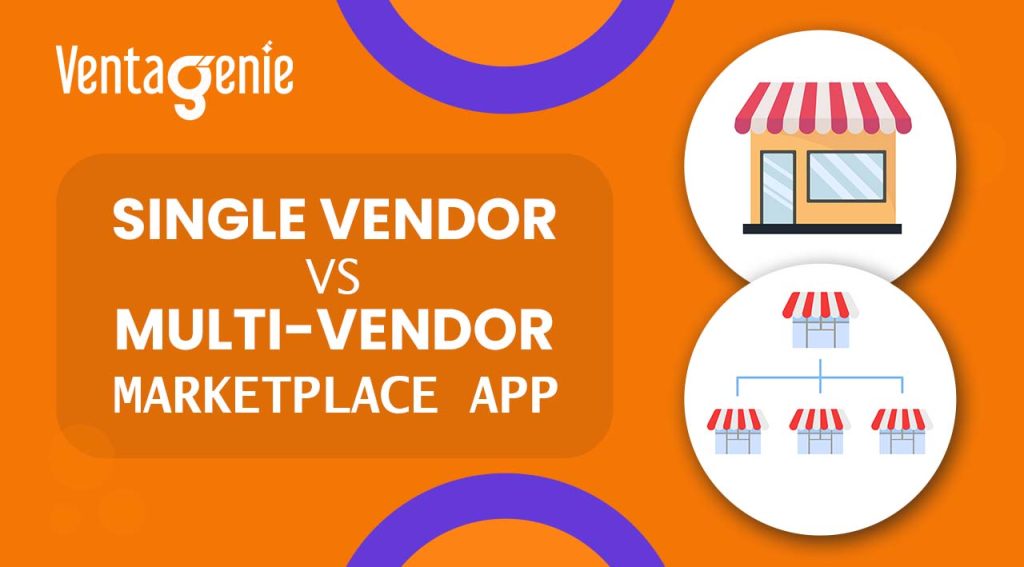
In today’s digital-first economy, choosing the right marketplace business model is not just a technical decision — it’s a long-term strategic move that directly impacts scalability, revenue potential, operational complexity, and investor appeal. Whether you are launching a startup, expanding an enterprise, or building a hyperlocal service platform, understanding the difference between a single vendor app and a multi-vendor marketplace is critical.
Over the last decade, the global shift toward platform-driven commerce has accelerated rapidly. Companies like DoorDash, Zomato, Blinkit, and Porter have proven that a multi-vendor marketplace model can scale faster through network effects and commission-based revenue systems. At the same time, global giants such as Amazon and Flipkart demonstrate how a large-scale B2C marketplace platform can dominate entire industries by connecting millions of sellers and buyers under one ecosystem.
However, not every business needs a multi-seller platform. A single vendor app remains highly effective for brands that prioritize control, product exclusivity, and direct customer ownership. Many D2C companies continue to thrive using a focused single-brand eCommerce strategy.
The real question is:
- Do you want complete control over inventory and branding?
- Or do you want to build a scalable ecosystem where multiple sellers contribute to growth?
- Are you aiming for a niche brand experience or a broad B2C marketplace platform?
- Do you prefer direct product margins or diversified commission revenue streams?
Each model comes with its own operational structure, technology requirements, monetization layers, and risk profile. The choice between a single vendor app and a multi-vendor marketplace ultimately depends on your capital capacity, expansion strategy, target audience, and long-term business vision.
In this guide, we will break down both models in depth, compare their advantages and challenges, analyze real-world examples, and help you determine which marketplace business model aligns best with your business objectives in 2026 and beyond.
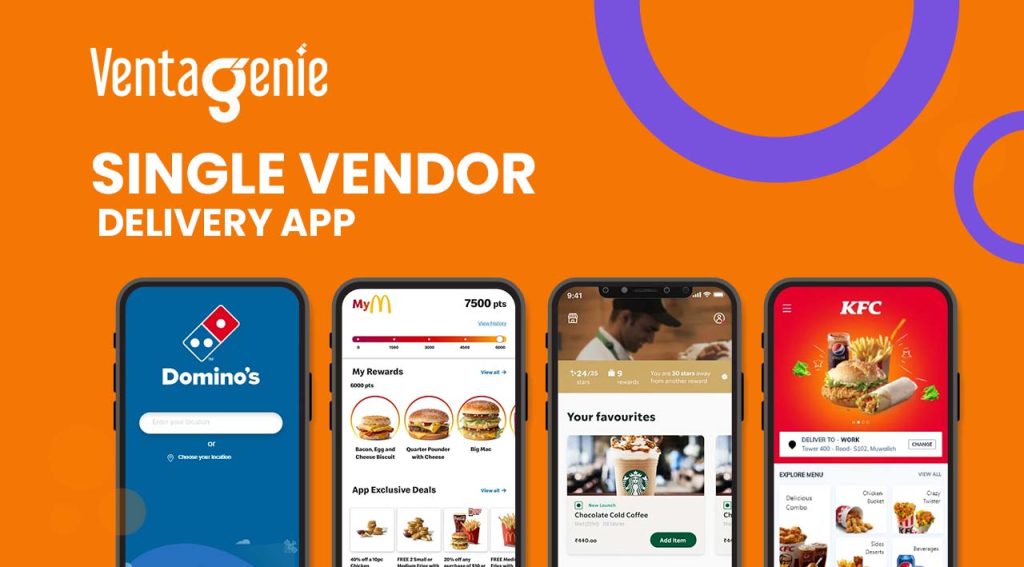
What is a Single Vendor Delivery App?
Imagine a grocery store in Los Angeles called GreenHarvest Market. To boost sales, the owner launches a delivery app where customers can order fresh produce, dairy, and household items with same-day delivery.
But there’s one condition:
Only GreenHarvest Market sells on the app.
No other stores. No third-party vendors.
This is a Single Vendor Delivery App — a platform where one business sells and delivers its own products directly to customers.
Definition:
A Single Vendor Delivery App in the grocery industry is a platform where one grocery store (or one brand) sells and delivers its own products directly to customers without involving multiple sellers.
Example: Domino’s Pizza App, McDonald’s App, Starbucks App, KFC App
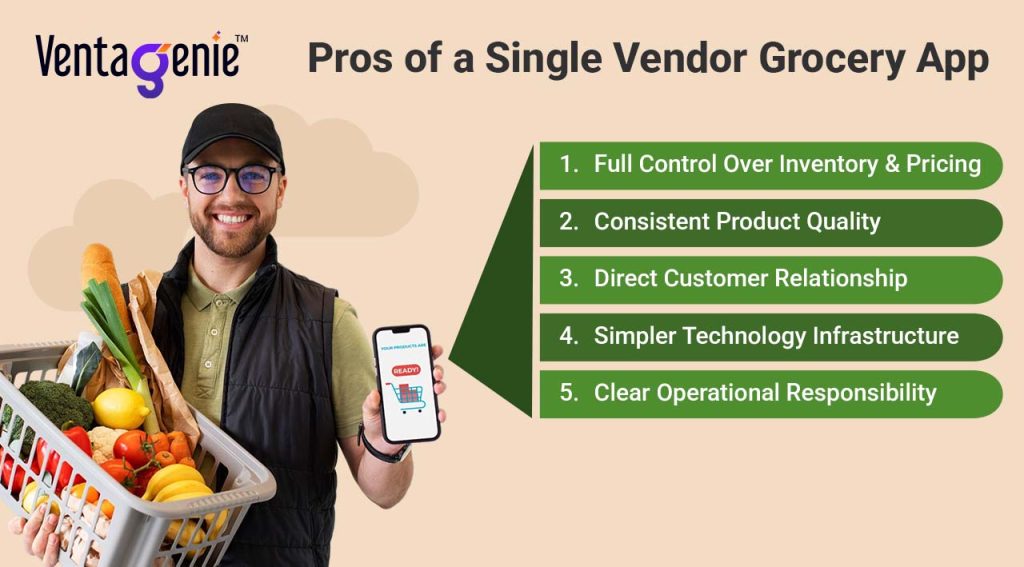
Pros of a Single Vendor Grocery App
Marketplace platforms can operate in different models:
1. Full Control Over Inventory & Pricing
The store owner decides:
- Which products to stock
- What price to charge
- Which discounts to run
- When to offer bundle deals
There’s no price competition inside the platform.
2. Consistent Product Quality
Since all groceries come from one store:
- Quality standards remain uniform
- Supplier relationships are controlled
- Packaging remains consistent
Customers know what to expect.
3. Direct Customer Relationship
The store collects:
- Customer purchase history
- Preferred items
- Recurring buying patterns
This allows:
- Personalized promotions
- Loyalty rewards
- Subscription-based grocery plans
4. Simpler Technology Infrastructure
A single vendor grocery app does not require:
- Vendor onboarding system
- Commission calculation engine
- Multi-seller dashboards
- Automated payout management
This reduces development complexity and operational overhead.
5. Clear Operational Responsibility
If there’s a delayed order or missing item, there is no confusion about who is responsible.
The grocery store owns the entire experience.
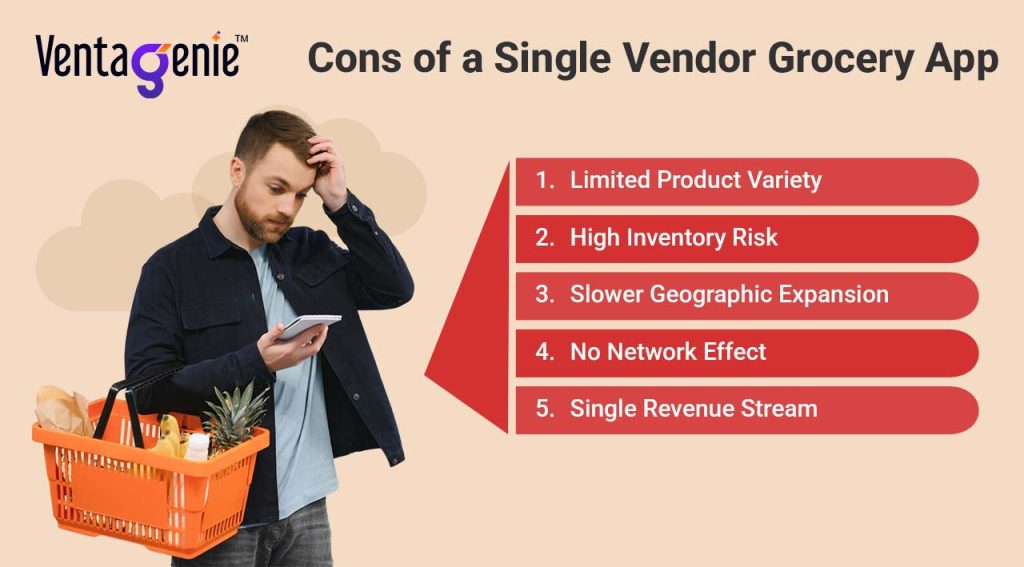
Cons of a Single Vendor Grocery App
While GreenHarvest Market enjoys control, growth limitations become visible over time.
1. Limited Product Variety
If a customer wants specialty imported goods that GreenHarvest does not stock, they must go elsewhere.
Unlike a multi-vendor grocery marketplace, the app cannot offer alternative suppliers.
Limitation: Restricted catalog expansion.
2. High Inventory Risk
If demand forecasting fails:
- Unsold perishables may expire
- Capital gets locked in excess stock
- Waste increases
The store absorbs the full financial risk.
Limitation: Higher operational exposure.
3. Slower Geographic Expansion
To expand to another city, GreenHarvest must:
- Open a new physical location
- Set up a warehouse
- Hire staff
- Manage new logistics
In a multi-vendor marketplace model, expansion can happen by onboarding local grocery partners instead.
Limitation: Capital-intensive scaling.
4. No Network Effect
Growth depends entirely on:
- Marketing budget
- Store capacity
- Brand recognition
There is no ecosystem effect where additional sellers attract more customers.
Limitation: Linear growth rather than exponential growth.
5. Single Revenue Stream
Revenue comes only from:
- Grocery sales
- Delivery fees
There is no opportunity to earn from:
- Vendor commissions
- Sponsored listings
- Seller subscriptions
- Marketplace service fees
Limitation: Limited revenue diversification.
What is a Multi-Vendor Marketplace App?
Imagine you launch an app in New York called CityServe.
Instead of offering products or services from just one business, your app connects:
- Multiple restaurants
- Grocery stores
- Pharmacies
- Electronics sellers
- Local service providers
Customers can:
- Compare different sellers
- Choose better prices
- Access wider product options
- Order from multiple vendors
- Track deliveries in real time
- Read reviews before purchasing
That is a Multi-Vendor Marketplace App.
Unlike a single vendor app (where only one business sells), a multi-vendor marketplace allows multiple independent sellers or service providers to operate within one platform. The platform owner manages technology, payments, logistics coordination, and commissions — while vendors manage their own inventory or services.
It is a scalable marketplace business model built on ecosystem economics.
Platforms like DoorDash, Amazon, and Zomato operate using this structure.
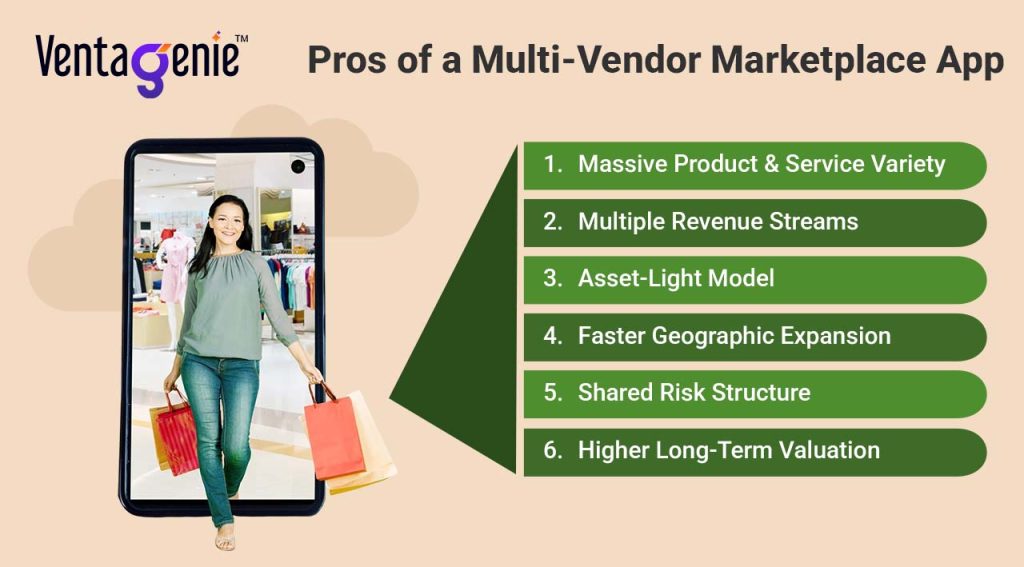
Pros of a Multi-Vendor Marketplace App
1. Massive Product & Service Variety
Customers prefer platforms where they can:
- Compare brands
- Explore alternatives
- Choose based on price, reviews, or delivery speed
More choice increases user engagement.
2. Multiple Revenue Streams
The platform can generate revenue from:
- Commission per transaction
- Vendor subscription plans
- Sponsored listings
- Advertising placements
- Delivery/service fees
- Featured promotions
Unlike a single vendor app, revenue is diversified.
3. Asset-Light Model
The platform owner does not need to:
- Manufacture products
- Store inventory
- Maintain large warehouses
Vendors manage their own stock.
This reduces capital risk.
4. Faster Geographic Expansion
To expand into a new city or region, you simply onboard local vendors instead of building new infrastructure.
Scaling becomes faster and more flexible.
5. Shared Risk Structure
If one vendor underperforms, others continue operating.
The platform is not dependent on a single supplier.
6. Higher Long-Term Valuation
Investors often favor marketplace models because they:
- Scale faster
- Generate recurring commission revenue
- Benefit from network effects
- Have stronger growth multipliers
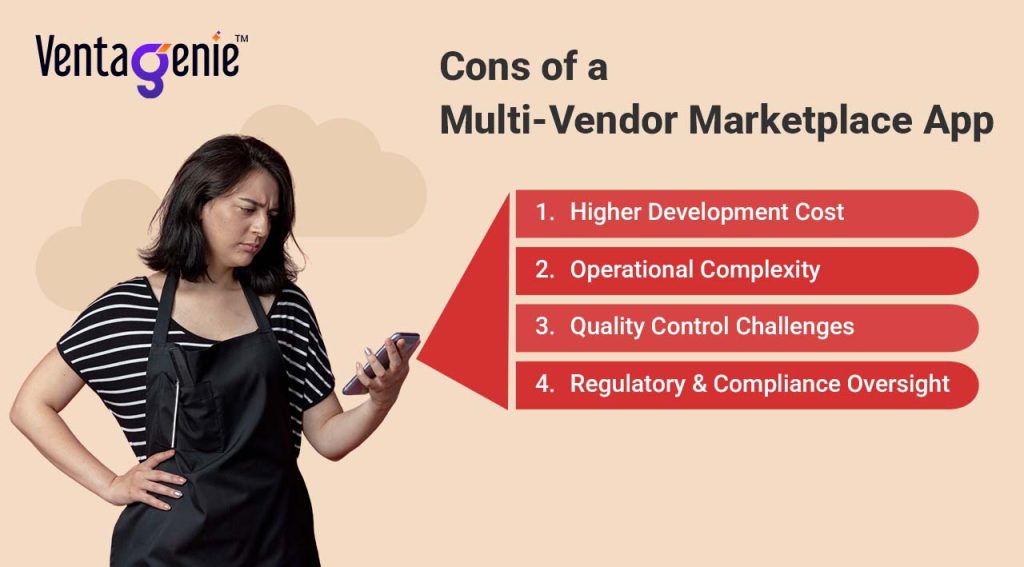
Cons of a Multi-Vendor Marketplace App
While powerful, it comes with complexity.
1. Higher Development Cost
Requires:
- Vendor onboarding system
- Multi-seller dashboards
- Commission calculation engine
- Automated payout distribution
- Review & rating management
- Admin governance panel
Technical architecture is more advanced than a single vendor app.
2. Operational Complexity
You must manage:
- Vendor verification
- Quality standards
- Dispute resolution
- Platform policies
Strong governance is essential.
3. Quality Control Challenges
Since multiple vendors operate independently:
- Service levels may vary
- Packaging quality may differ
- Customer experience may not be uniform
The platform must implement rating and monitoring systems.
4. Regulatory & Compliance Oversight
Handling multiple sellers means:
- Tax compliance
- Vendor licensing
- Regional regulations
Administrative oversight increases.
Why Multi-Vendor Marketplace Apps Are Stronger 2026
A single vendor app builds one digital store.
A multi-vendor marketplace builds a digital ecosystem.
The strength comes from:
- More sellers → More products & services
- More options → More customers
- More customers → More seller interest
- More sellers → Platform growth accelerates
This is called the network effect — and it drives exponential growth.
When Should You Choose Single Vendor?
- You manufacture your own products
- You operate in a niche luxury segment
- Brand control is top priority
- You prefer operational simplicity
When Should You Choose On-Demand Multi-Vendor?
- You want to build a hyperlocal ecosystem
- You aim for rapid city expansion
- You target food, grocery, logistics, services
- You want recurring commission revenue
- You want scalable tech platform
When Should You Choose Amazon-Type Marketplace?
- You want national/global expansion
- You can manage large seller ecosystem
- You have high initial capital
- You aim for category dominance
The Hybrid Strategy
Many successful platforms start hyperlocal and then expand.
Example strategy:
- Launch city-based on-demand marketplace
- Add subscription tiers
- Introduce dark store model
- Expand to additional service categories
This phased scaling reduces risk.
Pros & Cons Comparison Table
Factor | Single Vendor | On-Demand Multi-Vendor | Amazon-Type Marketplace |
Inventory Risk | High | Low | Low |
Scalability | Moderate | High | Very High |
Network Effect | No | Yes | Yes |
Revenue Streams | Limited | Multiple | Multiple |
Development Cost | Lower | High | Very High |
Investment Appeal | Moderate | Strong | Strong |
- Did You Know?
👉 Most high-valuation startups in commerce operate as multi-vendor platforms.
👉 Platform-based businesses typically achieve better lifetime value (LTV) due to ecosystem lock-in.
👉 On-demand apps often generate more frequent transactions than traditional eCommerce stores.
👉 Marketplace apps benefit from vendor-driven organic growth.
Features of a Multi-Vendor Delivery App
A multi-vendor delivery app is far more complex than a single vendor application because it must manage multiple sellers, real-time logistics, customer interactions, and financial settlements simultaneously.
Customer App Features
- Smart search & filters
- Multi-vendor cart
- Real-time order tracking
- Secure payment options
- Ratings & reviews
- Push notifications
- Coupons & referral system
Vendor Panel Features
- Easy vendor registration
- Product/service management
- Inventory tracking
- Order management
- Commission & payout tracking
- Sales analytics dashboard
Delivery Partner App
- Rider registration & verification
- Auto order assignment
- GPS navigation
- Earnings dashboard
- Delivery status updates
Admin Panel
- Vendor & user management
- Commission control
- Analytics & reports
- Dispute management
- Multi-city management
Advanced Features (Trending)
- AI-based recommendations
- Quick commerce support (10–30 min delivery)
- Subscription model
- Multi-category support (food, grocery, pharmacy, logistics)
Why Ventagenie is the Right Delivery App Development Partner
At Ventagenie, we specialize in:
- Custom single store app development solutions
- Scalable multi delivery app development solutions
- Hyperlocal delivery app architecture
- Multi-vendor marketplace platform development
- AI-powered recommendation systems
- Commission and payout automation engines
- Real-time tracking integration
- Multi-city deployment and scaling support
We don’t just build apps.
We build scalable digital ecosystems engineered for growth.
Final Verdict: Which Model Wins?
If your vision is limited to one brand and controlled growth, a single vendor app is practical.
If your vision is to dominate a market, build recurring revenue, and scale across cities or categories — a multi-vendor marketplace app is the stronger long-term strategy.
In 2026 and beyond, digital commerce is platform-driven.
The real question is not whether you need an app.
It is whether you are building a store — or building an ecosystem.
If you’re ready to launch a scalable delivery app development solution tailored to your business goals, Ventagenie is ready to build it with you.
Ready to Launch Your Delivery App?
Whether you need a single store app development solution or a scalable multi delivery app development solution, Ventagenie builds powerful, growth-ready marketplace platforms tailored to your vision.
Frequently Asked Questions
A single vendor app allows only one business to sell products or services directly to customers.
A multi-vendor marketplace app connects multiple independent sellers under one platform and generates revenue through commissions and service fees — similar to DoorDash or Amazon.
If your goal is brand control and limited operations, a single store app works well.
If your goal is rapid scaling, multi-city expansion, and recurring commission revenue, a multi delivery app development solution is the stronger long-term strategy.
Multi-vendor platforms can generate revenue from:
- Commission per order
- Vendor subscription plans
- Featured listings
- Advertising placements
- Delivery/service charges
- Surge pricing
This diversified revenue model increases long-term profitability.
Yes. Many businesses start with a single store app development solution and later expand into a multi-vendor marketplace model.
However, building scalable architecture from the beginning makes future upgrades smoother.
Multi-vendor delivery platforms are ideal for:
- Food delivery
- Grocery delivery
- Pharmacy delivery
- Logistics & parcel services
- Hyperlocal services
- E-commerce marketplaces
Ventagenie specializes in:
- Custom single vendor app development
- Scalable multi-vendor marketplace app development
- Commission engine integration
- Real-time tracking systems
- Multi-city deployment
- Cloud-based scalable infrastructure
We design marketplace platforms built for long-term growth — not just launch.
Yes. With proper cloud infrastructure, localization support, multi-currency payment integration, and regulatory compliance, a B2C marketplace platform can scale nationally or globally.
The first step is a strategy consultation to evaluate:
- Your target market
- Business goals
- Revenue model
- Technology requirements
From there, a customized roadmap can be created to launch your scalable delivery platform.