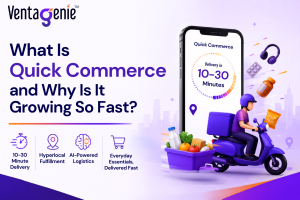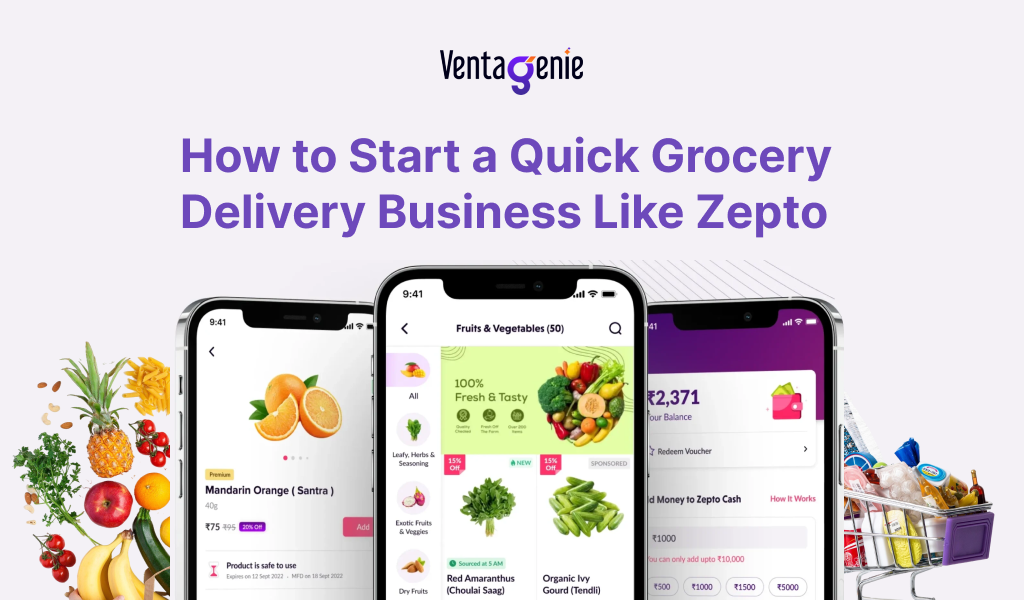
Imagine this situation.
You’re cooking dinner. Halfway through, you realize you’re missing onions. Not tomorrow. Not in an hour. Now.
A few minutes later, someone rings your doorbell.
That single moment explains why quick grocery delivery exists.
This business model is not about groceries. It’s about panic, urgency, relief, and habit. And that’s exactly why so many founders, startups, and enterprises are trying to build ultra-fast grocery delivery apps — and why many of them fail.
Companies like Zepto, Blinkit, Instacart, DoorDash, Shipt, InstaShop, Careem have proven that quick grocery delivery is not just a marketing gimmick but a scalable business when executed correctly. This guide explains how the quick grocery delivery business works, why quick commerce grocery delivery is growing so rapidly, and how entrepreneurs can build a custom grocery delivery app solution to compete in this space.
Let’s break it down honestly.
What Quick Grocery Delivery Really Is ?
On the surface, the quick grocery delivery model looks like speed and logistics. In reality, it is a behavioral product disguised as a delivery app.
The model works by removing thinking from grocery shopping.
No planning.
No lists.
No waiting windows.
A customer opens an app, orders a few items, and receives them almost instantly. That experience rewires expectations. After that, traditional grocery delivery feels slow — even if it’s objectively fast.
This is why companies like Zepto didn’t just launch an app. They rebuilt the entire grocery supply chain around one idea: time matters more than price.
The promise of quick delivery is not a feature — it is the foundation upon which the entire business is designed.
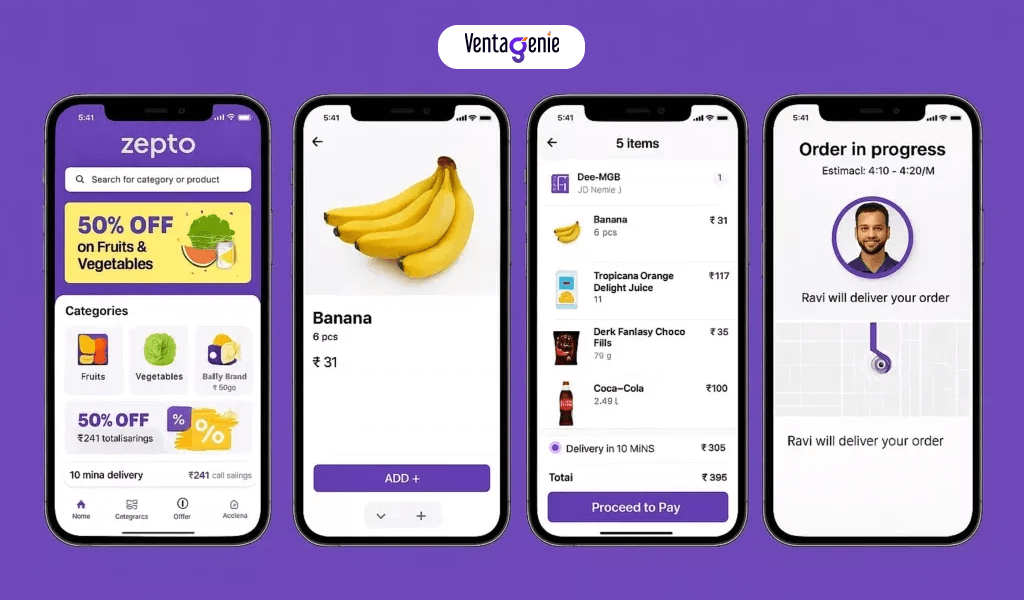
Real-World Example : How Zepto Enables Quick Grocery Delivery
Zepto operates a network of strategically placed dark stores across urban neighborhoods. Each dark store serves a limited delivery radius, ensuring minimal travel time. Inventory is curated based on local consumption patterns, focusing on fast-moving grocery items.
When a customer places an order:
- The grocery delivery app identifies the nearest dark store
- Inventory is verified in real time
- A picker collects items in under two minutes
- A delivery partner already nearby delivers the order immediately
This tightly integrated system enables instant grocery delivery at scale.
What Is Quick Commerce — And Why It Changed Everything
Quick commerce (Q-commerce) is a retail model focused on delivering goods in minutes rather than hours or days. While traditional eCommerce emphasizes product variety and discounts, Q-commerce emphasizes:
Traditional eCommerce assumes:
“I’ll order now and wait.”
Quick commerce assumes:
“I need this immediately.”
This distinction changes everything — inventory, store design, delivery flow, even app UI.
In grocery quick commerce, customers aren’t browsing. They’re reacting.
Forgotten ingredients. Sudden cravings. Unexpected guests. Late-night needs.
The app becomes a reflex, not a destination.
In grocery quick commerce, customers are not planning weekly shopping trips. They are fulfilling immediate needs — forgotten items, cravings, or emergency essentials. This behavioral shift is what makes quick grocery delivery apps so powerful.
Why People Actually Use Quick Grocery Delivery Apps ?
1. The Fear of Waiting:
Logistics automation uses software and machines to reduce repetitive manual work. In 2026, logistics automation tools USA are widely used for:
2. The Fear of Inconvenience:
Nobody wants to step out, stand in queues, or interrupt their day. Instant grocery delivery eliminates friction entirely.
3. The Comfort of Control:
Knowing groceries can arrive anytime creates emotional safety. People don’t stock up — they rely.
4. Habit Lock-In:
Once someone orders milk, bread, or snacks multiple times and it arrives quickly, the brain stops considering alternatives.
This is why users don’t “compare apps” every time. They default to the fastest one.
The Dark Truth: Why Many Quick Commerce Startups Fail
This model is seductive — and dangerous.
Many founders assume:
“If we build the app, the business will work.”
That’s where things break.
1. Operational Fear
Speed is not a feature. It’s discipline. One delayed delivery destroys trust faster than ten successful ones.
2. Cost Pressure
Without density, delivery costs explode. Without repeat users, margins collapse.
3. Inventory Fear
Wrong SKUs mean empty shelves. Empty shelves mean broken promises.
4. Over-Expansion
Scaling too fast without mastering one zone leads to chaos.
This is why the quick grocery delivery businessrewards execution, not ideas.
How the Quick Grocery Delivery ModelWorks ?
A successful quick commerce grocery delivery business depends on seamless coordination between physical infrastructure, technology, and logistics.
Dark Store Grocery Delivery Model Explained
Dark stores are small, delivery-only fulfillment centers located close to customers. They are optimized for speed, not foot traffic.
Key advantages of dark stores include:
- Customer grocery delivery app
- Delivery partner app
- Admin and inventory management dashboard
Dark stores are the operational backbone of any ultra-fast grocery delivery business.
Grocery Delivery App Solution: Technology Stack
A modern grocery delivery app solution includes:
- Faster order picking
- Lower real estate costs compared to supermarkets
- Data-driven inventory selection
- Reduced stock wastage
Essential features include :
- Real-time inventory synchronization
- Smart order routing
- GPS-based delivery tracking
- Push notifications
- Analytics and performance monitoring
Without robust technology, 10-minute grocery delivery is impossible to sustain.
Hyper-Local Logistics & Last-Mile Delivery
Delivery partners operate within tightly defined zones near dark stores. Two-wheelers are preferred for faster navigation in traffic.
The goal is not just speed but predictability. Customers trust platforms that consistently meet promised delivery times.
In Short:
Dark stores aren’t warehouses — they’re precision machines.
SKUs are chosen based on urgency, not popularity.
Delivery partners are positioned before orders arrive.
Apps are designed to reduce thinking, not showcase features.
Every decision answers one question:
“Does this save time?”
Essential Features of a Quick Grocery Delivery App
To successfully build a quick commerce grocery delivery platform, the app must be designed specifically for speed, reliability, and habit formation.
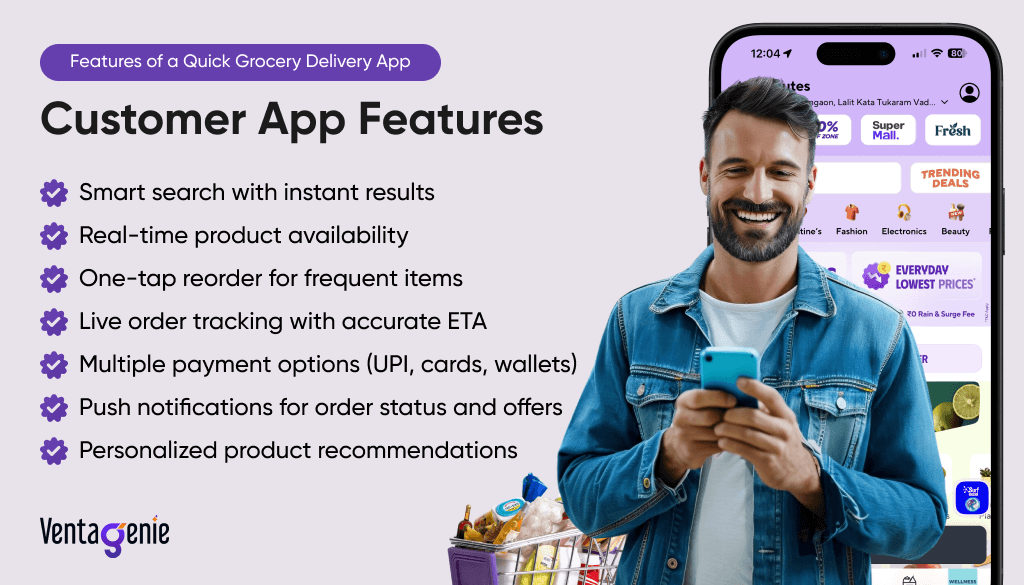
Customer App Features
The customer app is the primary touchpoint and must feel effortless.
Key features include:
- Smart search with instant results
- Real-time product availability
- One-tap reorder for frequent items
- Live order tracking with accurate ETA
- Multiple payment options (UPI, cards, wallets)
- Push notifications for order status and offers
- Personalized product recommendations
The goal is to reduce decision-making time and checkout friction to near zero.
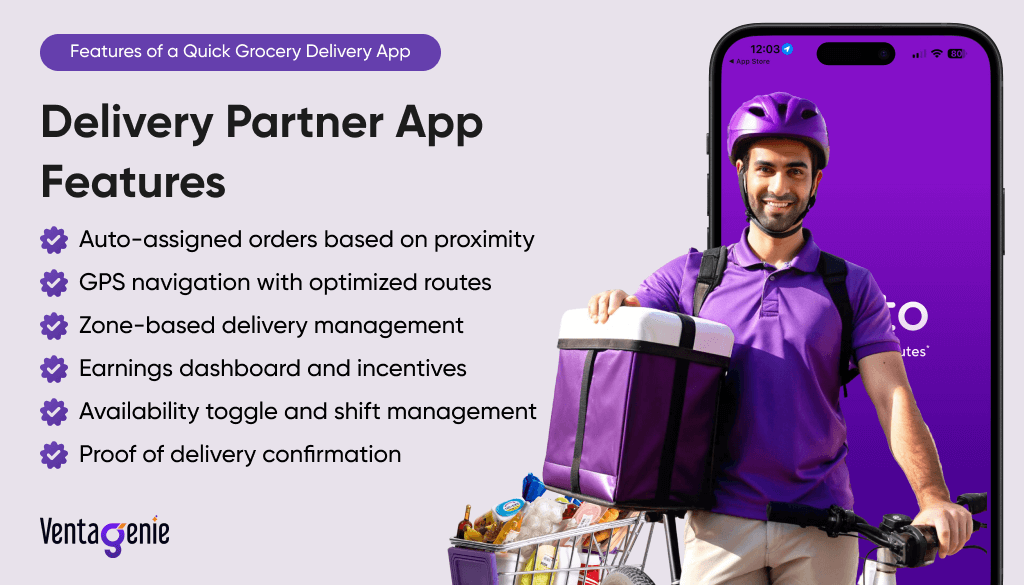
Delivery Partner App Features
Delivery speed depends heavily on delivery partner efficiency.
Essential features include :
- Auto-assigned orders based on proximity
- GPS navigation with optimized routes
- Zone-based delivery management
- Earnings dashboard and incentives
- Availability toggle and shift management
- Proof of delivery confirmation
This app must prioritize clarity and speed over complexity.
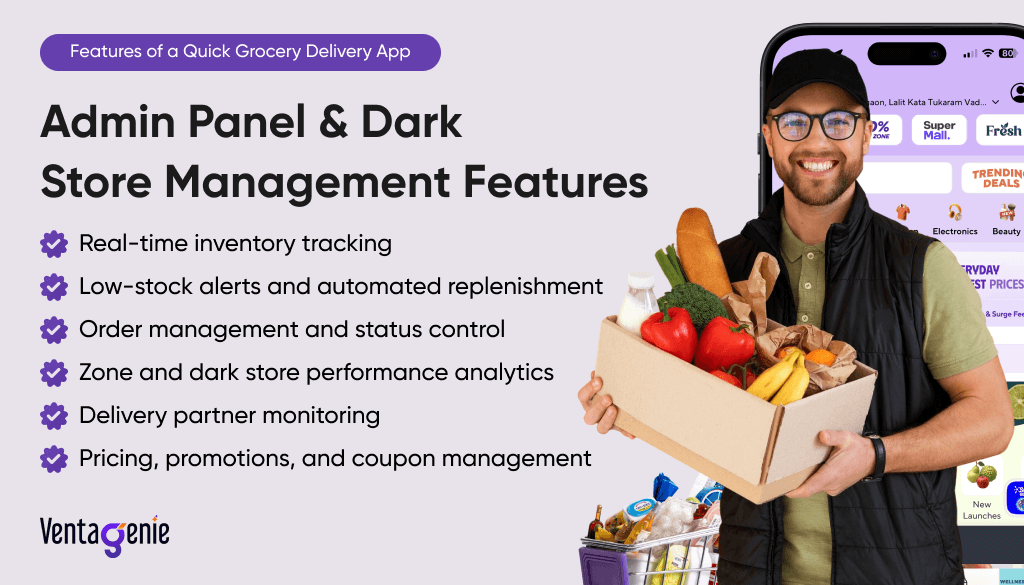
Admin Panel & Dark Store Management Features
The admin system is the operational brain of the platform.
Critical features include:
- Real-time inventory tracking
- Low-stock alerts and automated replenishment
- Order management and status control
- Zone and dark store performance analytics
- Delivery partner monitoring
- Pricing, promotions, and coupon management
This backend ensures operational discipline and scalability.
What a Real Quick Grocery Delivery App Needs ?
Not flashy screens. Not complex menus.
It needs:
- Products that are always available
- Checkout that feels invisible
- Delivery tracking that feels reliable
- Reordering that takes seconds
- Notifications that reassure, not annoy
On the operations side :
- Live inventory control
- Dark store visibility
- Delivery partner coordination
- Zone-wise performance monitoring
Without these, the promise collapses.
Where Technology Partners Actually Matter
This is not a DIY project.
The difference between failure and scale often comes down to whether the technology understands quick commerce — not generic eCommerce.
Platforms built for speed behave differently.
Inventory logic is different.
Delivery logic is different.
Even UI logic is different.
This is where companies like Ventagenie come in — not as “app developers,” but as Grocery Delivery App Development Solution who understand how quick commerce systems actually operate under pressure.
If You’re Thinking of Building One — Read This Carefully
Do not chase 10 minutes as a headline.
Earn it operationally.
Do not expand early.
Dominate one zone first.
Do not discount heavily.
Build habits instead.
Do not treat this as a grocery app.
Treat it as a time-saving machine.
How Ventagenie Helps Build a Quick Grocery Delivery App
Ventagenie provides end-to-end grocery delivery app development tailored for quick commerce and 10-minute delivery models.
Ventagenie helps businesses with :
- Custom grocery delivery app development
- Dark store inventory and order management
- Delivery partner applications
- Admin dashboards and analytics
- Scalable architecture for multi-city expansion
By leveraging Ventagenie’s expertise, businesses can launch faster, reduce development risk, and scale efficiently in the ultra-fast grocery delivery market.
Final Thought
Quick grocery delivery is not about groceries.
It’s about how modern humans live.
People don’t want more options.
They want fewer interruptions.
If you build a system that respects time, removes friction, and delivers certainty, people will come back — again and again.
And that’s what makes this model powerful — and unforgiving.
Think Like a Leader.
Build Systems That Respect Time. Invest in a Modern Quick Commerce Grocery Platform and Scale Confidently.
Frequently Asked Questions
A 10-minute grocery delivery business is a hyper-local quick commerce model where groceries and daily essentials are delivered to customers within 10 minutes of placing an order via an app. It focuses on speed, convenience, and reliability.
Quick commerce, or Q-commerce, is a model of eCommerce that emphasizes ultra-fast delivery instead of just product variety. In groceries, it allows customers to get what they need immediately — no planning, no waiting.
The model works by:
- Operating dark stores in high-density areas
- Stocking only high-demand items
- Assigning nearby delivery partners instantly
- Using an app with real-time inventory and tracking
All of this ensures orders are picked, packed, and delivered within 10 minutes.
Dark stores are delivery-only micro-warehouses located near customers. They reduce travel time, optimize picking speed, and help maintain the 10-minute promise.
Essential features include:
- Customer app: fast search, live tracking, instant checkout
- Delivery app: real-time route optimization, order assignment
- Admin panel: inventory management, analytics, order monitoring
- Optional: subscriptions, loyalty programs, push notifications
With proper planning, a pilot launch in one zone can happen in 4–6 weeks. Full city-wide scaling usually takes 3–6 months, depending on infrastructure and operations.
- High repeat usage due to habit formation
- Increased customer loyalty
- Premium pricing opportunities
- Predictable demand patterns
- Better operational control through dark stores
High-demand, fast-moving items like milk, bread, eggs, snacks, beverages, and daily essentials. These items ensure faster picking, fewer stock-outs, and satisfied customers.
Delivery partners are assigned orders in real time and operate in a small delivery radius for speed. Often, two-wheelers are used for faster navigation in dense urban areas.
Yes, but profitability depends on density, repeat customers, and operational discipline. Managing zones carefully and avoiding over-expansion is critical to financial success.