Why Logistics Companies in the USA Are Shifting to Custom Mobile Apps in 2026
The logistics landscape in the United States is evolving rapidly. Delivery expectations are rising, operational costs are increasing, and competition is intensifying. To remain efficient and competitive, logistics providers are embracing technology, especially custom mobile logistics apps.
Across freight, courier, and transportation networks, companies are moving beyond traditional systems and manual workflows. Instead, modern mobile platforms are being used to improve visibility, reduce costs, and enhance customer satisfaction.
But what’s driving this large‑scale shift, and why now?
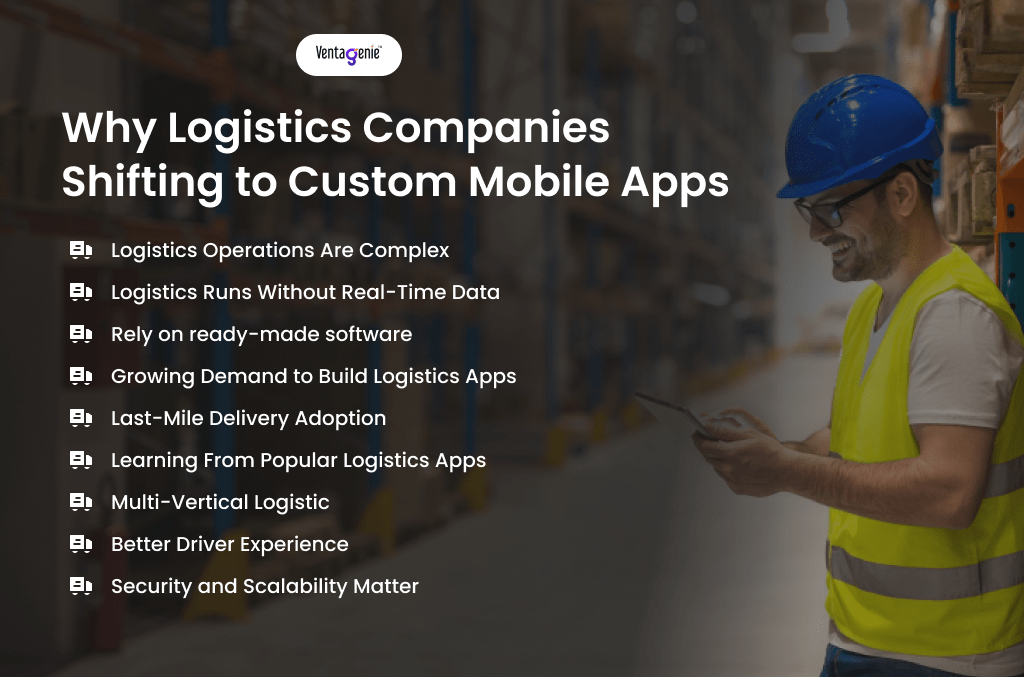
Logistics Operations Are Becoming More Complex
Logistics was once about moving goods from point A to point B. Today, it involves much more.
- Same-day and next-day delivery expectations
- Real-time tracking demands
- Multi-city and interstate deliveries
- Driver shortages and fuel cost pressure
- Did you know?
Last‑mile delivery now represents up to 53% of total shipping costs in modern logistics, up from 41% just a few years ago, driven by rising consumer expectations and delivery volumes. smartroutes.io
When operations become complex, visibility becomes critical. Without the right digital tools, delays, miscommunication, and inefficiencies are introduced.
- Ask Yourself
How
much time does your team spend manually updating delivery statuses each day?
This is where logistics app development is being adopted as a practical solution.
What Happens When Logistics Runs Without Real-Time Data ?
Without real-time systems:
- Delivery updates are delayed
- Customers remain uncertain
- Dispatch decisions are made blindly
- Operational costs rise silently
- Did you know?
About 91% of consumers actively track their packages online.
Custom logistics apps are being used to bring all delivery data into one place. Real-time tracking, live dashboards, and automated updates help logistics teams stay informed at every stage.
- Ask Yourself :
How much time does your support team spend answering “Where is my delivery?” calls?
Would faster visibility make daily operations easier to manage?
For many US logistics companies, the answer has been yes.
Why Off-the-Shelf Software Is Often Not Enough
Many logistics businesses initially rely on ready-made software. Over time, limitations begin to surface.
- Features do not match actual workflows
- Scaling becomes expensive
- Integrations are limited
- Customization is restricted
This is why custom logistics app development services are being preferred. When an app is built around a company’s operations, efficiency improves naturally.
The Growing Demand to Build Logistics Apps in the USA
Across courier, freight, and transportation sectors, companies are choosing to build logistics apps that support :
- Courier and last-mile delivery
- Fleet and driver management
- Warehouse coordination
- Freight and dispatch automation
These systems are designed to grow alongside the business, rather than holding it back.
Last-Mile Delivery Is Driving App Adoption
Last-mile delivery is one of the most expensive and challenging parts of logistics.
Traffic congestion, failed deliveries, and inefficient routes directly impact profitability. To solve this, mobile delivery apps are being used to:
- Optimize routes automatically
- Provide accurate delivery ETAs
- Share real-time updates with customers
- Reduce fuel and time wastage
- Fact
In the US and developed markets, the average cost per standard last‑mile delivery is around $10.10, and real‑time route optimization has been shown to reduce delivery mileage by up to 20%.
Consumers are also driving innovation :
55% prefer same‑day delivery, and 45% would pay extra for faster or more flexible options. (Source: https://wifitalents.com/last-mile-delivery-statistics)
This approach has been widely adopted across the USA, especially in urban and suburban markets.
Learning From Popular Logistics Apps
Many logistics companies take inspiration from platforms that have already proven successful.
Popular examples include :
- Amazon Logistics for last-mile delivery efficiency
- UPS and FedEx for shipment tracking and automation
- Uber Freight for digital freight matching
- DHL for global logistics visibility
- Roadie for same-day delivery models
Globally, platforms like Aramex, Fetchr, Dunzo, Porter, Shadowfax, ShipBob, and Flexport have also influenced how logistics apps are designed.
Because of this, many businesses now aim to create an app like these platforms, customized for their own operational needs.
Why “Create App Like” Models Are Trusted
Building an app inspired by a proven logistics platform reduces uncertainty.
When companies choose to create an app like Amazon Logistics or Uber Freight, benefits often include:
- Faster development timelines
- Familiar user experiences
- Proven workflow structures
- Higher adoption by drivers and customers
However, customization remains essential. Each logistics operation is different.
Multi-Vertical Logistics Is Easier With One App
Many US logistics companies manage multiple delivery models at once :
- Courier services
- Freight transportation
- Warehouse operations
- Intercity logistics
Handling these separately creates confusion and delays. A multi-vertical logistics app allows all operations to be managed from one system.
Would managing everything from a single dashboard reduce daily friction?
For many teams, it already has.
Better Driver Experience Leads to Better Deliveries
Driver productivity and satisfaction directly impact delivery success.
Custom driver apps are helping by providing :
- Smart navigation and routing
- Digital proof of delivery
- Clear task assignments
- Performance visibility
When drivers are supported with the right tools, delivery efficiency improves automatically.
Data Is Becoming a Competitive Advantage
Logistics apps are no longer just operational tools. They are becoming decision-making platforms.
With analytics and dashboards, companies can :
- Track delivery performance
- Identify inefficiencies
- Forecast demand
- Reduce operational costs
Data-driven logistics is no longer optional in the USA—it is becoming standard.
Why Security and Scalability Matter
As logistics operations expand, systems must remain secure and reliable.
Custom-built logistics apps allow :
- Better data control
- Stronger security practices
- Scalable infrastructure
- Compliance with regional regulations
This level of control is one reason businesses prefer working with a specialized logistics app development company.
Planning to Build a Logistics App ?
If your business is exploring how to build a logistics app, create an app like leading US logistics platforms, or modernize courier and delivery operations, expert guidance can help avoid costly mistakes.
What Is a Custom Logistics Mobile App ?
A custom logistics app is a tailored mobile or web platform designed to meet specific operational requirements. Such apps often include :
- Live tracking and customer updates
- Route optimization and dispatch automation
- Driver navigation and task management
- Analytics dashboards for performance insights
- Integration with ERP, CRM, and warehouse systems
Unlike generic solutions, a custom app is built around a company’s workflow, not the other way around.
The Future of Logistics Is Mobile-First
By 2026, logistics companies without mobile-first systems may struggle to compete. Customers expect transparency, speed, and digital convenience.
Those investing early in custom logistics app development are better positioned to :
- Scale operations
- Improve customer satisfaction
- Stay competitive in the US market
Final Thought
The move toward custom logistics apps is not driven by technology trends alone. It is driven by real operational challenges.
As logistics becomes more complex, mobile apps are being used to simplify operations, reduce costs, and improve delivery performance.
- Ask Yourself :
Is the current system ready for the next stage of growth ?
What could your logistics operations achieve if visibility, automation, and real‑time intelligence were available in the palm of your hand?
That is the question many logistics companies in the USA are now asking.
Frequently Asked Questions :
Logistics app development is the process of building custom mobile or web applications that help businesses manage delivery operations, fleet tracking, warehouse workflows, and transportation management. These apps are used to improve visibility, automate dispatching, and optimize routes across logistics networks.
US logistics companies are building custom logistics apps to reduce operational costs, improve last-mile delivery efficiency, and meet rising customer expectations for real-time tracking. Custom apps provide flexibility that off-the-shelf software often lacks.
Delivery efficiency is improved through real-time GPS tracking, automated route optimization, predictive ETAs, and smart dispatching. These features reduce delays, fuel consumption, and manual errors across courier and freight operations.
A modern logistics app typically includes:
- Real-time shipment tracking
- Route optimization and ETA prediction
- Driver app with navigation and proof of delivery
- Order and delivery management system
- Dispatcher dashboard with analytics
These features help logistics businesses operate at scale.
Yes, a logistics app can be built inspired by platforms like DHL, FedEx, or Uber Freight. While proprietary systems are not copied, similar functionality—such as shipment tracking, freight management, and automated dispatch—can be developed using custom architecture.
Multi-vertical logistics app development refers to building a single platform that supports multiple logistics models, such as courier delivery, freight transportation, warehouse management, and last-mile delivery. This approach enables centralized control and reduces operational complexity.
Yes, logistics app development is especially effective for courier and last-mile delivery businesses. Features like live tracking, delivery verification, customer notifications, and smart routing help reduce failed deliveries and improve customer satisfaction.
The development timeline depends on app complexity, features, and integrations. A basic logistics app may take a few months, while a full-scale logistics management platform with customer, driver, and admin panels typically takes longer.
The cost to build a logistics app varies based on features, platforms (iOS, Android, web), integrations, and scalability requirements. Most logistics app development companies provide a custom estimate after understanding business requirements.
Advanced logistics apps can support multi-modal transportation, including air, road, rail, and ocean shipments. These systems allow businesses to manage different transport modes from one centralized platform.
AI improves logistics app development by enabling intelligent route optimization, predictive delivery ETAs, demand forecasting, driver performance analysis, and fraud detection. AI-powered logistics apps help businesses make faster and more accurate decisions.
Yes, a well-designed logistics app is built on scalable architecture that supports high delivery volumes, multiple regions, and global operations. Scalability ensures long-term performance as logistics demand grows in the USA and international markets.
Before choosing a logistics app development company, businesses should consider industry experience, scalability of solutions, integration capabilities, security standards, and long-term support. Proven experience in courier, fleet, and transportation systems is essential.
The right time to build a logistics app is when manual processes cause delays, operational costs are rising, or customer expectations are not being met. Early adoption often leads to better efficiency and long-term competitive advantage.